
Beijing vs Hangzhou: Forbidden City Versus West Lake Cult...
- Date:
- Views:177
- Source:The Silk Road Echo
H1: Beijing vs Hangzhou: When Imperial Authority Meets Poetic Serenity
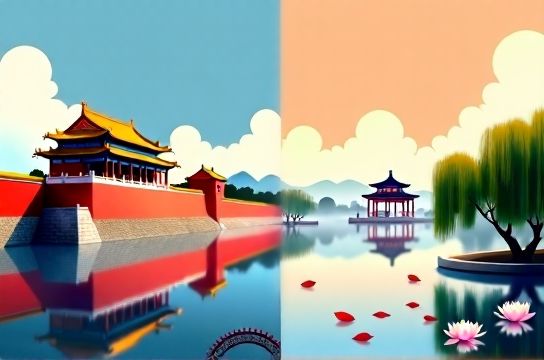
You’re standing in Tiananmen Square at dawn — red banners flapping, guards marching with metronomic precision, the Forbidden City’s vermilion walls glowing under low sun. Two hours later, you’re sipping hand-picked Longjing tea on a willow-shaded pier at West Lake, watching a mist-lifted pagoda emerge like a brushstroke from Song dynasty ink painting. These aren’t just two cities. They’re two grammars of Chinese civilization — one written in stone, decree, and hierarchy; the other in water, poetry, and quiet observation.
This isn’t about ranking ‘best’ — it’s about alignment. Your travel purpose dictates which grammar speaks louder.
H2: The Core Contrast — Not Geography, But Cultural Syntax
Beijing is China’s political and ceremonial spine. Its DNA is institutional: dynastic succession, statecraft, ideological continuity. Even its modernity — the CCTV Tower, Zhongguancun’s AI labs, Daxing Airport’s algorithmic flow — serves that spine. Hangzhou, by contrast, is China’s cultural diaphragm: breathing in commerce (Alibaba), aesthetics (Southern Song painting), and ecology (West Lake’s UNESCO-recognized lake-and-hills system). It doesn’t reject authority — it negotiates with it through elegance, not edict.
That difference manifests immediately:
• In transport: Beijing’s subway runs on clockwork frequency (average wait: 2.3 min peak, Updated: June 2026), but stations are cavernous, functional, often overwhelming. Hangzhou’s metro is newer (Line 1 opened 2012), quieter, lined with silk-screen murals of Bai Juyi’s poems — and integrates seamlessly with public bike-sharing (over 120,000 bikes, real-time app tracking, Updated: June 2026).
• In pace: Beijing operates on ‘state time’ — meetings start late but end abruptly; queues move fast but feel transactional. Hangzhou moves on ‘lake time’ — slower cadence, longer eye contact, service staff who ask *how your day has been*, not just what you’ll order.
• In architecture: Beijing’s skyline is vertical assertion — the National Centre for the Performing Arts dome, the Galaxy SOHO’s interlocking curves, all declaring presence. Hangzhou’s signature structures (like the Xixi Wetland Visitor Centre) are horizontal, recessive, designed to disappear into bamboo groves or reflect in still water.
H2: Forbidden City vs West Lake — More Than Just Two Landmarks
Let’s be precise: You don’t ‘visit’ the Forbidden City. You enter a sovereign system. Its 980 surviving buildings (out of original 9,999 — a number symbolizing imperial perfection) are arranged along a 7.9 km north-south central axis — the longest uninterrupted ceremonial corridor in the world. Every gate, courtyard, and roof tile follows Ming-dynasty ritual codes: yellow-glazed tiles for emperors, green for princes, no blue unless sanctioned by the Son of Heaven. Walking through Meridian Gate isn’t sightseeing — it’s walking through a constitutional document in brick and timber.
West Lake? It’s the opposite: an anti-monument. No single ‘entrance’. No master plan — just centuries of layered human intervention (dikes built by Bai Juyi in 822 CE, Su Dongpo in 1090 CE) that deliberately mimic nature. Its ten famous scenes — 'Broken Bridge in Snow', 'Lotus in the Breeze at Crooked Courtyard' — aren’t fixed locations. They’re atmospheric conditions, best experienced at specific light, season, and emotional resonance. You don’t check them off. You wait for them.
That distinction cascades into everything else.
H2: Food — Power on a Plate vs Harmony in a Bowl
Beijing cuisine is about concentration and control:
• Peking duck: Not just roasted — inflated with air, hung to dry for 12+ hours, glazed with maltose syrup, roasted over fruitwood. Served with 12 precisely cut pancakes, scallions cut into 3-cm batons, hoisin sauce thickened to exact viscosity. It’s a performance of mastery — every element calibrated, nothing accidental.
• Zhajiangmian: Fermented soybean paste fried with pork belly, served over hand-pulled noodles. Salty, umami-dense, grounding — food for bureaucrats, scholars, soldiers.
Hangzhou food is about balance and subtlety:
• Dongpo Pork: Named after poet-official Su Dongpo, who supposedly invented it while exiled here. Pork belly braised *eight hours* in Shaoxing wine, rock sugar, and soy — so tender it parts at the touch of chopsticks, rich but never greasy, sweet but never cloying. It’s indulgence made ethical.
• West Lake Vinegar Fish: Fresh grass carp poached, then dressed in a translucent, tart-sweet vinegar glaze infused with ginger and bamboo shoots. Served at room temperature — no heat masking flaws. It tastes like the lake itself: clean, bright, slightly mineral.
Crucially, Beijing’s food culture rewards endurance: street snacks like jianbing (savory crepes) are eaten standing, fast, functional. Hangzhou’s culinary rhythm is seated, lingering — even casual restaurants serve tea first, then small cold dishes, then mains, then fruit. Rushing feels linguistically inappropriate.
H2: Traditional vs Modern — Not Opposites, But Different Integrations
Both cities host cutting-edge tech — but deploy it differently.
In Beijing, AI powers surveillance, traffic optimization, and state media personalization. Facial recognition gates at Forbidden City entry verify tickets *and* cross-check against national ID databases (pilot launched 2024, now standard at all major heritage sites, Updated: June 2026). This isn’t convenience — it’s sovereignty made infrastructural.
In Hangzhou, AI serves civility: the ‘City Brain’ traffic system reduces average intersection wait times by 15% (vs. national urban avg. of 8%, Updated: June 2026), but its most-used feature is real-time West Lake crowd density mapping — updated every 90 seconds via thermal sensors and CCTV analytics — pushed to WeChat mini-programs so visitors avoid congestion *before* they leave their hotel. Tech here mediates experience, not control.
Even traditional crafts diverge: Beijing’s cloisonné enamel workshops (like Jingtailou) preserve Ming-Qing imperial motifs — dragons, phoenixes, cloud bands — unchanged for 600 years. Hangzhou’s silk artisans at the China National Silk Museum experiment with digital looms that translate satellite imagery of West Lake into warp-and-weft patterns — tradition as living data, not static relic.
H2: A Practical Side-by-Side Comparison
| Category | Beijing | Hangzhou |
|---|---|---|
| Core Travel Vibe | Imperial gravity — history as weight, presence, authority | Lake serenity — history as texture, reflection, quiet accumulation |
| Must-Do Cultural Ritual | Attend the flag-raising ceremony at Tiananmen Square (arrive by 4:45am) | Join a sunrise tai chi circle at Liuhe Pagoda, then drink Longjing at nearby Meijiawu village |
| Best Day Trip | Mutianyu Great Wall (less crowded than Badaling, cable car up, toboggan down) | Xitang Water Town (1,000-year-old canals, wooden houses on stilts, authentic local life) |
| Food Value (per meal) | ¥60–¥120 for solid local meal (e.g., roast duck lunch set) | ¥45–¥95 for equivalent (e.g., Dongpo pork + seasonal veg + tea) |
| Transport Stress Factor (1–5) | 4 — Metro efficient but dense; taxi hailing competitive; language barrier higher | 2 — Metro intuitive; Didi/WeChat Pay seamless; English signage widespread near West Lake |
| Ideal Trip Duration | 4–5 days minimum (Forbidden City alone takes 2 full days to absorb meaningfully) | 3–4 days (West Lake reveals itself gradually — 1 day isn’t enough to feel its rhythm) |
H2: Who Should Choose Which City?
Choose Beijing if:
• You want to understand how China governs itself — not just historically, but *now*. Visit the National Museum, then walk to Zhongnanhai’s guarded perimeter wall. Observe how power occupies space.
• You’re drawn to monumental scale and formal aesthetics — symmetry, axial planning, symbolic color coding.
• You’re comfortable with friction: language gaps, bureaucratic processes (e.g., Forbidden City ticketing requires passport upload 72h ahead), and crowds that test patience.
Choose Hangzhou if:
• You seek cultural depth *without* institutional intensity — where history lives in tea ceremonies, not throne rooms.
• You prioritize sensory harmony: taste, scent (lotus, wet stone, steamed rice), sound (crickets at Quyuan Garden, boat oars in mist), and visual rhythm (willows, bridges, distant hills).
• You value seamless logistics — high-speed rail to Shanghai (45 min), integrated transit apps, and hospitality that anticipates need before request.
H2: The Overlooked Truth — They’re Complementary, Not Competitive
Most first-time China travelers pick one. Smart repeat visitors do both — and sequence matters. Go to Beijing *first*: its sheer scale, density, and historical weight recalibrates your sense of China’s center. Then go to Hangzhou: the contrast isn’t relief — it’s revelation. You suddenly *see* Beijing’s rigidity as necessary scaffolding; Hangzhou’s fluidity as essential counterbalance. Neither works without the other.
This duality is why many expats split time — working in Beijing’s diplomatic or finance districts, retreating to Hangzhou weekends. It’s also why Alibaba’s HQ sits in Hangzhou, not Beijing: innovation thrives where structure meets serenity.
H2: Practical Travel Advice — Beyond the Brochure
• Timing matters more than you think: Avoid Beijing during Golden Week (Oct 1–7) — Forbidden City hits 80,000 daily cap, lines stretch 2km, security screening takes 90+ minutes (Updated: June 2026). Hangzhou’s West Lake peaks mid-April (peony bloom) and early October (maple tint), but even then, arrive before 7am to have Su Causeway to yourself.
• Accommodation logic: In Beijing, stay within the 2nd Ring Road — proximity to Forbidden City, Temple of Heaven, and hutongs trumps hotel luxury. In Hangzhou, prioritize West Lake’s west or south shores (e.g., Yanggong Causeway area) — views and walkability beat star rating.
• Language tip: In Beijing, learn ‘Qǐng wèn…’ (‘Excuse me, where is…?’) — polite framing eases interactions. In Hangzhou, a smile and pointing at a dish works — servers often bring complimentary osmanthus jelly or chrysanthemum tea unprompted.
• Budget note: Beijing’s museum entry fees are higher (Forbidden City ¥60, Summer Palace ¥30), but many historic hutong tours are free or donation-based. Hangzhou’s West Lake is free to enter — only specific gardens (Leifeng Pagoda ¥40, Lingyin Temple ¥30) charge. Total daily cultural spend averages ¥120 in Beijing vs. ¥75 in Hangzhou (Updated: June 2026).
H2: Final Thought — It’s Not About Choosing, But Listening
Beijing shouts in bronze bells and granite inscriptions. Hangzhou whispers in ripples and tea steam. Neither is louder — they’re different frequencies of the same civilization. Your job isn’t to pick a favorite. It’s to tune your ear.
For deeper logistical planning — visa timelines, high-speed rail booking hacks, or neighborhood-by-neighborhood safety and vibe assessments — our full resource hub offers step-by-step support tailored to your travel profile. Start with the complete setup guide to align your itinerary with your actual travel rhythm — not the brochure’s.
The real contrast isn’t between cities. It’s between the version of China you expect — and the one that waits, patiently, to be felt.