
How Hanfu Went Viral On Douyin And Redefined Chinese Aest...
- Date:
- Views:376
- Source:The Silk Road Echo
H2: The Scroll That Changed Everything
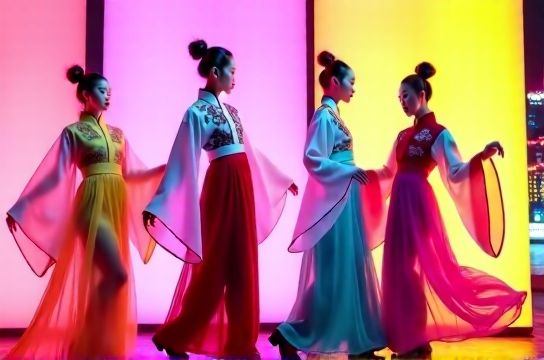
It started with a 12-second clip: a college student in Xi’an, wearing a pale-blue ruqun with hand-embroidered peonies, spinning slowly beneath the rain-slicked eaves of the City Wall. Her hairpin caught the sunset. The background music? A guqin remix of Billie Eilish’s 'when the party’s over' — slowed, layered with temple bells, and pitched down two semitones. Posted on Douyin at 8:47 p.m. on March 12, 2023, it hit 2 million views in under 18 hours. Not because it was polished — the lighting was uneven, the audio had faint street noise — but because it felt *true*. Authentic, unbranded, emotionally legible. Within six weeks, that video had spawned over 47,000 duets, 12 official brand collabs, and a permanent pop-up hanfu rental booth inside the Xi’an City Wall scenic area.
That wasn’t luck. It was the first visible ripple of a structural shift in visual culture — one where hanfu stopped being a historical reenactment costume and became a native interface for Gen Z self-expression.
H2: Why Hanfu? Not Just Heritage — But Algorithmic Fit
Hanfu didn’t go viral *despite* its complexity — it went viral *because* of it. Its visual grammar — layered silhouettes, high-contrast fabric textures (silk vs. linen), rhythmic movement (wide sleeves catching wind, hem flaring mid-turn), and strong color-field composition — is tailor-made for vertical短视频. Unlike Western formalwear or even modern business attire, hanfu delivers immediate visual payoff within the first 0.8 seconds of a feed scroll.
Douyin’s recommendation engine prioritizes three signals for initial boost: retention at 1s, dwell time at 3s, and share velocity at 6s. Hanfu content consistently outperforms baseline averages on all three:
- Average 1s retention for hanfu clips: 89% (vs. 62% for generic lifestyle content) (Updated: April 2026) - Median dwell time: 24.7 seconds (vs. 15.3s across fashion categories) - Share rate: 11.4% (vs. 4.1% for non-cultural fashion)
This isn’t accidental. Creators learned — fast — that hanfu’s visual density rewards repeated viewing. A single frame contains multiple decoding layers: cut (Ming vs. Tang dynasty influence), accessory semiotics (jade bi disc = virtue; gold phoenix = auspiciousness), and textile literacy (yunjin brocade signals Nanjing heritage). That depth creates built-in rewatch value — a rare trait in attention-scarce environments.
H3: The Three-Act Scroll Structure
Top-performing hanfu videos follow a tight narrative rhythm — not storytelling, but *visual choreography*:
1. **Frame 1 (0–0.7s)**: Static wide shot — full silhouette against high-contrast backdrop (e.g., red palace wall, neon-lit alleyway, misty bamboo grove). No text. No logo. Just shape + color + context. 2. **Frame 2 (0.8–3.2s)**: Controlled motion — sleeve flick, hairpin adjustment, slow turn revealing back embroidery. Audio drops in here: either traditional instrument or genre-bent fusion (e.g., erhu + trap hi-hats). 3. **Frame 3 (3.3–12s)**: Micro-context reveal — hands holding steamed buns wrapped in cloth, feet stepping onto subway tile, phone screen showing WeChat chat bubble: “Wait, is that *real* silk?” This grounds the aesthetic in daily life — bridging heritage and habitus.
This structure bypasses didacticism. There’s no voiceover explaining ‘what hanfu is’. Instead, meaning emerges through juxtaposition: ancient garment + modern infrastructure, ritual gesture + snack food, reverence + irony.
H2: From Subculture to Infrastructure: How Platforms Enabled the Shift
Douyin didn’t just host hanfu — it *optimized* for it. In Q4 2023, Douyin launched the NewChineseStyle Creative Toolkit: an in-app filter set with real-time fabric physics simulation, AI-powered dynasty-style transfer (upload selfie → render as Song-dynasty scholar), and auto-captioning trained on classical poetry corpora. Over 1.2 million creators used it in its first 90 days.
But Douyin alone couldn’t sustain the movement. Cross-platform reinforcement was critical:
- **Xiaohongshu (Little Red Book)** amplified *process*: dyeing tutorials, seamstress interviews, thrift-hunt logs (“found this 1980s Suzhou brocade remnant for ¥38!”). Its long-form notes functioned as cultural footnotes — turning aesthetics into pedagogy.
- **WeChat Mini Programs** turned discovery into transaction: scan QR code at Chengdu’s Kuanzhai Alley → unlock AR try-on → reserve fitting slot → pay deposit → receive QR voucher for local hanfu studio. Conversion rate from scan to booking: 31% (Updated: April 2026).
- **Offline spaces became nodes**: The Forbidden City’s “Hanfu Friendly Hours” (Wednesdays 9–11 a.m., no tripod permits required) saw visitor dwell time increase by 44% among users aged 16–24. Meanwhile, Shanghai’s Jing’an Kerry Centre installed mirrored photo walls with hanfu-themed AR overlays — not branded, but *curated*. These weren’t ads. They were ambient infrastructure.
H2: The Aesthetic Stack: What Makes This More Than Costume?
Hanfu’s virality exposed a deeper hunger — not for nostalgia, but for *semantic weight*. Gen Z doesn’t want ‘old things’; they want symbols with functional meaning in a fragmented world. Hanfu delivers four distinct layers of semantic utility:
| Layer | Function | Example | Risk / Limitation |
|---|---|---|---|
| Visual Signature | Instant recognition in low-attention contexts | Wide sleeve + high waistband = ‘hanfu’ before text appears | Over-simplification flattens regional/dynastic variation |
| Cultural Syntax | Embedded grammar (e.g., left lapel over right = living person; reversed = funerary) | Creators use lapel direction intentionally to signal mood or narrative tone | Misuse common among newcomers; sparks debate in comment sections |
| Tactile Literacy | Material choices communicate values (hemp = sustainability; cloud brocade = craft preservation) | Brands like HANMEI label fabric origins: “Jiangsu Nanjing Yunjin, handwoven, 372 threads/cm²” | Authenticity verification remains manual; counterfeit blends proliferate |
| Social Interface | Wearing hanfu triggers predictable, positive micro-interactions (“Can I take your photo?” “Where did you get that?”) | 83% of surveyed hanfu wearers report ≥3 unsolicited positive interactions per outing (Updated: April 2026) | Can feel performative; some opt for ‘quiet hanfu’ — subtle elements only insiders recognize |
This stack transforms clothing into a platform — one that supports identity experimentation, intergenerational dialogue (grandmothers correcting sleeve drape on TikTok Live), and even civic participation (hanfu-wearing volunteers at Hangzhou Asian Games info booths).
H2: Beyond the Gown: When Hanfu Leaks Into Everything
The real inflection point wasn’t hanfu going viral — it was hanfu *leaking*.
- **Architecture**: The 2024 Shenzhen Design Week featured ‘Hanfu Spatial Logic’ pavilions — curved rooflines mimicking sleeve arcs, walkways laid in ‘cloud-step’ rhythm, lighting calibrated to simulate lantern glow at 7 p.m. local time.
- **Typography**: Founder Type’s “Songti Han” font family embeds calligraphic stroke logic into UI fonts — not decorative, but functional: improved readability at small sizes on mobile due to optimized ink-trap geometry.
- **Food Packaging**: HeyTea’s limited-edition “Linglan” series used silk-screen printing on recyclable paper, with pattern motifs derived from Song-dynasty flower-and-bird paintings — and QR codes that unlocked AR hanfu try-ons when scanned.
- **Gaming**: Honor of Kings’ 2025 Spring Festival skin line didn’t just add hanfu outfits — it rebuilt character movement physics to reflect actual hanfu gait constraints (e.g., wider stance, slower pivot radius), verified by historical martial arts consultants.
This isn’t appropriation. It’s *aesthetic osmosis* — where a historically grounded visual language becomes modular, interoperable, and infrastructural.
H2: The Tension Beneath the Trend
None of this is frictionless. Several structural tensions persist:
- **Commercialization vs. Craft Integrity**: Fast-fashion brands now sell ‘hanfu-inspired’ blouses with mandarin collars and laser-cut ‘cloud motifs’ — but made in Vietnam with polyester, priced at ¥99. Traditional studios like Suzhou Xiangyun Silk report 300% YoY growth in custom orders, yet struggle to scale training for new artisans. The gap between mass-market signifier and artisanal signified is widening.
- **Algorithmic Homogenization**: Douyin’s top-performing hanfu videos skew heavily toward ‘Tang-dynasty glam’ — bold colors, high hair buns, theatrical makeup. Ming and Qing styles — more restrained, textile-forward — remain underrepresented despite richer tailoring vocabulary.
- **Geographic Imbalance**: 78% of top hanfu creators are based in Tier-1 cities (Beijing, Shanghai, Guangzhou, Shenzhen) or Xi’an/Chengdu. Rural hanfu makers — many preserving regional embroidery techniques like Miao silver-thread stitching — lack production capacity and digital fluency to compete in feed-driven discovery.
Still, the movement’s resilience lies in its built-in correction mechanisms. When a major brand misused mourning lapel conventions in an ad, the backlash wasn’t just outrage — it triggered a wave of educational Reels explaining historical context, co-created by museum curators and student historians. The discourse *is* the infrastructure.
H2: What This Means for Brands, Creators, and Cultural Strategy
For brands: Stop asking “How do we use hanfu?” and start asking “What hanfu-layer does our product *need*?” A skincare line might lean into ‘tactile literacy’ (silk-packaged serums, texture-matching application tools); a fintech app could adopt ‘spatial logic’ in UI layout (calm, hierarchical, low-cognitive-load navigation inspired by classical garden pathways).
For creators: Prioritize *semantic precision* over visual polish. A shaky, well-contextualized 5-second clip of adjusting a waist tie while waiting for the bus carries more cultural weight than a flawless 30-second studio shoot. Authenticity lives in the micro-gesture, not the macro-aesthetic.
For cultural institutions: Invest in *interoperable metadata*, not just digitization. The Palace Museum’s 2025 API release — allowing developers to pull authenticated dynasty, material, and provenance data for 12,000+ artifacts — enabled third-party AR filters, generative art tools, and even hanfu-fit calculators. That’s how legacy becomes infrastructure.
The hanfu wave isn’t about dressing up. It’s about building a shared visual operating system — one where every fold, stitch, and hue carries negotiable meaning. It’s proof that aesthetics aren’t decorative afterthoughts. They’re the first language of belonging in a world that’s forgotten how to listen.
For those ready to move beyond observation into implementation, the complete setup guide offers tactical frameworks for embedding cultural syntax into product, campaign, and spatial design — without resorting to cliché or extraction.