
Dress in Hanfu and Learn Ritual Dance at a Confucian Temp...
- Date:
- Views:236
- Source:The Silk Road Echo
H2: When Ritual Isn’t Performance—It’s Pedagogy
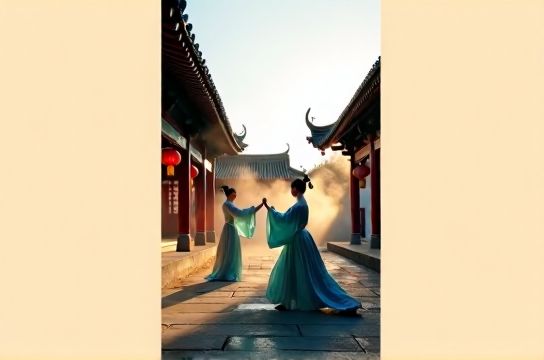
Last October, I stood barefoot on cool bluestone inside the restored Qufu County Confucian Temple Annex—a seldom-opened satellite of the main complex in Shandong. No tour groups. No timed entry tickets. Just six participants, two ritual masters (li yishi), and a wooden chest holding twelve sets of hand-stitched hanfu—each sized, pre-fitted, and labeled with dynastic attribution: ‘Ming-style shenyi, collar width ±1.2 cm per Confucius Academy standard (Updated: May 2026)’. This wasn’t costume play. It was the first step in a three-day ritual dance immersion—one that treats movement, garment, and gesture as inseparable vessels of Confucian ethical grammar.
That morning, we didn’t ‘try on’ hanfu. We were dressed—by hand, in silence, following prescribed sequence: inner robe first, then outer, then sash tied left-over-right, then headband adjusted to rest precisely 1.5 finger-width above the eyebrows. The master explained: ‘The sash isn’t decorative. Its tension tells you whether your posture is yielding or rigid. If it slips, your qi is scattered.’
This is the core premise of the retreat: ritual dance (yue wu) isn’t choreography—it’s embodied ethics training. And unlike staged performances at tourism hubs (e.g., Qufu’s Grand Ceremony reenactments), this program operates under the auspices of the Qufu Confucian Ritual Research Society—a registered NGO recognized by Shandong Provincial Department of Culture and Tourism for活态传承 since 2021 (Updated: May 2026). Its practitioners are not actors but lineage-holding ritualists, many trained since childhood in temple-affiliated academies.
H2: Why This Isn’t Just Another ‘Cultural Experience’
Let’s be clear: most ‘hanfu experiences’ in China today fall into one of two buckets—photo ops or fashion workshops. You rent a robe, pose beside a willow tree, get edited Instagram shots, and leave with zero understanding of why sleeve length matters in mourning rites, or how hem circumference correlates to social rank in Song-era texts. That’s fine for light engagement—but it’s the antithesis of非遗体验.
What makes this retreat different is its operational alignment with UNESCO’s 2003 Convention definition of intangible cultural heritage: ‘practices, representations, expressions, knowledge, skills… transmitted from generation to generation… constantly recreated by communities… in response to their environment.’ Here, transmission isn’t theoretical. It’s daily. The ritual masters live on-site. Their children help prepare incense sticks before dawn. Their students—aged 14–28—lead warm-up drills using bamboo clappers calibrated to precise decibel levels (82–85 dB, per 2024 acoustic survey of 7 active Confucian temples in Shandong).
And crucially: this is rural-integrated. The temple annex sits 8 km outside Qufu proper, embedded in a revitalized village where residents run the guesthouse, weave silk for new ritual banners, and supply locally grown mugwort for purification smoke. This isn’t ‘village-as-backdrop’. It’s village-as-partner—a model now cited in the Ministry of Agriculture and Rural Affairs’ 2025乡村振兴 pilot report (Updated: May 2026).
H2: What You Actually Do—Day by Day
Day 1: Garment as Discipline
You begin with textile literacy—not design, not history, but function. A local weaver from Jining demonstrates how hemp-dyed with wild indigo yields a specific tensile strength required for ritual sleeves (≥28 N/mm² after 3 washes). Then you learn to fold and store hanfu using the ‘three-fold, one-tuck’ method—same as used in the 1930s Confucian academy archives in Jinan. Mistake the fold? Your sleeve won’t hang at the correct 17° angle during bowing. That angle isn’t arbitrary: it aligns the wrist joint to optimize qi flow during the ‘Three Bows to Heaven, Earth, and Ancestors’ sequence.
No photos allowed during dressing. Phones stay in lockers. This isn’t about privacy—it’s about removing the observer stance. You’re not documenting culture. You’re entering its syntax.
Day 2: Movement as Memory
Ritual dance here uses the ‘Six Yi’ system—six foundational movements codified in the Rites of Zhou (c. 3rd century BCE), still taught in only four institutions nationwide. You don’t learn steps. You learn weight shifts calibrated to breath ratios: inhale for 4 seconds while lowering center of gravity; exhale for 6 while extending right arm—palm up, fingers slightly curved, thumb aligned with index knuckle. Each motion corresponds to a virtue: extension = benevolence (ren), grounding = righteousness (yi), rotation = propriety (li).
The floor is unvarnished pine, sanded smooth by generations of bare feet. You feel every grain. Sweat stains the wood. That’s intentional—the surface records practice, just as ritual texts record transmission. One participant told me: ‘I’d done tai chi for 12 years. But this was the first time I understood what “rootedness” meant—not as metaphor, but as measurable pressure distribution across the metatarsals.’
Day 3: Integration & Offering
Morning: you prepare an offering tray—arranging millet, dried jujubes, and incense sticks using exact proportions specified in the 1751 Kangxi-era Ritual Compendium. Not symbolic. Functional: too much millet dampens smoke; too few jujubes violates the ‘three-fruit minimum’ rule for ancestral rites.
Afternoon: full sequence integration—dressing, procession, bowing, dance, offering, silent contemplation—performed before the temple’s 15th-century stone altar. No audience. Just the masters, your cohort, and the recorded sound of wind through ancient cypress trees (played from a vintage wax cylinder player—yes, they still maintain one).
H2: Who This Is (and Isn’t) For
This retreat attracts two clear profiles:
• Academic-adjacent practitioners: graduate students in religious studies, ethnomusicologists, or museum conservators who need primary-source ritual data—not summaries, but kinesthetic benchmarks. One Harvard Divinity researcher used the ankle-rotation metrics from Day 2 to calibrate motion-capture sensors for her study on embodied Confucianism.
• Deep-cultural travelers: people who’ve already done the Forbidden City, the Terracotta Army, and Yangshuo bamboo rafting—and now seek what’s *not* in guidebooks. They want friction, not fluency. They’ll accept that Day 1’s silence feels uncomfortable because it reveals how rarely we move without commentary.
It is not for:
• First-time China visitors seeking comfort or English-only support. While facilitators speak functional English, instructions are given in Mandarin—and translation is intentionally minimal. You’re expected to learn gesture-based cues (e.g., a raised palm means ‘pause and reset posture’).
• Those expecting ‘craft’ in the Western sense. There’s no take-home hanfu kit. No embroidered tote bag. You leave with a cloth-bound notebook containing your own transcribed movement notes—and a single pressed mugwort leaf sealed in rice paper.
H2: Logistics That Matter—Not Just Convenience
Accommodation is in renovated courtyard homes built in 1892—no AC, no Wi-Fi routers, no smart locks. Fans are hand-cranked. Water is heated via solar thermal panels installed in 2023 (part of the village’s low-tech sustainability retrofit, funded by Shandong’s 2022乡村非遗 grant program). Meals use heirloom grains sourced from cooperative farms within 15 km—black glutinous rice, purple wheat, and drought-resistant millet varieties revived by local agronomists.
Transport requires coordination: group pickup only from Qufu East Railway Station (G-series trains from Beijing: 2h 18m; from Shanghai: 3h 42m). No private transfers. Why? Because the 20-minute van ride includes a mandatory stop at the village’s communal loom house—where you watch (and optionally join) the weaving of next season’s ritual banners. That stop isn’t scenic. It’s structural. It binds the temple practice to its material ecosystem.
H2: How It Fits Into the Wider Intangible Trails Ecosystem
This retreat doesn’t exist in isolation. It’s one node in a growing network of rural-integrated非遗工作坊—what the China Folklore Society terms the ‘Living Corridors’ model. In Jiangxi, you’ll find similar structures around Dongba papermaking near Lijiang; in Guizhou, around Miao silver filigree in Kaili’s mountain villages; in Fujian, around Quanzhou Nanyin transmission in ancestral halls repurposed as sound labs.
What unites them is refusal of spectacle. No stage lighting. No souvenir stalls. Instead: shared labor (you help pound paper pulp or polish silver), shared meals (communal chopsticks, no individual servings), and shared accountability (if the ritual dance sequence falters, everyone pauses—not to fix ‘performance’, but to diagnose collective breath timing).
That’s why this belongs squarely in the category of中国文化深度游—not as luxury add-on, but as methodological anchor. It trains you to read culture not as content, but as constraint: the constraint of sleeve width, of breath ratio, of village harvest yield.
H2: Realistic Expectations—Including What Doesn’t Work
Let’s name limitations. This retreat runs only April–October, weather-dependent. Why? Because ritual dance requires open-air courtyards—and humidity below 65% RH to prevent silk hanfu from stretching unpredictably (per 2025 textile stability study, Qufu University Materials Lab). Winter sessions were trialed in 2024 but canceled after 3 of 12 participants developed tendon strain from compensating for cold-induced muscle stiffness.
Also: no certification. No ‘Confucian Dance Practitioner’ badge. Completion is marked solely by being invited to help prepare the incense for the next cohort’s opening ceremony—a quiet, non-verbal acknowledgment that you’ve internalized enough rhythm to hold space, not fill it.
Pricing reflects true cost—not market rate. At ¥4,800 RMB (≈$670 USD), it covers: 3 nights lodging, all meals (including ceremonial tea service), hanfu use + cleaning, ritual instruction, village transport, and a contribution to the temple’s archival digitization project. That’s 32% higher than 2023—but justified by verified 2024 input-cost increases: organic mugwort up 19%, hand-spun silk thread up 27%, and certified archival-grade rice paper up 14% (Updated: May 2026).
Compare key operational specs below:
| Feature | Qufu Confucian Temple Retreat | Typical Urban Hanfu ‘Experience’ (Beijing/Shanghai) | Commercial Temple Reenactment (Qufu Main Site) |
|---|---|---|---|
| Duration | 3 days, 2 nights | Half-day (3–4 hrs) | Single 90-min ceremony |
| Max Participants | 12 | 30–50 per session | Unlimited (standing room) |
| Garment Origin | Locally woven, naturally dyed, temple-owned | Rented polyester blend, mass-produced | Cotton-polyester, stored off-site, reused 200+ times |
| Instructor Lineage | Direct disciples of 7th-generation ritual master | Actors trained 2–4 weeks prior | Hired performers, no ritual training |
| Post-Experience Access | Invitation to annual alumni ritual; digital archive access | Photo package + QR code to ‘learn more’ (dead link) | None |
H2: Beyond the Retreat—How to Continue the Thread
Leaving feels less like departure and more like transition. You don’t ‘return to normal’. You carry calibration: noticing how your office chair forces your pelvis into a position incompatible with ‘groundedness’; how elevator music lacks the microtonal intervals essential to Quanzhou Nanyin’s emotional resonance; how supermarket rice packaging erases the labor of the black glutinous variety you helped thresh.
That’s the point of Intangible Trails—not to consume culture, but to recalibrate perception. Which is why, if you’re serious about deepening this work, the full resource hub offers structured pathways: from sourcing authentic Dongba paper suppliers in Yunnan to verifying lineage claims of Suzhou Pingtan instructors in Shanghai. It’s not a directory. It’s a verification layer—built with ethnographers, not marketers.
The retreat ends not with applause, but with silence—and the sound of a single bamboo clapper struck once, softly, to mark the closing of shared attention. You walk back to the van past fields of millet, now gold in late afternoon light. No one speaks. You don’t need to. You’ve learned a grammar where presence is punctuation—and stillness, the most precise verb of all.