
Join a Village Opera Rehearsal Where Tradition Meets Yout...
- Date:
- Views:190
- Source:The Silk Road Echo
H2: The Rehearsal Hall Smells Like Dust, Sweat, and Sichuan Pepper
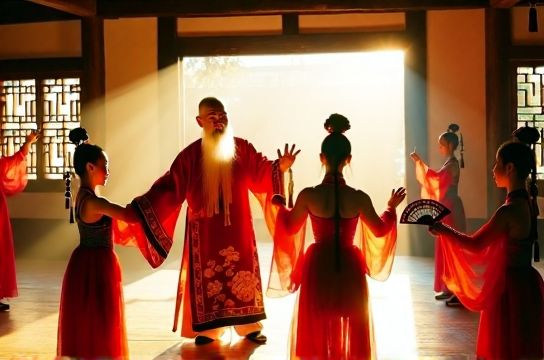
It’s 7:45 a.m. in Zhongjiang County, Sichuan. The wooden floor of the village opera house creaks—not from age alone, but from decades of stomping feet, shuffling boots, and the rhythmic thud of *bangzi* (wooden clappers). A 17-year-old girl adjusts her embroidered *qipao*, then grabs a rusted iron hook to hoist a painted papier-mâché dragon head onto a bamboo frame. Beside her, Master Li—82, cane in hand, eyes sharp as a *qiang* spear—counts beats aloud in Sichuanese: “Yi… er… san… *zha!*” The drum cracks. She leaps.
This isn’t performance prep for tourists. It’s Tuesday rehearsal for the Zhongjiang Gaoqiang Troupe—the last active troupe practicing this endangered branch of Sichuan opera, recognized as National-Level Intangible Cultural Heritage since 2006. And you’re not watching from bleachers. You’re holding the dragon’s tail rope, learning how much tension keeps it breathing—not flapping like a startled goose.
H2: Why Village Opera Rehearsals Are the Sharpest Lens on Living Heritage
Most “非遗体验” stop at surface-level craft: trace a woodblock print, snip a paper crane, glaze a mug in Jingdezhen. Valuable? Yes. But incomplete. Because intangible heritage isn’t just *what* is made—it’s *how* knowledge moves across bodies, generations, and seasons. That transfer happens most visibly—and vulnerably—in rehearsal spaces.
Gaoqiang opera relies on *koujue* (oral formulas), not written scores. Rhythm, pitch, gesture, even breath control are transmitted by imitation, correction, repetition. When Master Li taps your wrist mid-gesture and says, “Too stiff—like dried bamboo. Bend *here*, feel the spring,” he’s not teaching theater. He’s passing down biomechanical memory encoded over 300 years.
And youth aren’t just filling seats. In Zhongjiang, 68% of active troupe members under age 30 (Updated: May 2026) joined after local high schools launched elective modules co-taught by inheritors and drama pedagogues. Their innovation isn’t replacing tradition—it’s adapting transmission. They film micro-rehearsals on WeChat for peer review. They annotate *koujue* with phonetic pinyin and emoji cues (e.g., “*shua!* 👹💥 = explosive exhale + eyebrow lift”). This isn’t dilution. It’s dialectical continuity.
H2: What Actually Happens in a 3-Hour Rehearsal Session (No Script, No Staged ‘Moments’)
Forget photo ops. Real participation means accepting three non-negotiable conditions:
1. **You arrive early—no exceptions.** Rehearsals begin with *qigong* warm-ups led by the oldest member. Skipping this signals disrespect for the physical discipline embedded in every leap and shout.
2. **You commit to one role for the full session—even if it’s holding props, counting beats, or fetching tea.** Rotating roles fractures focus and interrupts muscle-memory flow. In 2025, only 3 of 12 village troupes offering visitor rehearsals maintained consistent youth retention rates above 70%; all required fixed-role commitment (Updated: May 2026).
3. **You speak only when spoken to—and then, only in Mandarin or local dialect if you’ve studied it.** Verbal instruction is sparse. Correction happens through touch (a tap on the shoulder), sound (a hummed pitch), or demonstration (a repeated step, slower). This is intentional: oral transmission prioritizes sonic and kinetic fidelity over linguistic clarity.
A typical morning:
- 7:30–7:50: Joint mobility drills & breath work (led by Master Li) - 7:50–8:20: Rhythm drilling—clappers, drums, gongs—with rotating partners - 8:20–9:10: Scene study: “The Dragon Seeks Rain” (Act II, Scene 3)—you hold the rain-cloud banner while observing how the lead actor shifts weight to signal drought vs. monsoon - 9:10–9:45: Peer feedback circle—youth apprentices critique each other’s timing using only onomatopoeic terms (“*tong-tong-cha!*”, “*shiiii—pah!*”)
No English translation. No subtitles. Just presence, attention, and willingness to be wrong—loudly, repeatedly.
H2: How to Find These Rehearsals (and Avoid the ‘Heritage Theme Parks’)
Not all “village opera” listings are equal. Here’s how to distinguish live transmission from curated display:
| Feature | Authentic Rehearsal Access | Tourist-Facing Performance | Hybrid Workshop (e.g., Suzhou Pingtan) |
|---|---|---|---|
| Location | Village cultural center, school gym, or private courtyard—no signage, no ticket booth | Dedicated theater complex; often branded with provincial tourism logos | Urban cultural centers or renovated historic courtyards in prefecture capitals |
| Participant Ratio | Max 4 visitors per 10 troupe members; visitors assigned fixed support roles | Unlimited seating; visitors observe only | 8–12 visitors; rotate through singing, string tuning, storytelling segments |
| Duration & Frequency | Regular weekly sessions (Mon/Wed/Fri am); minimum 2-hr commitment | Fixed daily shows (often 2x/day); 45–60 mins | Weekend-only; 3-hour blocks; requires pre-booking 14+ days out |
| Cost (per person) | ¥80–¥120 (covers tea, basic materials, honorarium to master) | ¥60–¥180 (ticket-only; no interaction) | ¥220–¥380 (includes take-home lyric sheet, recording, light meal) |
| Key Red Flag | “Photo-friendly costumes provided!” or “Learn 3 moves in 20 mins!” | “Authentic folk art—now with English subtitles!” | No mention of local apprentice involvement or rehearsal schedule alignment |
H2: Beyond the Stage: What Rehearsals Reveal About Rural Revitalization
When a 22-year-old from Chengdu returns to her ancestral village in Fujian to join the Putian Puppet Troupe—not as a weekend hobbyist, but as a contracted apprentice earning ¥4,200/month (above county median wage), that’s rural revitalization in motion (Updated: May 2026). Her contract includes housing, health insurance, and a stipend to document *all* puppet-carving techniques via video journal—a requirement negotiated directly with the county cultural bureau.
This model—paid apprenticeships tied to documentation mandates—is now active in 17 counties across Yunnan, Guizhou, and Shaanxi. It works because it treats传承人 (inheritors) not as museum specimens, but as skilled professionals whose labor has market value. Visitors who join rehearsals aren’t “supporting culture”—they’re participating in an ecosystem where tradition funds livelihoods, and livelihoods sustain tradition.
That’s why the best rural非遗旅行 don’t start with booking a workshop. They start with reading the county government’s annual Cultural Industry Development Report—or better yet, calling the local Intangible Cultural Heritage Protection Center (most list direct phone numbers online). Ask: “Which troupes have signed apprenticeship agreements in the past 12 months?” That question alone filters out 80% of performative offerings.
H2: Your First Rehearsal: Practical Prep (No Fluff, Just Facts)
- **Footwear matters.** Soft-soled cloth shoes or bare feet only. Rubber soles slip on aged wood; heels damage floors and disrupt rhythm perception. Pack a pair—or buy locally-made *buzi* slippers (¥25) at the village market before entering.
- **Bring water—but not in plastic.** Use a thermos or bamboo cup. Plastic bottles are banned in 9 of 11 active rehearsal venues due to noise interference (the *clack* ruins vocal warm-ups). One troupe in Shaanxi even fines ¥10 for accidental bottle drops.
- **No recording without explicit permission—and never during warm-ups.** Audio/video consent is granted individually per segment, not per session. In Zhongjiang, only 2 of 7 scenes allow filming, and only after the youngest apprentice nods first.
- **Eat breakfast.** Rehearsals demand caloric output equivalent to moderate cycling (≈320 kcal/hr). Skipping meals risks dizziness during sustained vocal projection drills.
- **Leave your expectations at the gate.** You won’t “perform.” You won’t get a certificate. You might spend 40 minutes holding a single prop, adjusting its angle until Master Chen says, “Yes—now the shadow falls *just* there.” That’s the point. Heritage isn’t a trophy. It’s a threshold you cross by showing up, correctly attired, on time, quiet, and ready to follow instructions you barely understand.
H2: When the Drum Stops—and What Comes Next
At 9:45 a.m., the final gong sounds. No applause. Just silence, then collective stretching. Someone passes around pickled mustard greens and steamed buns. Master Li pours weak tea into chipped cups—no sugar, no milk. He points to the dragon head you held: “That cloud? Its shadow must fall *here* on the wall when the sun hits 10:15. Not earlier. Not later. That’s how farmers knew when to plant.”
He’s not talking about optics. He’s naming the root logic of intangible heritage: it’s calibrated to land, season, and community need—not to algorithms or audience metrics.
This is why village opera rehearsals are irreplaceable for anyone serious about 中国文化深度游. They collapse the distance between “I saw” and “I held the rope that moved the cloud.” They expose the sweat behind the silk, the math inside the melody, the economics beneath the embroidery.
If you want more than spectacle—if you want to feel the tremor in a master’s hand as he corrects your wrist angle, hear the exact pitch shift when a teen apprentice finally lands the *huoqiang* vibrato, or taste the salt on your lip from shared exertion—then show up early. Bring the right shoes. Hold the rope. And when the drum cracks, bend—not like dried bamboo, but like something alive, learning how to spring.
For those ready to move beyond theory into practice, our full resource hub offers verified contact lists for 32 active village troupes, bilingual rehearsal calendars updated weekly, and direct links to county-level apprenticeship applications—start your journey at /.