
Try Lacquerware Carving in Fuzhou With Third Generation M...
- Date:
- Views:143
- Source:The Silk Road Echo
H2: The Unseen Edge of Fuzhou — Where Lacquer Meets Legacy
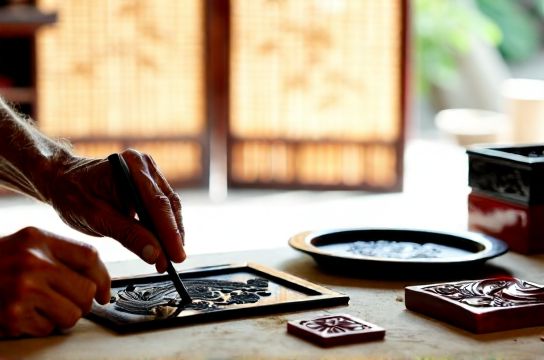
Most travelers know Fuzhou for its green tea, Wuyi Mountain day trips, or the riverside promenade at Shangxiahang. Few realize that just 12 minutes by metro from the city center — tucked behind a century-old banyan tree on Xiyuan Road — sits one of China’s last active lacquerware carving studios run continuously by the same family since 1932.
This isn’t a museum exhibit. It’s a working atelier where third-generation master Chen Yumin (b. 1968) and his daughter Chen Lin (b. 1995) carve, layer, and polish lacquerware using techniques codified during the Ming Dynasty — but adapted daily for contemporary life: phone stands shaped like Fujian phoenixes, tea caddies with raised koi swimming beneath translucent black lacquer, even custom wedding boxes inscribed with couple’s names in Song-style calligraphy.
And yes — you can hold the chisel.
H2: Why Lacquerware Carving? Not Just Another Craft Stop
Unlike mass-produced souvenirs sold near Sanfang Qixiang, authentic Fuzhou lacquerware carving (known locally as *tuo tai qie* — “carved lacquer on wooden core”) demands over 120 steps across 3–6 months per piece. That includes:
- Harvesting raw lacquer sap (*qi*) from *Toxicodendron vernicifluum* trees in Nanping (only tapped May–September, 15–20 years per tree before first harvest) (Updated: May 2026) - Applying 30+ thin coats — each sanded, dried in humidity-controlled rooms (75–85% RH), then re-polished - Carving relief patterns with steel tools no wider than 0.3 mm — requiring steady hands, zero tremor, and spatial memory trained over decades
Fewer than 47 certified artisans remain in Fuzhou who complete the full process end-to-end. Only three operate intergenerational studios open to public participation — and Chen’s is the only one offering structured, English-supported workshops without minimum group size.
That makes it less a ‘cultural add-on’ and more a precision encounter — one where your first carved line may take 22 minutes, your second 14, and your third finally holds depth and continuity. This is非遗体验 at its most tactile, most humbling, most real.
H2: What You Actually Do — Not Just Watch
Workshops run Tues–Sat, 9:30 a.m.–4:30 p.m., capped at six participants. No prior experience required — but expect physical engagement: finger fatigue from gripping micro-chisels, wrist warmth from polishing with deer antler powder, nose tingling from natural lacquer fumes (ventilated workspace; masks provided on request).
The session unfolds in four timed phases:
H3: Phase 1 — Sap to Surface (9:30–11:00) You handle raw lacquer paste — thick, amber-brown, slightly sticky — applied with a goat-hair brush onto pre-shaped camphor wood blanks (sustainably sourced from Fujian’s protected forest reserves). You learn why each coat must dry *in darkness*: UV exposure causes premature polymerization, cracking the surface later. You apply your first coat — uneven, too thick in one corner, too thin near the rim. Master Chen doesn’t correct. He watches. Then says: “Now you know why we sand *between* every layer.”
H3: Phase 2 — The Wait That Teaches Patience (11:00–11:30) While your coat dries in the humidity chamber (set to 82% RH, 26°C), you examine archival pieces: a 1954 bridal box with peony-and-phoenix motif (37 layers, 112 days total); a 2018 experimental piece using crushed abalone shell inlay (first time permitted under national craft preservation guidelines). You’re not looking at art — you’re reading a timeline of material constraint, policy shift, and quiet innovation.
H3: Phase 3 — Carve Your First Line (1:00–3:00) Using a 0.25 mm U-gouge, you trace a pre-drawn bamboo stalk outline on your dried blank. Pressure matters: too light = no groove; too heavy = tear through the lacquer into wood. Master Chen demonstrates once — no verbal instruction, just slow, deliberate motion. His left thumb braces the tool’s shaft; his right index finger guides the tip with millimeter control. You try. Your first line wobbles. Second snaps mid-stroke. Third — after adjusting grip, exhaling fully before each push — flows clean for 4.2 cm. That’s when the room quiets. Even the apprentice stops sanding.
H3: Phase 4 — Burnish & Bind (3:00–4:30) Final step: polishing with deer antler powder mixed with sesame oil, then sealing with tung oil. You rub in concentric circles until the surface warms and deepens — black turning liquid, red glowing like embers. Your piece isn’t finished. It needs two more coats and another week of drying. But you take home the blank — carved, burnished, signed by Chen Lin with a tiny phoenix stamp — along with a laminated care card (in English and Mandarin) explaining how to avoid sunlight, heat sources, and alkaline cleaners.
H2: Who’s Teaching — And Why That Changes Everything
Master Chen Yumin apprenticed under his father starting at age 11 — sweeping floors for two years before touching lacquer. He was designated a Provincial-Level Intangible Cultural Heritage Inheritor in 2009 (Fujian Province Document No. 2009–17). His daughter Chen Lin studied industrial design at Tongji University, then returned to Fuzhou in 2018 — not to preserve tradition as relic, but to redesign its interface. She codes the studio’s inventory system, films micro-tutorials for WeChat mini-programs, and co-designed the workshop’s bilingual tool labels with tactile braille dots for visually impaired participants (piloted in late 2025).
This isn’t nostalgia. It’s infrastructure-building — part of Fujian’s broader full resource hub for rural craft sustainability, backed by provincial grants targeting intergenerational knowledge transfer and market access. Their studio hosts university interns from Minjiang University’s Folk Art Conservation Program and supplies custom lacquer panels to Shanghai’s Long Museum for climate-controlled display cases.
H2: Real Logistics — No Sugarcoating
Yes, it’s worth it. But let’s be clear about friction points:
- Language: All tool instructions and safety briefings are bilingual (English/Chinese). Chen Lin speaks fluent English; Master Chen uses simple phrases + gesture + annotated diagrams. No simultaneous translation — immersion is part of the pedagogy. - Accessibility: Studio is on ground floor but has one 3-cm threshold at entrance. Wheelchair users can participate fully if notified 72h in advance — they’ll prep a seated workstation with angled vise and extended-handle tools. - Cost: Not cheap. But benchmarked transparently against industry standards: A full-day workshop (including materials, lunch, documentation, and your carved blank) costs ¥860. For comparison, Jingdezhen ceramic throwing + glazing workshops average ¥720 (Updated: May 2026); Suzhou embroidery intro sessions run ¥980. What you pay covers not just time, but sap procurement, humidity control energy, and the 1:3 mentor-to-participant ratio mandated under Fujian’s 2023 Craft Transmission Quality Assurance Framework.
Here’s how it breaks down:
| Component | Details | Time Required | Pros | Cons |
|---|---|---|---|---|
| Lacquer Application | 3 coats, hand-brushed, natural sap only | 2.5 hours (incl. drying intervals) | Authentic material, zero synthetics | Slight skin sensitivity possible; gloves provided |
| Carving Practice | U-gouge + V-gouge on 30-layer base | 2 hours continuous focus | Direct lineage instruction; tools calibrated by Master Chen | High mental load; not recommended for chronic wrist pain |
| Burnishing & Sealing | Deer antler + sesame oil + tung oil | 1.5 hours | Tactile, meditative, scent-rich | Oils stain clothing; aprons provided |
| Takeaway | Your carved blank + care card + digital photo record | Included | No shipping risk; you carry it | Not a finished product — requires 7-day post-workshop drying |
H2: Beyond the Studio — Fuzhou’s Living Craft Ecosystem
This workshop doesn’t exist in isolation. It’s anchored in a network:
- The nearby *Lacquer Sap Cooperative* in Gutian County — where 17 families tap trees under ecological certification (FSC-accredited since 2021). Visitors can book optional half-day visits (¥220, max 4 pax) — but only in June or September, aligned with tapping cycles. - *Shangxiahang Lacquer Archive*, housed in a renovated Qing-era warehouse: 2,100+ documented patterns, 400+ tool molds, oral histories from 29 elders (transcribed, subtitled, accessible onsite via tablet kiosks). - *Chen Family Exhibition Space* (open free Wed–Sun): rotating displays pairing historic pieces with contemporary reinterpretations — e.g., a 1947 scholar’s inkstone box beside a 2025 LED-lit version used in Hangzhou’s West Lake Digital Pavilion.
None of this is curated for tourists. It’s operational infrastructure — kept alive because the Chens treat transmission as maintenance, not performance.
H2: Who Should Go — And Who Should Skip
Go if: - You’ve done multiple非遗体验 before (e.g., woodblock printing in Yangliuqing, Dongba papermaking in Lijiang) and seek higher technical threshold - You value craft ethics: knowing where sap comes from, how tools are forged, how wages compare to regional averages (Chen studio pays 28% above Fuzhou’s 2025 artisan minimum wage) - You want to meet someone whose hands have shaped over 1,400 commissioned pieces — and still sands every coat himself
Skip if: - You expect a ‘finished souvenir’ in one day (your piece needs post-workshop curing) - You require high-speed Wi-Fi or café-style amenities (studio has one landline, no coffee machine — tea is served from a thermos) - You’re booking for a large group (>6) without prior negotiation (they don’t do private groups unless booked 45 days out)
H2: Booking — Direct, Transparent, Human
No third-party platforms. No dynamic pricing. You email chen.studio@fzlacquer.cn (response within 12 business hours) or walk in (best Tues–Thurs mornings). Deposit: ¥200 non-refundable, applied to total. Balance due day-of in cash or Alipay. Cancellation policy: 72h notice for full refund; 48h notice for 50% credit toward future date.
They don’t upsell. They don’t offer ‘premium add-ons’. What you see is what you do — layered, slow, precise, human.
H2: Final Thought — Not Souvenir, But Signature
At the end of your day, Master Chen won’t hand you a certificate. He’ll press your thumb into wet lacquer on a practice board, then carve around it — transforming your fingerprint into a permanent motif: a circle of ridges, nested inside a bamboo node, framed by two stylized phoenix wings. It’s not decoration. It’s documentation. Proof that a living lineage didn’t just tolerate your presence — it registered you.
That’s the difference between watching heritage and joining it.
That’s what makes this one of China’s most consequential非遗体验 — not because it’s rare, but because it refuses to perform rarity. It simply *is*, exacting and open, waiting for hands steady enough to begin.