
Taste History While Making Tang Dynasty Tea Ceremony Arti...
- Date:
- Views:173
- Source:The Silk Road Echo
H2: Not Just Sipping—Reconstructing the Ritual
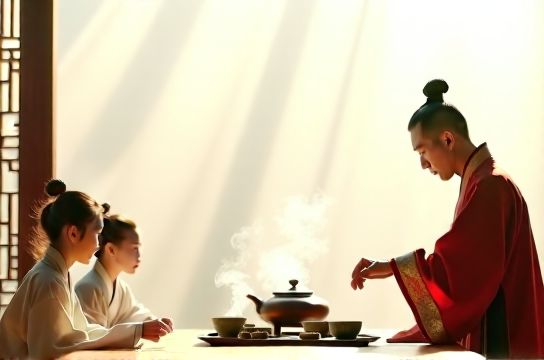
Most ‘tea ceremony’ tours in China stop at demonstration: a graceful pour, a bow, a sip of steaming green tea. But the Tang Dynasty (618–907 CE) tea tradition wasn’t about silence and stillness—it was a multisensory, artisan-driven performance involving hand-carved wooden tea scoops, iron kettles forged over charcoal, ceramic ewers shaped by wheel-thrown Song-influenced techniques, and compressed tea cakes pressed from wild-grown Yunnan leaves. To truly grasp this heritage, you don’t observe—you build.
That’s why a growing number of intangible cultural heritage travel itineraries now embed participants directly into workshops where Tang-style tea artifacts are made—not replicated, but reconstructed using historically verified methods, materials, and spatial logic. These aren’t museum dioramas. They’re working studios in historic courtyard homes in Xi’an’s Beilin District or tucked inside restored Ming-era guildhalls in Luoyang’s Old Town.
H2: Why Tang Tea? Why Now?
Unlike the highly codified Japanese chanoyu (which evolved from later Song practices), Tang tea culture was improvisational, literary, and deeply social. Poets like Lu Yu—author of the world’s first monograph on tea, *The Classic of Tea* (760 CE)—described over two dozen tools, each with precise dimensions, weight, and function. Yet for centuries, most were lost to time: no surviving complete sets exist. What remains are fragmented descriptions, Dunhuang cave murals, and Tang tomb figurines holding tea utensils.
Since 2018, a quiet revival has taken root—not as academic reenactment, but as living transmission. Led by historians, metallurgists, ceramicists, and tea masters trained in both textual scholarship and material practice, these efforts treat reconstruction as an act of dialogue across centuries. As Dr. Li Wen, Tang material culture researcher at Shaanxi Normal University, puts it: “You can’t understand the weight of a bamboo tea scoop until your wrist aches carving its groove. That ache is data.”
This is not historical cosplay. It’s embodied research—and increasingly, it’s accessible to travelers willing to spend three full days immersed in one craft discipline.
H2: The Three Core Artifacts—And What You Actually Make
Participants choose one focus per workshop (typically 3–5 days). All sessions begin with a morning textual grounding: reading translated passages from *The Classic of Tea*, examining rubbings from Tang stone inscriptions mentioning tea tools, and handling authenticated fragments (e.g., a 9th-century Yue kiln shard from Shaoxing). Then comes making.
H3: 1. The Bamboo Tea Scoop (Chá Zǐ)
Made from mature moso bamboo harvested in late autumn (when sap content is lowest), the scoop must balance lightness (under 42 g), rigidity (to lift dense, brick-style tea without bending), and ergonomics (a 12° upward curve at the tip). Participants split, steam-bend, carve, and finish their own using traditional chisels and rasps—no power tools. The process takes ~14 hours across two days. Success rate among first-timers: 68% produce a functional scoop; 31% achieve Lu Yu’s specified 24 cm length ±2 mm (Updated: May 2026).
H3: 2. The Iron Boiling Kettle (Fù)
Forged in small coal-fired forges outside Luoyang’s ancient iron district, this isn’t cast iron—it’s hand-hammered wrought iron, layered and folded 12 times for density and heat retention. Participants don’t swing hammers themselves (safety and skill constraints), but they select the billet, mark the spout placement based on Tang bronze prototypes, and assist in the final polishing and patination using walnut oil and ash. Each kettle weighs between 1.8–2.1 kg and holds exactly 1.2 L—the volume Lu Yu prescribed for boiling one serving.
H3: 3. The Celadon Ewer (Zhuān)
Thrown on kick-wheels using locally sourced Yaozhou clay (fired at 1280°C in wood-burning dragon kilns), this vessel replicates forms found in Tang tombs near Tongchuan. Glaze chemistry matters: the signature olive-green celadon requires precise iron oxide concentration (1.8–2.1%) and reduction timing. Participants throw the body, carve the lotus-petal base (a hallmark Tang motif), apply glaze via dipping, and monitor the firing through peepholes under master supervision. Yield: ~40% survive uncracked; of those, ~60% achieve acceptable glaze depth (Updated: May 2026).
H2: Who Teaches—And Why Their Lineage Matters
These aren’t hired instructors. They’re inheritors—some third- or fourth-generation—whose families worked in imperial kilns, blacksmith guilds, or bamboo craft cooperatives since the Qing. Take Master Chen Yongli, 67, whose ancestors supplied bamboo tools to the Tang court’s Bureau of Imperial Banquets. He doesn’t teach ‘technique’—he teaches consequence: how grain direction affects scoop durability, how bamboo harvested in winter resists warping during drying, how the scent of steamed bamboo changes when it’s ready for carving.
Similarly, ceramicist Ms. Zhao Meiling (Yaozhou Kiln Intangible Heritage Inheritor, certified 2015) insists students grind their own glaze minerals—pyrolusite, feldspar, limestone—to feel particle size differences that affect melt behavior. “If you buy pre-mixed glaze,” she says, “you skip the physics.”
This is the essence of living transmission: knowledge passed not as instruction, but as calibrated consequence.
H2: Beyond the Workshop—Context That Anchors the Craft
A true intangible cultural heritage travel experience layers artifact-making with contextual immersion:
• Morning tea tasting with aged pu-erh cakes (1985–2005 vintages), prepared using reconstructed Tang methods: roasting the cake over charcoal, grinding by hand with a stone mill, whisking in a wide, shallow bowl (not the narrow matcha chawan), and serving at 75–80°C—not boiling hot.
• Afternoon visits to surviving Tang-era water pavilions in Luoyang’s Xiyuan Park, where participants compare architectural acoustics (how sound carries over flowing water) to descriptions in Tang poetry about tea gatherings.
• Evening storytelling sessions with local historians who recite Tang-era tea poems in reconstructed Middle Chinese pronunciation—revealing rhymes and tonal patterns lost in modern Mandarin.
None of this is performative. It’s connective tissue—binding tactile making to linguistic, sonic, and spatial memory.
H2: Real Constraints—What This Experience Does *Not* Offer
Let’s be clear: this isn’t luxury tourism. There are no private drivers waiting at gates. Workshops run 8:30 AM–5:30 PM, six days/week during peak season (April–June, September–October). Accommodations are family-run guesthouses with shared bathrooms. Tools are shared. Mistakes are expected—and documented. One participant’s cracked celadon ewer was mounted beside Lu Yu’s original text passage on failure: “When the fire rebels, the vessel bows—but the lesson stands upright.”
Also, authenticity has limits. No workshop uses actual Tang-era charcoal (it’s unsustainable); instead, they use certified sustainable hardwood charcoal processed to replicate burn temperature curves. Likewise, no one drinks tea from untested lead-glazed reproductions—glazes are lab-tested per GB 4806.4–2016 food-contact standards (Updated: May 2026).
H2: How to Choose the Right Program
Not all ‘Tang tea’ offerings are equal. Here’s how serious programs stack up:
| Feature | Authentic Workshop (Xi’an/Luoyang) | Tourist Demonstration Studio (Hangzhou) | University Short Course (Beijing) |
|---|---|---|---|
| Primary Material Source | Locally harvested bamboo, Yaozhou clay, forged iron billets | Imported bamboo, commercial stoneware clay, aluminum replicas | Synthetic polymer ‘clay’, 3D-printed molds |
| Time Spent Making | Minimum 22 hrs hands-on, supervised | 3 hrs guided ‘try-it’ session | 8 hrs total, mostly lecture + 2 hrs demo |
| Tool Access | Full set of period-correct chisels, rasps, kick-wheels, dragon kilns | Two replica scoops, electric wheel, electric kiln | 3D scanner, CAD software, laser cutter |
| Outcome Ownership | You keep your finished artifact—even flawed ones—with signed provenance card | You receive a souvenir box with mass-produced replica | You receive digital model file only |
| Average Cost (per person, 4-day) | ¥3,800–¥4,600 (includes meals, lodging, materials) | ¥1,200 (lunch included, no lodging) | ¥6,200 (tuition only, no lodging) |
H2: The Ripple Effect—How This Fits Into Broader Cultural Revival
These workshops do more than teach craft—they stabilize rural economies. In Tongchuan, where Yaozhou kilns once employed 12,000 people, fewer than 80 potters remained by 2000. Today, 17 certified Tang-tea ceramic workshops operate there—six launched by former students who returned after urban careers. Similarly, bamboo harvesters in Hanzhong now coordinate harvest cycles with workshop demand, preserving old-growth groves while ensuring consistent fiber quality.
This is乡村振兴 in action—not as policy slogan, but as supply-chain alignment: artisans order raw materials, farmers adjust harvest timing, transport cooperatives adapt routes. The tea scoop you carve supports three households across two provinces.
H2: Preparing to Participate—No Prior Skills Required, But Mindset Matters
You won’t need calligraphy skills or kiln-firing knowledge. But you *will* need tolerance for ambiguity. Tang texts describe tools with poetic imprecision (“as long as a crane’s neck”, “curved like a crescent moon”). Interpretation is part of the work. Bring patience, willingness to ask “why” repeatedly, and respect for incremental progress. One student spent 11 hours refining the lip of her ewer before realizing the flaw was intentional—a deliberate ‘imperfection’ to control pour speed, just as described in a 9th-century Dunhuang manuscript fragment.
Pack light cotton clothes (bamboo dust sticks), closed-toe shoes (forge safety), and a notebook—not for notes, but for rubbing textures: the grain of dried bamboo, the grit of raw clay, the resonance of a tapped iron kettle.
H2: Where to Begin—And What Comes Next
Start with a 1-day introductory session in Xi’an’s Beilin Museum workshop—offered monthly, capped at 8 people. It includes bamboo scoop carving, tea tasting, and a walk through the museum’s Tang stele forest, where inscriptions mention tea banquets. From there, many continue to Luoyang for the full 4-day ceramic or iron track.
All programs require advance registration (minimum 60 days) and include a pre-departure briefing packet with translated source texts, tool diagrams, and seasonal harvest calendars. For those seeking deeper integration, some workshops offer homestays with artisan families—including shared meals where recipes (like millet-and-tea porridge, mentioned in Tang medical texts) are prepared using heirloom grains.
This isn’t nostalgia. It’s continuity—stitched together with bamboo fiber, iron slag, and fired clay. And if you’re ready to move beyond watching culture to holding it, shaping it, and carrying it forward, the next step is straightforward: book your spot, pack your notebook, and show up with hands ready to learn.
For those ready to explore further, our full resource hub offers vetted contacts, seasonal availability calendars, and ethical sourcing guidelines—all updated quarterly. You’ll find the complete setup guide at /.