
Learn Batik and Tie Dye From Bai Ethnic Artisans in Dali
- Date:
- Views:253
- Source:The Silk Road Echo
H2: Why Dali’s Bai Batik and Tie-Dye Are More Than Just Patterns
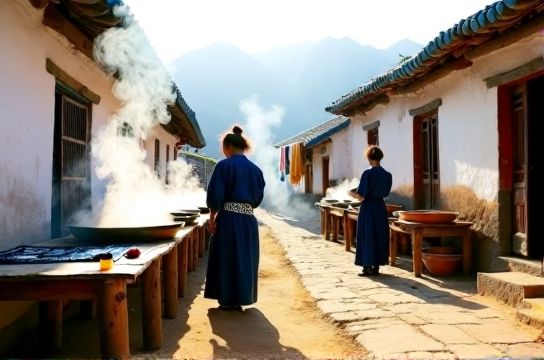
Most travelers see Dali as postcard-perfect: Erhai Lake shimmering under mist, Three Pagodas silhouetted at dusk, cobblestone alleys lined with cafes. Few know that tucked behind the tourist-facing shop fronts in Zhoucheng Village—just 25 minutes north of Dali Old Town—reside three generations of Bai ethnic artisans preserving a textile tradition over 1,200 years old. Their batik (wax-resist dyeing) and tie-dye (扎染, zārǎn) aren’t decorative novelties. They’re encoded language: indigo-dyed crane motifs signal longevity; geometric borders map ancestral migration routes; asymmetrical folds in cloth echo the terraced fields of Cangshan Mountain.
This isn’t museum display. It’s活态传承—living transmission. And it’s fragile. As of May 2026, only 47 certified Bai batik masters remain in Yunnan province, down from 112 in 2012 (Yunnan ICH Office, Updated: May 2026). The decline isn’t due to lack of interest—it’s structural. Synthetic dyes undercut indigo prices by 68%; urban migration pulls youth away from multi-year apprenticeships; and mass-produced ‘Bai-style’ scarves sold in Lijiang markets bear no relation to the original process.
So how do you engage meaningfully—not just buy, but understand? Not just watch, but co-create? That’s where intentional非遗旅行 begins.
H2: What You’ll Actually Do—Not Just See
Forget passive observation. A full-day workshop in Zhoucheng starts before sunrise. You’ll join Master Liang (b. 1953), her hands stained permanently blue from decades of handling fermented indigo vats, as she harvests fresh Polygonum tinctorium leaves—a species native to Cangshan’s mid-elevation slopes. She won’t hand you a pre-mixed dye. You’ll help pound the leaves, layer them with lime and rice wine in a wooden fermentation pit, then test pH daily for 7–10 days until the vat turns coppery-green and smells like damp earth and ammonia. That’s when it’s ready.
Then comes the wax work. Bai batik uses a copper-tipped *tjanting* tool heated over charcoal—not electric irons. Temperature control is tactile: too hot, the wax cracks; too cool, it clogs the spout. You’ll practice on scrap hemp cloth first, drawing freehand floral vines inspired by local wisteria. No stencils. No tracing. Your hand learns rhythm, not replication.
Tie-dye follows a different logic: compression, not resistance. Bai artisans use over 17 distinct binding techniques—some documented in Ming-era scrolls now held at the Yunnan Provincial Library. You’ll learn *shuangxian jie* (double-thread binding), where two threads are twisted around pinched fabric to create crisp, starburst-like repeats—and *yun jie* (cloud binding), a looser, spiral fold yielding soft, watercolor gradients. Each technique requires precise tension calibration: too tight, and dye won’t penetrate; too loose, and patterns blur.
Crucially, you’ll dye your own piece—not one pre-prepared by staff. You’ll lower cloth into the vat for exactly 8 minutes, lift, oxidize in open air for 5 minutes (watching the green turn to blue), then repeat—up to five dips for true depth. This isn’t timed by phone alarm. It’s judged by the sheen on the surface, the weight in your hands, the scent shift in the air. That’s the threshold between craft and ritual.
H2: Who’s Teaching—and Why It Matters
Master Liang doesn’t hold a government-issued ‘Intangible Cultural Heritage Inheritor’ certificate. She never applied. Her authority comes from lineage: her grandmother taught her mother, who taught her, who now teaches her granddaughter—currently a sophomore at Yunnan Arts University studying textile conservation. That intergenerational chain is what makes this活态传承—not static preservation, but adaptive continuity.
Contrast this with the ‘intangible heritage experience’ offered at some commercial compounds near Dali Ancient City: 90-minute sessions using pre-printed templates, synthetic indigo paste from Hangzhou, and English-speaking facilitators with no Bai roots. Those programs serve volume—not depth. They generate revenue, yes, but they don’t feed the ecosystem. In Zhoucheng, every workshop fee goes directly to the artisan household, funds indigo field maintenance, and supports the village’s after-school embroidery class for girls aged 10–14.
That’s乡村振兴 in action—not top-down policy, but bottom-up resilience. Since 2021, Zhoucheng’s cooperative has installed solar dryers to reduce firewood use, partnered with Kunming University of Science and Technology to test soil pH for optimal indigo growth, and launched a micro-loan fund so young artisans can buy copper tools without predatory borrowing. These aren’t add-ons. They’re embedded in the workflow.
H2: What to Expect—Realistically
Don’t expect perfection on your first try. Your first batik line will wobble. Your first cloud bind will bleed. That’s built into the pedagogy. Master Liang keeps a ‘mistake cloth’—a wall-hanging stitched from students’ flawed pieces—annotated with notes: “Too much wax pressure—line cracked at curve,” “Oxidation interrupted—blue turned gray.” It’s not shame. It’s calibration.
Also, prepare for sensory immersion—not comfort. Indigo vats operate best at 18–22°C. Workshops run year-round, but winter sessions mean working in unheated stone courtyards. Summer means humidity thick enough to chew. You’ll wear cotton aprons (provided), but indigo stains skin for 3–5 days—no shame, no scrubbing. It’s a temporary tattoo of participation.
And yes, language is a barrier—but not a wall. Master Liang speaks limited Mandarin and no English. Her granddaughter translates, but deliberately avoids over-explaining. Instead, she models: dipping, folding, testing, adjusting. You learn through repetition, gesture, shared silence. That’s how knowledge transfers in oral traditions—not via PowerPoint, but pulse and pause.
H2: How It Fits Into Broader Intangible Cultural Heritage Travel
Batik and tie-dye in Dali aren’t isolated. They’re nodes in a living network. After your workshop, many participants continue to Shaxi Ancient Town to meet Naxi papermakers practicing东巴造纸 (Dongba papermaking)—using wild bark, hand-beaten pulp, and sun-drying on bamboo frames. Others head east to Jingdezhen for ceramic making, where glaze chemistry echoes indigo fermentation science. The connective tissue isn’t geography—it’s methodology: slow material transformation, generational dialogue, ecological attunement.
This is why intangible cultural heritage travel isn’t just ‘cultural tourism.’ It’s ethnographic engagement with systems. When you grind indigo leaves, you’re participating in botanical knowledge honed across centuries. When you bind cloth with specific tension, you’re engaging physics understood intuitively, not calculated. When you sit with Master Liang as she recounts how her family hid wax recipes during the Cultural Revolution, you’re hearing oral history that never made it into textbooks.
That’s the value proposition of Chinese cultural deep travel: not consumption, but co-witnessing.
H2: Practical Details—Booking, Timing, What to Bring
Workshops run Monday–Saturday, year-round, with strict caps: max 8 participants per session to maintain ratio (1 master + 1 apprentice per 4 learners). Bookings open 60 days ahead via the Zhoucheng Artisan Cooperative’s WeChat mini-program (English interface available). No walk-ins accepted—this protects both artisan capacity and learning integrity.
Cost: ¥380 RMB/person (includes all materials, lunch of Bai sour soup noodles, and a finished 40cm × 40cm cloth). Children under 12 not accepted—this isn’t ‘craft camp.’ Minimum age is 14, reflecting actual apprenticeship entry norms.
What to bring: Closed-toe shoes (stone floors + dye spills), spare cotton shirt (indigo transfers), notebook (not digital—paper absorbs the workshop’s rhythm better), and patience. Leave expectations at the gate.
H2: Comparing Authentic Bai Workshops vs. Commercial Alternatives
| Feature | Zhoucheng Artisan Cooperative (Authentic) | Dali Ancient City ‘Heritage Hub’ (Commercial) | Hotel-Hosted Workshop (Luxury Resort) |
|---|---|---|---|
| Indigo Source | Locally grown & fermented on-site (Cangshan-sourced Polygonum) | Imported synthetic indigo paste (Shandong-manufactured) | Premixed liquid dye (imported from Japan) |
| Wax Tool | Copper-tipped tjanting, hand-forged in Dali County | Plastic-tipped stylus with electric heater | Pre-heated wax pen (battery-operated) |
| Binding Techniques Taught | 5 traditional Bai methods, including yun jie and shuangxian jie | 2 simplified methods (spiral & bullseye only) | 1 method (pre-marked template folding) |
| Post-Workshop Support | PDF guide on indigo vat maintenance + 1-year email access to apprentice | QR code to generic YouTube tutorial | Branded tote bag + Instagram photo op |
| Revenue Flow | 100% to artisan household + cooperative fund | 70% to operator, 30% to hired facilitator | 95% to resort, 5% to contracted vendor |
H2: Beyond the Cloth—What Stays With You
You’ll leave Zhoucheng with more than a dyed square of cloth. You’ll carry the weight of wet hemp in your palms, the sting of lime on a cut finger, the sound of Master Liang humming an old Bai harvest song while stirring the vat. You’ll notice indigo’s color shifts differently under Himalayan light versus Beijing smog. You’ll read news about rural revitalization not as policy abstraction, but as the solar dryer you helped install, or the university grant that let her granddaughter study without leaving home.
That’s the quiet power of intangible heritage travel. It doesn’t shout. It settles—in your muscles, your memory, your understanding of time. Craft isn’t fast. Neither is real understanding.
If you’re serious about connecting with living traditions—not curated performances—start here. The full resource hub offers seasonal workshop calendars, artisan bios, and ethical booking protocols—all grounded in respect, not extraction. It’s the difference between passing through culture and pausing within it.
H2: Final Note—This Isn’t ‘Learning a Skill.’ It’s Relearning Attention.
In a world optimized for speed and scale, Bai batik and tie-dye ask for slowness. For missteps. For watching a vat breathe. For trusting your hands before your eyes. That’s not nostalgia. It’s recalibration. And in Zhoucheng, it’s still happening—not preserved behind glass, but lived, dyed, folded, and passed on—one imperfect, indigo-stained thread at a time.