
Weave Bamboo Crafts With Yunnan Minority Artisans
- Date:
- Views:178
- Source:The Silk Road Echo
H2: When the Bamboo Stalks Speak Back
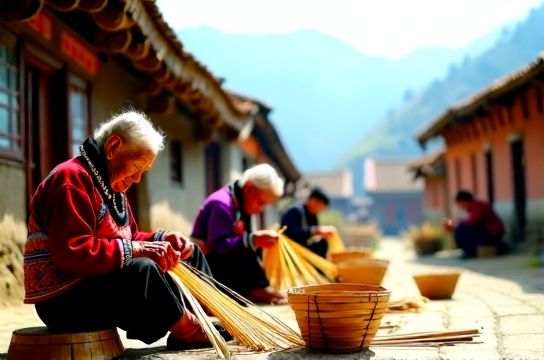
You arrive at a stone-paved courtyard in Xizhou, Dali Prefecture. A woman in indigo-dyed Bai attire sits cross-legged on a woven mat, fingers flying—not typing, but splitting a fresh moso bamboo culm into hair-thin splints with a hand-forged knife. Her granddaughter watches, then picks up a half-finished fish-shaped basket. No instruction sheet. No QR code linking to a video tutorial. Just quiet repetition, occasional murmured corrections, and the soft *shush-shush* of bamboo sliding over bamboo.
This isn’t performance. It’s continuity.
Bamboo weaving across Yunnan’s minority communities—Bai, Yi, Dai, and Hani—isn’t listed as UNESCO ICH (yet), but it meets every criterion for living heritage: intergenerational transmission, adaptive use of local ecology, embedded ritual function (e.g., Dai wedding baskets holding betel nuts; Yi funeral mats guiding spirits), and resilience amid rapid change. Since 2019, over 42 village-level bamboo cooperatives have registered under China’s National Intangible Cultural Heritage Protection Program, with 17 receiving direct fiscal support for training apprentices (Updated: May 2026). Yet most remain invisible to mainstream tourism—no glossy brochures, no fixed ‘craft village’ gates. You find them through word-of-mouth, local NGO referrals, or by showing up at a market stall in Shaxi and asking, gently, where the weavers live.
H2: Why Bamboo? Why Yunnan? Why Now?
Bamboo isn’t just material—it’s infrastructure. Moso bamboo (Phyllostachys edulis) grows 1.2 meters per day in Yunnan’s humid valleys. It regenerates without replanting, sequesters 35% more CO₂ than equivalent timber stands, and its rhizomes prevent landslide erosion—a critical function in mountainous terrain where roads wash out yearly. For artisans, it’s also deeply symbolic: hollow yet strong, flexible but unbreakable—qualities mirrored in minority philosophies of harmony and endurance.
But raw abundance doesn’t equal craft survival. Mechanized plastic imitations now flood rural markets: ¥3.50 synthetic ‘bamboo’ fruit trays versus ¥85 hand-split, smoke-cured, triple-weave Bai grain sieves. The price gap isn’t about cost—it’s about time. A master weaver spends 18–22 hours to prepare materials for one medium basket (splitting, soaking, polishing, dyeing with local indigo or turmeric). Then another 30–45 hours weaving. That’s not labor—it’s embodied knowledge: knowing which culms to harvest at the waning moon (to reduce starch and deter beetles), how long to soak in spring water from a specific limestone fissure, when the fiber tension shifts mid-weave and demands micro-adjustment of wrist angle.
That knowledge isn’t written down. It’s held in muscle memory—and fraying fast. Of the 127 officially recognized bamboo weaving inheritors in Yunnan (as of 2025 provincial ICH registry), 63% are over 65. Only 11% of weavers under 35 report daily practice—most supplement income with ride-hailing, e-commerce, or seasonal construction work. This isn’t apathy. It’s rational calculus: a 22-year-old in Dali City earns ¥4,800/month driving Didi; full-time weaving nets ¥2,100–¥2,900, with zero social insurance or sick leave.
So why does this experience matter for travelers seeking authentic cultural depth? Because bamboo weaving is a lens—not just into technique, but into systems: land stewardship, gendered labor (weaving is predominantly women’s work, yet men control forest access rights), inter-ethnic exchange (Dai patterns borrow Lao motifs; Bai techniques absorb Naxi knotting methods), and the quiet friction between state-led乡村振兴 policy and grassroots reality.
H2: What You’ll Actually Do (Not Just Watch)
Forget ‘observe a demo, then try one pre-cut piece.’ Real engagement means entering the workflow at its source:
• Day 1: Harvest & Split — With permission from village elders, accompany a family to their managed grove. Learn to identify mature culms (4–6 years old, nodes evenly spaced, bark smooth and waxy). Use a foot-anchored machete to fell—not chop—and carry stalks back shoulder-high. At home, split with a metal ‘splitting horn’ and mallet, guided by touch: too thick = brittle; too thin = limp. Expect blisters. Expect laughter when your first 10 splints shatter.
• Day 2: Cure & Dye — Soak in cold mountain stream for 72 hours (timing varies by season—monsoon water moves faster, requiring shorter soak). Smoke over pine resin fire for 4–6 hours to harden fibers and repel insects. Then dip in fermented indigo vats (Bai method) or turmeric-rice wine mix (Dai), testing color depth by rubbing splint against palm skin.
• Day 3–5: Weave — Start simple: a flat coaster using plain weave. Progress to diagonal twill for baskets. Learn the ‘dragon scale’ base (Yi), ‘peacock eye’ border (Dai), or ‘three-bridge’ rim lock (Bai). No templates. Measurements are by thumb-width, knuckle-joint, or the length of a rice stalk. Mistakes aren’t corrected—they’re incorporated: a dropped strand becomes a deliberate texture line; uneven tension evolves into a ‘mountain wave’ motif.
You won’t finish a market-ready piece. You’ll finish a flawed, personal artifact—and understand why ‘perfection’ is culturally irrelevant here. Function is sacred. A sieve must let chaff pass but hold millet. A cradle must flex to soothe, not rigidly support. Your coaster may warp. That’s data—not failure.
H2: Logistics: Where, When, and How to Respectfully Participate
Workshops occur only in villages where cooperatives have formal agreements with local cultural bureaus and elected elders’ councils. No drop-ins. All programs require 4-week advance booking via vetted local NGOs (e.g., Yunnan Folk Arts Alliance) or certified rural homestay networks. Minimum group size: 2. Max: 6—because space is tight, and attention is finite.
Pricing reflects true cost recovery—not profit extraction. Fees cover material prep, elder stipends (¥200/day), interpreter compensation (many artisans speak limited Mandarin), and cooperative administrative overhead. No ‘luxury add-ons’. Lodging is in family homes: shared courtyard bathroom, meals cooked over wood fire, sleeping on cotton-stuffed futons. Wi-Fi is spotty; phone signal vanishes past the third ridge.
| Village Cluster | Key Ethnic Group | Signature Technique | Duration | Price (per person) | Pros | Cons |
|---|---|---|---|---|---|---|
| Xizhou (Dali) | Bai | Smoke-cured flat-weave grain sieves, indigo-dyed borders | 5 days / 4 nights | ¥3,200 | Strongest English-speaking interpreters; accessible by public bus from Dali Old Town | Limited privacy; high season (June–Aug) books 6 months ahead |
| Shangri-La County (Deqin) | Yi | Dragon-scale base + horsehair reinforcement for ceremonial baskets | 6 days / 5 nights | ¥3,800 | Rarest techniques; includes visit to sacred bamboo grove ceremony | Altitude (3,200m); requires moderate hiking fitness; no road access—arrive by 4WD shuttle |
| Jinghong (Xishuangbanna) | Dai | Turmeric-dyed peacock-eye motifs; woven-in betel nut compartments | 4 days / 3 nights | ¥2,900 | Warm climate year-round; easiest transport (daily flights from Kunming); strongest ritual context | Fewer elder masters available (many teach in county vocational schools); monsoon season (July–Sept) limits outdoor harvesting |
All programs include a post-workshop follow-up: a digital photo archive of your process (shared only with consent), plus a physical ‘material passport’—a small bamboo tube containing samples of your harvested, split, dyed, and woven pieces, sealed with beeswax. It’s not a souvenir. It’s evidence of participation.
H2: Beyond the Workshop: Seeing the Ecosystem
What makes this more than a craft class is witnessing the ecosystem that sustains it. In Xizhou, you’ll visit the cooperative’s ‘bamboo bank’—not financial, but ecological: families deposit seedlings grown from cuttings of their best-performing groves, then withdraw saplings to plant on degraded slopes. In Jinghong, you’ll sit with Dai elders as they recite origin chants while blessing new bamboo shoots—a 12-minute oral poem listing every insect, bird, and soil microbe that cohabits the grove. In Deqin, you’ll help load cured culms onto mule trains bound for the county market—where weavers barter baskets for salt, wool, or solar charger parts.
None of this is staged. You’re present during real work cycles, real negotiations, real fatigue. You hear the sigh when a government agricultural officer arrives to promote ‘high-yield bamboo hybrids’—varieties that grow faster but lack tensile strength and resist no pests. You see the polite nod, the quick glance exchanged between mother and daughter, the later whispered explanation: “They don’t understand. Strong bamboo needs slow growth. Like good people.”
H2: Ethical Ground Rules (Non-Negotiable)
• No photography during ritual moments (e.g., grove blessings, first-weave prayers) unless explicitly invited. Ask first. Wait for verbal ‘yes’—not a smile or nod.
• Never refer to artisans as ‘masters’ unprompted. Titles like ‘A-ma’ (Bai grandmother) or ‘Nuo-ge’ (Yi elder brother) are earned, not assumed.
• Compensation goes directly to households—not NGOs or tour operators—via verified mobile payments tracked by village accountants.
• Take nothing but photos, leave nothing but footprints… except one thing: your finished piece. It belongs to you. Its flaws are yours. Its story starts with you.
H2: Connecting Threads
Bamboo weaving isn’t isolated. It’s a node in China’s broader intangible cultural heritage landscape—tangled with ceramic making in nearby Jianchuan (where potters use bamboo ribs to shape clay), linked to Dongba papermaking in Lijiang (whose fiber pulp is often strained through bamboo sieves), resonant with Miao silver filigree (where wire-thin metal mimics bamboo’s tensile grace). To understand one is to glimpse the logic of many.
That’s why these experiences belong squarely in the Intangible Trails category—not as exotic diversions, but as entry points into systemic thinking about cultural resilience. They demand patience, humility, and tolerance for ambiguity. You won’t ‘master’ bamboo in five days. But you might finally grasp what ‘living heritage’ truly means: not preservation behind glass, but breath inside a beating heart.
For those ready to move beyond surface-level民俗文化 and engage with the quiet, urgent work of活态传承, this is where depth begins. Explore our full resource hub for verified programs, artisan profiles, and ethical guidelines—all updated monthly. complete setup guide (Updated: May 2026).