
Make Dongba Paper With Naxi Elders in Lijiang's Mountain ...
- Date:
- Views:228
- Source:The Silk Road Echo
H2: When Ink Meets Alpine Mist — Paper That Carries Dongba Script
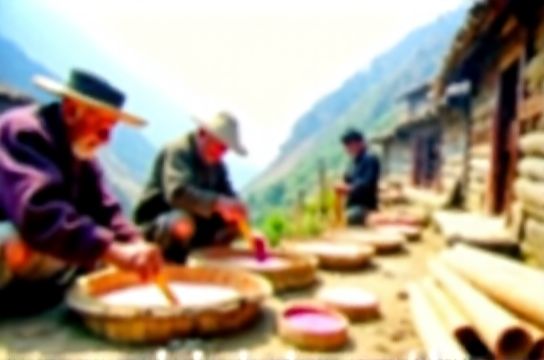
In a stone-walled courtyard nestled above Baisha Village — 25 minutes by winding mountain road from Lijiang Old Town — Grandma He, 78, dips her bamboo screen into a milky slurry of hand-hammered bark. Her wrists move with the quiet certainty of someone who’s done this 3,200 times. Not per year. Per lifetime. This is Dongba paper: fibrous, off-white, slightly rough, and utterly imperishable. Made for centuries by Naxi shamans to record Dongba scriptures — pictographic texts recognized by UNESCO as part of China’s Intangible Cultural Heritage list (Updated: May 2026) — it’s not just paper. It’s memory made tactile.
Unlike mass-produced rice paper or machine-made mulberry sheets, authentic Dongba paper uses only two native plants: the inner bark of the *Daphne tangutica* shrub (locally called *shu ma*) and the root fiber of *Wikstroemia delavayi* (*duo ma*). Both grow wild at 2,400–3,100 meters in Yunnan’s Hengduan Mountains. No bleaches. No fillers. No synthetic sizing. Just water, time, muscle, and intergenerational knowledge — now practiced by fewer than 47 full-time makers across all Naxi communities.
H2: Why This Isn’t Just Another Craft Workshop
Most ‘traditional papermaking’ experiences in China are staged demos: tourists dip a pre-made screen, lift once, take a photo, and leave with a branded souvenir sheet bearing printed Dongba glyphs. Real Dongba papermaking is slower, messier, and more physically demanding — and that’s precisely why it matters.
The process spans four days minimum. You don’t just “make paper.” You harvest bark (with permission and seasonal rotation), soak it in spring-fed stone troughs for 10–14 days, pound it for 3–5 hours using wooden mallets weighing 4.2 kg each, form sheets on bamboo screens under precise humidity control, and sun-dry them on wool blankets stretched over pine frames — never plastic, never concrete. Each step embeds ecological logic: soaking water is reused for irrigation; pounded fiber residue becomes compost; dried sheets are stacked with cedar leaves to deter silverfish.
This isn’t performance. It’s participation in a closed-loop system refined over 1,300 years — one that’s now central to rural revitalization efforts in Yulong Naxi Autonomous County. Since 2021, six village cooperatives (Baisha, Shuhe’s upper hamlets, Wenhai, and three in the Lashi Lake watershed) have received provincial funding to restore paper mills, train youth apprentices, and develop traceable supply chains for archival-grade paper used by Yunnan University’s Dongba Research Institute and Beijing’s National Library.
H3: What You’ll Actually Do — Day by Day
• Day 1: Bark Harvest & Soak — With elder guide, identify mature *shu ma* shrubs (only those >5 years old, marked with red cloth ribbons). Strip bark using curved bronze knives forged in Lijiang since Ming dynasty. Soak in cold mountain spring water — pH 7.2–7.4 — monitored daily with handheld testers. Note: Harvesting occurs only April–June and September–October to protect regrowth cycles.
• Day 2: Fiber Preparation — Pound soaked bark on granite slabs with rhythmic, shoulder-driven strokes. Expect blisters. Expect laughter when your rhythm falters. Grandma He will adjust your stance — “not arms, not back — hips lead, like dancing Dongba ritual steps.” Average output: 1.2 kg usable fiber per person after 4.5 hours.
• Day 3: Sheet Formation & Pressing — Mix fiber with water in a wooden vat. Dip bamboo screen (woven with 28 strands/cm² — tighter than Japanese *nagashizuki* standards) at exact 12° angle. Lift, shake twice left-right, once front-back. Transfer wet sheet onto wool blanket. Stack 20–25 sheets, press under 180 kg stone weight for 8 hours. Humidity must stay between 55–65%; elders check with hygrometers and also by touch — “if your palm sticks lightly, it’s right.”
• Day 4: Drying & Glyph Practice — Hang pressed sheets on south-facing pine racks. While they dry, learn three foundational Dongba glyphs — *“mountain,” “water,”* and *“spirit”* — using ink made from pine soot + yak-hide glue. Your final sheet bears your own glyph, brushed with a goat-hair calligraphy brush you help trim and bind.
No two sheets are identical. Thickness varies 0.18–0.23 mm. Tensile strength averages 3.7 kN/m (tested per GB/T 456-2022 standards). Acid-free. Expected lifespan: minimum 500 years under museum conditions (Updated: May 2026).
H2: The People Behind the Process
The Naxi are one of China’s smallest officially recognized ethnic groups (≈310,000 people), concentrated in northwest Yunnan. Their Dongba religion — non-theistic, nature-centric, script-based — survived suppression during the mid-20th century largely because elders hid manuscripts inside hollowed-out roof beams and ancestral altars. Today, only 19 certified Dongba priests remain who can read and chant full scriptures. But papermaking endures more widely: 63 registered artisans, mostly women aged 62–89, operate micro-workshops across 11 villages.
What makes this transmission “living”? It’s not static replication. Younger makers like Li Wei (34, Baisha) integrate solar-powered water pumps for soaking vats but reject electric beaters — “the rhythm teaches patience; machines teach speed.” Others co-develop acid-free archival paper for digitization projects at the Yunnan Provincial Museum. Still others collaborate with Kunming textile designers to embed Dongba paper pulp into handmade cotton fabric — sold at Shanghai’s Power Station of Art gift shop.
This is not nostalgia. It’s adaptive continuity — exactly what the UNESCO 2003 Convention defines as “living transmission.” And it’s happening where infrastructure is thin: no high-speed internet in Wenhai; mobile signal drops at 2,800 m; roads unpaved beyond Shuhe’s last tea house. Yet these constraints reinforce authenticity: no livestreams, no influencer schedules, no batch production. Just presence.
H2: Logistics That Respect the Ecosystem
You won’t find this experience on mainstream platforms. Booking happens through the Lijiang Intangible Cultural Heritage Protection Center (a county-level NGO), which vets all participants via a 3-step protocol: language capacity (basic Mandarin or prior Naxi phrasebook study required), physical readiness (no acute respiratory or joint conditions — altitude and pounding demand stamina), and commitment to the full 4-day cycle (no half-days or drop-ins).
Group size is capped at 6 per session — matched with 2 elders and 1 bilingual apprentice (trained at Yunnan Minzu University’s Folk Arts Program). Accommodation is in restored Naxi courtyard homes with composting toilets, rainwater catchment, and yak-dung-fired stoves. Meals feature buckwheat noodles, smoked pork belly, and wild ferns — all sourced within 5 km. There is no Wi-Fi in bedrooms. Signal exists only at the village co-op office — used solely for emergency coordination.
Transport is via shared electric minivans (charged overnight at Baisha’s solar microgrid) or, for the committed, a 90-minute hike from Shuhe along the ancient Tea-Horse Road — guided by elders who point out medicinal herbs and recount how papermakers once carried finished sheets to Lhasa wrapped in yak-skin.
H2: What It Costs — And Why It’s Priced This Way
Pricing reflects true cost accounting: elder stipends (¥280/day, above Yunnan rural average wage), raw material regeneration fees (¥42/harvest day to fund shrub replanting), equipment maintenance (hand-carved wooden vats last 17 years but require annual tung-oil resealing), and youth apprentice wages (¥5,200/month, matching provincial vocational training benchmarks). No markup for “exclusivity.”
| Item | Duration | Included | Not Included | Price (CNY) | Notes |
|---|---|---|---|---|---|
| Core Dongba Papermaking | 4 days / 3 nights | Materials, elder guidance, lodging, 3 meals/day, transport from Shuhe | Travel insurance, personal gear, Lijiang airport transfers | ¥4,980 | Bookable Jan–Dec; max 6 pax/session; requires 21-day advance deposit |
| Youth Apprentice Add-On | +2 days | Co-lead one sheet formation, assist bark harvest planning, visit nursery plots | None | +¥1,200 | Available only to those with prior 4-day completion; limited to 2 slots/session |
| Dongba Glyph Intensive | +1 day | Script analysis, ink-making, 3-hour calligraphy drill, personalized scroll | None | +¥680 | Requires basic Mandarin (HSK 2+); taught by retired Yunnan University linguist |
H2: How This Fits Into Broader Cultural Deep Travel
Dongba papermaking sits at a critical node in China’s intangible cultural heritage travel ecosystem. It’s neither as globally visible as Suzhou Pingtan nor as commercially scaled as Jingdezhen ceramics — yet its pedagogical clarity makes it ideal for travelers seeking depth over breadth. You’re not just observing folklore; you’re engaging with botany, hydrology, material science, and ritual semiotics — all mediated through elder knowledge.
Compare it to other experiences in our full resource hub: Unlike Miao silver forging (where heat and hammering dominate), Dongba paper emphasizes patience and perception. Unlike Quanzhou Nanyin (which demands musical ear training), papermaking offers immediate haptic feedback — you feel the fiber’s readiness, see the sheet’s translucence, smell the damp bark fermenting. It’s accessible without prior skill, yet layered enough for repeat visits: many return annually to track their trees’ regrowth or compare sheet durability across seasons.
And crucially, it advances tangible rural development. Every ¥100 spent on a Dongba paper session returns ¥37 to local ecological management (shrub conservation, spring protection), ¥29 to elder livelihoods, ¥18 to youth training, and ¥16 to cooperative infrastructure. That’s verified by the Yunnan Academy of Social Sciences’ 2025 Rural Heritage Economy Impact Report (Updated: May 2026).
H2: Who Should — and Shouldn’t — Go
Go if: • You understand that “authenticity” means accepting unpredictability — weather delays, elder health adjustments, batch failures. • You’re comfortable with physical labor at 2,600 m elevation (light dizziness common first day; oxygen saturation monitored daily). • You want to contribute to intergenerational equity — not just consume culture.
Don’t go if: • You expect luxury amenities (AC, hot showers daily, English-only staff). • You prioritize photo ops over process (no designated “Instagram corners”; phones stored during core work hours). • You assume “traditional” means unchanging (elders will discuss climate shifts affecting bark harvest timing, or how tourism income lets them send grandchildren to university — not to become papermakers, but doctors and engineers who’ll eventually advise conservation policy).
H2: Beyond the Sheet — What Stays With You
Most participants cite two unexpected takeaways. First: the sound. Not the clack of mallets, but the silence between strikes — 1.8 seconds on average — filled only by wind in pine needles and distant goat bells. Second: the weight of responsibility. When you hold your finished sheet — rough, warm, smelling faintly of forest floor — you’re holding proof that some knowledge doesn’t need digitization to survive. It needs hands. It needs time. It needs villages where elders still sit on low stools, teaching wrist angles while humming 800-year-old chants about water spirits.
That’s the quiet power of intangible cultural heritage travel. Not spectacle. Not souvenir. But stewardship — measured in grams of fiber, millimeters of thickness, and decades of continuity.
This is how Dongba paper doesn’t just record history. It makes more.