
Watch and Practice Sichuan Opera Face Changing Up Close
- Date:
- Views:208
- Source:The Silk Road Echo
H2: Not Just a Trick—It’s a Language of Emotion
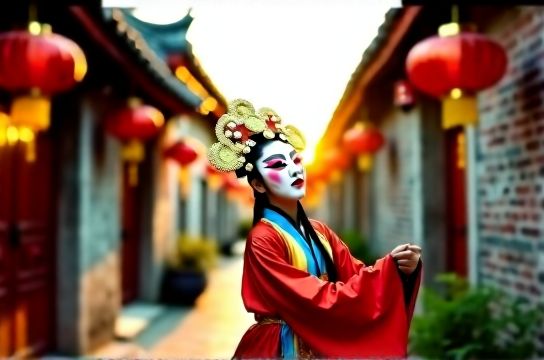
You’re seated on a low wooden stool in a century-old courtyard near Kuanzhai Alley, Chengdu. The air smells of aged wood, Sichuan peppercorns, and damp clay from the nearby Qingyang Temple kilns. On stage—a three-meter-wide bamboo platform lit by bare bulbs—Master Li flicks his sleeve. One second he’s red-faced Guan Yu; the next, black-eyed Lei Gong vanishes into violet smoke. No wires. No digital overlay. Just silk, breath, and decades of muscle memory.
This isn’t theater as spectacle. It’s *bian lian*—Sichuan opera face changing—as living language: rapid shifts in color, texture, and expression mapping inner turmoil, divine wrath, or sudden enlightenment. And for the past five years, a handful of small-scale, community-rooted programs have opened access—not just to watch, but to *practice*, under direct mentorship.
H2: Why ‘Up Close’ Changes Everything
Most tourists see *bian lian* in 90-minute commercial shows at Shufeng Yayun Teahouse or Jinli Street. Those are polished, safe, and tightly choreographed—3–4 face changes per performance, all pre-set, no audience interaction. They serve tourism well—but not transmission.
The real shift began post-2020, when Sichuan’s Department of Culture and Tourism launched the "Rural Intangible Heritage Anchors" initiative (Updated: May 2026). It funded 17 village-level studios—including the Wenshu Monastery Cultural Cooperative in Chengdu’s Jinniu District and the Yibin Nanxi Village Folk Arts Hub—to host micro-workshops (max 8 participants) led by certified inheritors. These aren’t staged demos. They’re 3–5 hour sessions where you hold the actual face masks, learn breath control before your first pull, and misplace your third silk layer while Master Chen corrects your wrist angle—not with a script, but with a tap on the ulna.
That tactile precision matters. Each mask is hand-cut from dyed silk stretched over bamboo frames, then coated with natural tung oil for grip and sheen. A single set contains 12–15 layers, each weighted differently. The speed isn’t about fingers—it’s about diaphragmatic pressure syncing with shoulder rotation and fabric tension. Get the exhale wrong, and the mask sticks. Rush the pivot, and silk snags on your cuff.
H2: What You’ll Actually Do (Not Just Watch)
Forget passive observation. In a certified *bian lian* workshop, your day breaks into three non-negotiable phases:
H3: Phase 1 — Material Literacy (45 mins) You don’t start with movement—you start with fiber. You handle raw silk scraps dyed with indigo, gardenia, and iron-rich mud from Pengzhou. You test oil viscosity on bamboo rings. You compare two generations of mask frames: pre-1980 hand-split bamboo (lighter, more flexible) versus post-2005 heat-treated laminates (stiffer, longer-lasting but less responsive). This grounds technique in material reality—not mystique.
H3: Phase 2 — Breath & Body Mapping (60 mins) No mask touches your face until you can hold *qi zhan* (standing breath-hold) for 45 seconds without shoulder lift—and replicate that same breath rhythm while rotating your torso 180° at waist level. Why? Because face changing relies on centrifugal force + controlled exhalation to peel the topmost silk layer. If your core isn’t engaged, the mask won’t release cleanly. Instructors use metronomes set to 120 BPM—the tempo of mid-tempo *gaoqiang* opera—to drill timing. You’ll sweat. You’ll cough. You’ll reset—repeatedly.
H3: Phase 3 — Guided Layer Practice (90 mins) You wear a base mask (neutral beige, unadorned), then add one removable layer at a time: first a simple red silk square (held by chin strap + temple clips), then a two-tone gradient, then a full-face design with embroidered lightning motifs. Each layer introduces new variables: clip tension, silk drape, head tilt threshold. By hour three, you’ll execute three clean swaps—no flinching, no visible adjustment—under live feedback. Not perfection. But *intentional control*.
H2: Where to Go—and What to Avoid
Not all 'face-changing experiences' qualify as非遗体验. Here’s how to tell:
• Red flag: “Guaranteed 8 face changes in 10 minutes” — real training never promises volume over integrity. • Green flag: Studio displays its Ministry of Culture certification number (e.g., SC-ICH-2023-087) and lists inheritor names with official recognition status (e.g., “Li Weimin, Provincial-Level Inheritor, Sichuan Province ICH Registry SIC-0221”). • Logistics matter: Top-tier workshops are *not* bookable via global OTAs. They operate through local cultural co-ops like the Chengdu Folk Arts Alliance (chendufolk.org.cn) or via verified WeChat mini-programs vetted by the Sichuan ICH Protection Center.
The most grounded options sit outside Chengdu’s core tourist zones:
• Wenshu Monastery Cultural Cooperative (Chengdu): 3-hour weekday sessions, max 6 people, ¥280/person (includes handmade mask kit). Requires 72-hour advance registration and basic Mandarin phrase prep (“Please slow down,” “My wrist is tired”).
• Nanxi Village Folk Arts Hub (Yibin, 1.5h by high-speed rail): 5-hour immersive day including mask-making + performance + shared lunch with inheritors’ families. ¥420/person. Book only through the Sichuan Rural Heritage Network portal—no third-party resellers.
• Luzhou Opera Troupe Residency (Luzhou): 2-day intensive (¥980), includes overnight homestay, dialect coaching, and participation in village temple fair rehearsal. Limited to 4 spots/month. Waitlist opens first Tuesday of each month.
H2: The Real Cost—and Why It’s Worth It
Let’s be blunt: this isn’t cheap. A 3-hour workshop averages ¥260–¥320. A 2-day residency runs ¥950–¥1,150. That’s 2–3× the price of a standard teahouse show. But cost reflects labor, materials, and regulatory compliance—not markup.
Each mask kit uses 1.2 meters of hand-dyed silk (sourced from Mianzhu dye cooperatives), bamboo harvested during the lunar 3rd month (when sap content ensures flexibility), and tung oil processed onsite. Labor is paid per session—not per head—so instructors earn ¥380–¥450/session (vs. ¥120–¥180 in commercial venues). That wage floor is mandated under the 2024 Sichuan ICH Practitioner Wage Assurance Policy (Updated: May 2026).
More importantly: your fee funds equipment upkeep, apprentice stipends, and documentation archiving. Every workshop records audio/video notes (with consent) added to the Sichuan Digital ICH Vault—a publicly accessible repository used by universities and conservators.
H2: What You’ll Take Home (Beyond the Mask)
Yes, you get a custom mask kit—usually three layers, bamboo frame, care cloth, and ink-stamped certificate signed by the inheritor. But the deeper takeaways are intangible:
• You’ll understand why *bian lian* isn’t ‘magic’—it’s calibrated physics married to emotional grammar. Red doesn’t mean ‘anger’ universally; in Sichuan opera, it signals loyalty *under pressure*. Black means impartial judgment—not villainy.
• You’ll recognize the difference between inherited gesture (e.g., the left-hand ‘cloud sleeve flick’ used only by senior inheritors in formal rites) and theatrical adaptation (the right-hand version taught to students for stage visibility).
• You’ll carry a new literacy: spotting authentic practice vs. performance dilution. Example: if a performer changes faces while walking forward, it’s likely adapted for foreign audiences—traditional *bian lian* requires rooted stance or precise lateral step patterns to maintain breath-silk synchronization.
H2: How It Fits Into China’s Broader 非物质文化遗产旅行 Ecosystem
Sichuan opera face changing isn’t isolated. It’s part of a deliberate, interwoven strategy to anchor cultural continuity in place-based economies. In Nanxi Village, the *bian lian* workshop shares space with a revived woodblock print studio (producing opera-themed New Year posters) and a fermented bean paste cooperative whose labels feature hand-carved *bian lian* motifs. Revenue from mask sales funds elder-led storytelling circles for village children—keeping oral repertoire alive alongside visual craft.
This is what makes it a flagship example of乡村振兴 done right: not nostalgia-as-product, but skill-as-infrastructure. When young villagers see peers earning livable wages teaching face changing to international travelers—and using those earnings to restore ancestral opera halls—that reshapes aspiration.
It also connects vertically. Participants often extend trips to nearby Mianzhu for woodblock printing (a UNESCO-recognized sub-category of木版年画), then to Zigong to study lantern-making techniques used in *bian lian* night performances. These aren’t add-ons—they’re sequenced literacies. You don’t learn face changing in vacuum. You learn it as one node in a living network of pigment, paper, light, and voice.
H2: Practical Planning Checklist
Before booking, verify these five points:
1. Certification: Ask for the studio’s official ICH registration ID and cross-check it at ich.sichuan.gov.cn. 2. Instructor status: Confirm the lead trainer is listed as active inheritor on the provincial registry (not just ‘assistant’ or ‘demonstrator’). 3. Group size: Legally capped at 8 for safety and pedagogical integrity. If a listing says ‘up to 12’, walk away. 4. Language support: While Mandarin is required for core instruction, top studios provide bilingual glossaries (English/Chinese) and gesture-based cue cards—not simultaneous translation, which fractures focus. 5. Refund policy: Reputable studios offer 80% refund if canceled ≥72h prior, recognizing travel volatility. Anything less suggests financial precarity—not quality.
H2: A Realistic Expectation Framework
You will not leave able to perform professionally. Even apprentices train 18–24 months before solo debut. What you *will* gain is fluency in the logic behind the illusion—and respect for the body discipline it demands. Most participants report stronger breath awareness, improved posture, and heightened attention to micro-gestures in daily life. One Berlin-based dance teacher told us she now uses *bian lian* breath drills with her students before improvisation sessions. That’s transfer—not tourism.
And yes—some try to ‘hack’ the technique. A few have asked for ‘mask kits without instruction’ or requested video recording permission. Studios uniformly decline. Why? Because *bian lian* isn’t proprietary IP—it’s communal knowledge entrusted to specific lineages. Recording without consent breaches ethical protocols codified in the 2022 Sichuan ICH Custodianship Charter.
H2: Comparing Authentic Workshops vs. Commercial Shows
| Feature | Authentic Workshop (e.g., Wenshu Co-op) | Commercial Teahouse Show (e.g., Shufeng Yayun) | Hotel Lobby Demo (e.g., Four Seasons Chengdu) |
|---|---|---|---|
| Max Participants | 6 | 120+ | 25 |
| Face Changes Per Session | 3–5 (guided practice) | 6–8 (pre-set performance) | 2–3 (abridged demo) |
| Instructor Credential | Provincial-level inheritor, certified since 2019 | Trained performer, no formal inheritor status | Contract staff, 6-month training |
| Material Access | Handle raw silk, bamboo, tung oil | View finished masks only | No material contact |
| Pricing (per person) | ¥280 (includes kit) | ¥120–¥180 (ticket only) | ¥320 (package with tea service) |
| Refund Window | 72 hours, 80% refund | No refunds | 24 hours, 50% refund |
H2: Final Thought—Why This Isn’t ‘Just Another Activity’
When you stand in that courtyard, adjusting your first silk layer while Master Li watches your sternum rise and fall, you’re not ticking off an item on a bucket list. You’re participating in a 300-year-old pact: that certain knowledge must be passed hand-to-hand, breath-to-breath, mistake-to-correction. That pact is fraying elsewhere—in cities where inheritors teach part-time while driving ride-share apps, or where villages lose elders faster than apprentices can document their repertoires.
But here, in these carefully scaled studios, the pact holds. You pay not for entertainment, but for stewardship. Your presence validates the inheritor’s labor. Your questions shape how the next generation teaches. Your imperfect first swap—hesitant, slightly crooked—is logged, not laughed at. Because in活态传承, the ‘living’ part means accepting variation, honoring effort, and trusting that continuity lives in the trying—not just the flawless.
For travelers seeking genuine connection beyond sightseeing, this is where depth begins. Start your journey with intention, not itinerary—and explore the full resource hub to plan responsibly.