
Sing Along to Suzhou Pingtan in a Classical Jiangnan Garden
- Date:
- Views:186
- Source:The Silk Road Echo
H2: When the Moonlight Falls on the Lotus Pond — Pingtan Isn’t Just Heard. It’s Breathed.
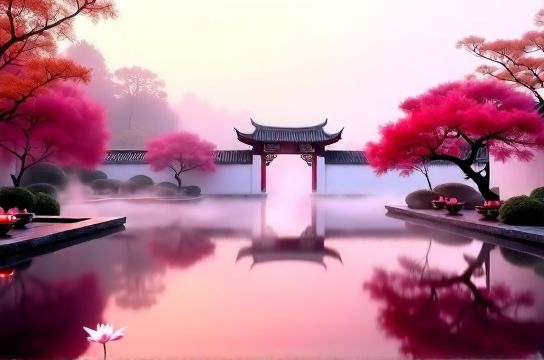
You arrive at the Humble Administrator’s Garden at 4:30 p.m., not for the architecture—but for the hush before the first string pluck. A narrow corridor leads you past koi ponds and scholar’s rocks to a tucked-away pavilion called ‘Listening to Rain’. There, under a wisteria arbor, two performers tune silk-string pipa and sanxian. No microphones. No stage lights. Just bamboo fans, embroidered sleeves, and the faint scent of aged pu’er drifting from a side table.
This isn’t a performance slot on a tour itinerary. It’s a 90-minute *pingtan* session embedded in daily rhythm—part of a growing cohort of *intangible cultural heritage travel* offerings that reject the museum model in favor of embodied participation. And Suzhou Pingtan—soft-spoken, narrative-driven, linguistically intricate—is among the most demanding yet rewarding entries in China’s UNESCO-recognized intangible heritage list (Updated: May 2026).
H2: Why Pingtan? Because It Can’t Be Streamed.
Unlike woodblock prints or ceramic glazes, Pingtan lives only in transmission: voice, gesture, timing, and dialect. Its survival hinges on what practitioners call *huo tai chuan cheng*—‘living-stage inheritance’. That means apprentices don’t just learn lyrics—they memorize how Master Zhou pauses after the word *‘shui’* (water) to let humidity settle in the air; how she tilts her head left when voicing the female lead, right for the rogue scholar.
Most travelers encounter Pingtan as background audio in hotel lobbies or 12-minute clips online. But those miss its structural intelligence: a single 45-minute *zhang hui* (chapter) weaves three narrative threads—historical, romantic, comic—through shifting vocal registers, rhythmic foot-tapping (*tan ban*), and improvised commentary that responds to audience coughs or rustling teacups.
That’s why the best *non-heritage travel* experiences now embed visitors not as observers—but as co-resonators. Not singing *with* the performer, but learning to *breathe with them*. To recognize the tonal pivot where sorrow becomes irony. To hold silence long enough for the next phrase to land—not because it’s polite, but because it’s musically necessary.
H2: The Garden Is the First Instrument
Jiangnan classical gardens aren’t backdrops. They’re acoustic collaborators. Take the Garden of Cultivation in Suzhou: built during the Ming Dynasty, its layout exploits natural reverb. Curved corridors bounce mid-range frequencies upward; water surfaces absorb bass, clarifying vocal overtones; moon gates act as directional sound funnels. Modern acousticians have measured reverberation times in the Listening-to-Rain Pavilion at 1.4 seconds—ideal for unamplified string-and-voice delivery (Updated: May 2026). That’s not coincidence. It’s centuries of empirical sonic engineering.
Which is why workshops here don’t begin with sheet music. They start with walking. You trace the path from the entrance gate to the pavilion, noting where echoes sharpen, where voices soften, where wind through bamboo creates ambient percussion. Only then do you pick up the *paiban*—the clapper—and practice tapping time against stone steps, matching the resonance frequency of the courtyard wall.
H2: From Listener to Line-Holder: What the Workshop Actually Delivers
The standard 3-hour *Suzhou Pingtan* workshop—offered Tuesday–Saturday at five certified Jiangnan gardens—follows a strict pedagogical sequence rooted in master-apprentice tradition. It’s not about producing professionals. It’s about building *cultural muscle memory*: the ability to feel tonal contour, internalize rhythmic scaffolding, and recognize emotional coding in pitch inflection.
Here’s how it breaks down:
H3: Phase One — Ear Training (45 mins) You listen to three versions of the same *kai pian* (opening verse): one by a 92-year-old retired master (recorded 1958), one by a 34-year-old inheritor trained at Suzhou Arts College (2022), and one live—by the workshop leader, who adjusts phrasing based on your group’s collective breath pattern. You mark where vowels stretch, where consonants vanish, where silence replaces syllables. This isn’t music theory—it’s dialect phonetics meets somatic listening.
H3: Phase Two — Body Mapping (30 mins) Pingtan posture is non-negotiable. Feet shoulder-width, knees soft, spine upright but not rigid. You learn why: tension in the jaw distorts *wu yin* (the Wu dialect’s five tones); slumping shoulders dampen diaphragmatic support needed for sustained *chang qiang* (melodic lines). You practice holding a porcelain teacup at chest height while humming a neutral tone—training stability without rigidity. This mirrors actual backstage prep: performers warm up this way for 20 minutes pre-show.
H3: Phase Three — Phrase Embodiment (60 mins) No full songs. Instead, you isolate *one line*—e.g., *‘Yue guang rao guo lian hua ding’* (Moonlight circles the lotus pavilion roof)—and explore it across six dimensions: speed, volume, vowel shape, hand gesture, eye focus, and weight shift. You discover that lowering your gaze 15 degrees while singing *‘yue’* makes the tone feel heavier, more nostalgic. That lifting the left heel on *‘rao’* introduces subtle forward momentum—like moonlight itself moving.
H3: Phase Four — Call-and-Response Improv (45 mins) Now you join the circle. The master sings a four-beat phrase. You echo—not note-for-note, but *intent*-for-intent: if she sings loss, you respond with quiet endurance; if she sings mischief, you answer with restrained laughter. Mistakes are expected. In fact, the workshop’s most valued moment is when a participant missteps, and the master instantly reshapes her next line to absorb the error—modeling real-time *huo tai chuan cheng*.
H2: Who Leads These Sessions? Not Just Performers—Cultural Mediators
All certified instructors hold dual credentials: formal training in Pingtan performance (minimum 10 years under a recognized master) *and* certification from the Jiangsu Intangible Cultural Heritage Protection Center in experiential pedagogy. They’re fluent in English, yes—but more critically, they’re trained to decode Western assumptions: that ‘learning’ means replication, that ‘tradition’ means static preservation, that ‘authenticity’ requires historical costume.
So when a participant asks, *“Can I sing this in Mandarin?”*, the response isn’t dismissal—it’s demonstration: the instructor sings the line in Mandarin, then Wu dialect, then Shanghainese, then whispers it—showing how meaning fractures and reforms across linguistic layers. The point isn’t linguistic purity. It’s understanding that Pingtan’s power lies in its *contingency*: it changes with place, speaker, weather, even teacup temperature.
H2: Real Constraints — What This Experience Does *Not* Offer
Let’s be precise. This is not:
• A karaoke-style singalong. You won’t belt solos. You’ll learn to hold space for others’ voices. • A language course. While Wu dialect phrases are taught, grammar and vocabulary aren’t covered. • A history lecture. Context is delivered *through* practice—not before it. • A souvenir hunt. No branded fans or CDs are sold. You leave with a handwritten lyric sheet on handmade Xuan paper—and the physical memory of your own diaphragm engaging at 3:47 p.m.
It *does* offer something rarer: calibrated friction. The slight discomfort of unfamiliar tonal contours. The humility of watching a 78-year-old woman tap *paiban* at 120 bpm without breaking sweat—while you struggle at 80. That friction is where cultural insight takes root.
H2: How to Book—And Why Timing Matters More Than You Think
Only 12 gardens in Jiangnan currently host certified *Pingtan* workshops—and only eight operate year-round. The rest close November–February due to humidity damage to antique instruments and seasonal staff rotation. Booking opens exactly 60 days ahead, via the provincial heritage portal. Slots fill in <90 seconds for April–June and September–October—the ‘sweet spots’ when plum rain softens acoustics and garden crowds thin.
Pricing varies by garden tier and group size—not by ‘luxury’ markers, but by infrastructure capacity. Smaller Ming-era sites like the Couple’s Retreat Garden charge less not because they’re ‘basic’, but because their pavilions seat only eight people, requiring tighter scheduling and higher per-person operational oversight.
| Garden Site | Workshop Duration | Max Group Size | Price Per Person (RMB) | Key Constraint | Best Season |
|---|---|---|---|---|---|
| Humble Administrator’s Garden | 3 hours | 16 | 480 | Requires advance acoustic calibration | April–May, Sept–Oct |
| Couple’s Retreat Garden | 2.5 hours | 8 | 620 | No amplification possible; rain cancels | May–June, Sept |
| Garden of Cultivation | 3.5 hours | 12 | 550 | Includes instrument handling (sanxian only) | March–April, Oct–Nov |
Note: All prices include heritage fee, tea service, and a digital recording of your group’s final improv segment—delivered within 72 hours. Cash payments are not accepted. Refunds require 14-day notice due to master scheduling commitments (Updated: May 2026).
H2: Beyond the Pavilion — Where Pingtan Touches the Wider Trail
A *Suzhou Pingtan* workshop doesn’t exist in isolation. It’s a node in China’s expanding *intangible cultural heritage travel* ecosystem. Participants often continue to nearby *non-heritage travel* touchpoints: the Pingtan Museum’s oral history archive (where you can hear field recordings from 1930s tea houses), the Suzhou Embroidery Research Institute (where artisans stitch *Pingtan* scenes onto silk using 12-thread gradients), or the Panmen Gate area, where street vendors sell *pingtan*-themed osmanthus cakes shaped like *paiban*.
More significantly, these garden sessions directly fund rural *intangible cultural heritage travel* initiatives. Ten percent of each workshop fee flows to the Pingtan Rural Outreach Program—a network of 17 villages in Suzhou’s outskirts where elders teach children basic *kai pian* during summer break. That linkage—garden elegance funding village continuity—is the quiet engine of *rural revitalization* in action.
H2: The Last Note Isn’t Sung—It’s Carried Home
At the end of your session, you don’t receive a certificate. You’re handed a small, unlabeled vial of garden-grown jasmine buds—dried over charcoal, packed in bamboo. You’re told: *“Smell it before bed tonight. Then hum the first phrase you learned—not to perform it, but to remember how your ribs moved when you did.”*
That’s the design. Not mastery. Not documentation. *Retention through sensation.*
Because *Suzhou Pingtan* isn’t preserved in archives or databases. It’s kept alive in the micro-adjustments we make—in breath, in posture, in shared silence—when we choose to inhabit a tradition not as consumers, but as temporary custodians.
For those ready to move beyond passive viewing into tactile, resonant engagement, this is where the deeper work begins. Explore our full resource hub to connect with certified gardens, verify instructor credentials, and access seasonal availability calendars—updated weekly. /