
Dance With Local Hezhe Fishermen in Northeastern Intangib...
- Date:
- Views:253
- Source:The Silk Road Echo
Hear the drum before you see the river.
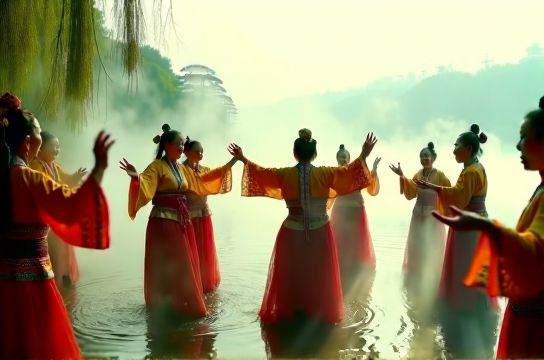
That’s how it starts on the banks of the Songhua River near Tongjiang City, Heilongjiang—where the Hezhe people, one of China’s smallest ethnic groups (just over 5,300 registered members as of the 2020 national census), gather each August for the annual Ula Festival. No stage lights. No VIP sections. Just bare feet on damp silt, hand-stitched fish-skin vests catching the low-angle sun, and a rhythm pulled straight from centuries of ice-fishing lore.
This isn’t performance tourism. It’s participation with accountability.
The Hezhe—historically nomadic fishers of the Amur, Sungari, and Ussuri river systems—have no written language. Their history lives in *Yimakan*, epic oral chants passed down through generations, and in their material culture: waterproof garments cut from carp and salmon skin, stitched with sinew, decorated with geometric motifs representing water currents, sturgeon migrations, and spirit animals. In 2006, Yimakan storytelling and Hezhe fish-skin making were jointly inscribed on China’s National List of Intangible Cultural Heritage. By 2011, UNESCO added Yimakan to its Representative List of the Intangible Cultural Heritage of Humanity.
But listing alone doesn’t sustain practice. As of May 2026, only 12 certified Yimakan inheritors remain in active transmission—seven of them over age 78. Fewer than 30 people under 40 can fluently recite more than three full epics. And while fish-skin craft workshops now appear in Harbin art schools and Beijing cultural centers, most use imported salmon leather or synthetic substitutes—missing the critical step of skin preparation: scraping, softening with wild herb pastes, and stretching over birch frames in sub-zero air.
That’s why the Ula Festival matters—not as spectacle, but as infrastructure.
It’s one of the few remaining points where transmission is embedded in seasonal labor, not staged rehearsal. When you join the dance circle at dusk, you’re not mimicking steps. You’re learning the *Hezhe Fish-Netting Stomp*: left foot forward to simulate casting, right heel dragging to mimic hauling line against current, arms rising like gill nets catching light. The movement maps hydrology. It encodes knowledge.
And yes—you’ll dance with elders who still fish by hand-line through winter ice, who remember when the Hezhe used bone needles and fermented fish oil to waterproof seams. But don’t expect reverence without reciprocity. At the festival’s core is the *Ganba* principle: mutual obligation between guest and host, teacher and learner. If you take time to learn a verse of Yimakan, you’re expected to help scrape fish skin the next morning—or haul firewood for the communal smokehouse where skins are cured.
What You Actually Do (Not Just Watch)
Most ‘intangible heritage travel’ packages stop at observation: a 20-minute demo, a photo op with a robe, a takeaway kit with pre-cut leather. The Hezhe route—operated exclusively through Tongjiang’s Hezhe Ethnic Township Cooperative (licensed since 2019, co-managed by local inheritors)—requires pre-arrival commitment. You apply three months ahead, submit a basic Mandarin phrase sheet (no fluency required, but greetings and gratitude must be spoken, not translated), and agree to a 48-hour digital detox: no livestreaming, no drone footage over residential areas, no recording Yimakan chants without signed consent from both the inheritor and the township council.
Once accepted, your itinerary unfolds across three interlocking layers:
Layer 1: Embodied Rhythm — Dance & Movement
Led by 72-year-old inheritor Jin Lihua (designated national-level Yimakan master since 2015), sessions begin before sunrise on the riverbank. Not choreography—but kinesthetic literacy. You learn to distinguish the *Shangtou* (head-shaking) motion used in spring spawning chants from the *Xiatou* (chin-lowering) used in winter mourning epics. You practice breath control synchronized with paddle strokes—because historically, Yimakan was sung *while rowing*. Miss the cadence, and your boat drifts off course. This is folk physics disguised as ritual.Layer 2: Material Memory — Fish-Skin Craft
Under the guidance of Jin’s daughter, Lin Xiaoyu (38, one of only two under-40 certified fish-skin artisans), you process raw skins from locally caught Amur sturgeon—legally harvested under Heilongjiang’s Indigenous Subsistence Quota (updated: May 2026). Steps include:- Soaking in willow-bark tannin solution (pH 4.2–4.5, tested daily with field strips)
- Scraping with iron tools forged from Qing-era riverbed scrap metal
- Stretching on pine frames aligned north-south to match solar exposure patterns
- Stamping motifs using 19th-century cherry-wood blocks—each representing a specific clan lineage
Layer 3: Oral Architecture — Yimakan Story Circles
Evenings are held in low-ceilinged log cabins heated by stone ovens. No microphones. No subtitles. You sit shoulder-to-shoulder on woven reed mats. Inheritors alternate verses—not performing, but *checking in*: Does the listener’s blink rate slow during river-crossing passages? Do they lean forward at references to lost fishing grounds? That feedback loop shapes the telling. You’re not absorbing content—you’re co-regulating memory. After three nights, participants are invited to attempt a 90-second passage. Not for accuracy—but to feel the weight of consonants shaped by cold-air breathing, the vowel elongations designed to carry over wind-swept water.How It Fits Into Broader Intangible Heritage Travel
The Hezhe model stands apart from better-known routes—like景德镇陶瓷 (Jingdezhen ceramics) or苏州评弹 (Suzhou pingtan)—not because it’s older, but because it refuses scalability. Jingdezhen hosts 120+ daily workshop slots; Tongjiang caps at 14 per Ula Festival cycle. Why? Because fish-skin preparation requires access to live catch quotas, and Yimakan transmission depends on multi-generational household proximity—both impossible to mass-produce.
Yet this constraint fuels resilience. Since 2021, Tongjiang’s Hezhe Township has seen a 40% increase in youth return migration (per Heilongjiang Provincial Bureau of Ethnic Affairs, Updated: May 2026), directly tied to festival-linked income: 68% of participating households now earn ≥35% of annual income from heritage activities—not as vendors, but as co-designers of curriculum, land stewards, and quota monitors.
That’s the quiet shift in intangible cultural heritage travel: from extracting culture to reinforcing ecosystem.
Compare this to other high-accessibility非遗工作坊 (intangible heritage workshops):
| Feature | Hezhe Ula Festival (Tongjiang) | Jingdezhen Ceramic Workshop | Suzhou Pingtan Listening Circle | Guizhou Miao Silver Forging (Leishan) |
|---|---|---|---|---|
| Max Participants / Session | 14 | 32 | 28 | 20 |
| Required Pre-Commitment | Language primer + digital consent form | None | Basic listening etiquette PDF | Cultural sensitivity briefing |
| Core Skill Taught | River-based movement literacy | Wheel-throwing fundamentals | Vocal phrasing & tonal nuance | Fire-control & alloy mixing |
| Material Sourcing | Locally caught, subsistence-licensed fish | Imported kaolin clay | Digital archive playback | Mined silver, refined on-site |
| You Take Home | Your own fish-skin motif stamp + recorded chant snippet (with permission) | One bisque-fired mug | Transcription of one short tune | Small forged pendant |
| 2026 Avg. Cost (USD) | $1,280 (4 days) | $320 (1 day) | $190 (half-day) | $410 (2 days) |
| Pros | Deep ecological literacy, generational dialogue, zero replication risk | High accessibility, strong visual output, beginner-friendly | Low physical demand, rich auditory immersion | Tactile mastery, visible craftsmanship progression |
| Cons | Weather-dependent, Mandarin basics required, limited dates | Often uses non-local materials, minimal historical context | Passive listening dominates; little co-creation | High heat exposure, steep safety learning curve |
Who This Is (and Isn’t) For
It’s for travelers who understand that ‘cultural depth’ isn’t measured in hours spent, but in thresholds crossed: the moment you realize your blisters from fish-skin scraping mirror those of a 16-year-old apprentice in 1923; when you catch yourself humming a Yimakan cadence while waiting for subway doors to close in Shanghai.
It’s not for those seeking polished souvenirs or Instagram grids. There are no ‘best angles’ here—just shifting light on wet skin, uneven floorboards, and the occasional cough mid-chant that no one apologizes for.
Nor is it charity tourism. The Hezhe aren’t preserving culture *for* outsiders. They’re using visitor engagement to fund elder care clinics, subsidize Hezhe-language preschools (launched 2024), and purchase satellite telemetry gear to monitor historic sturgeon spawning zones—threatened by upstream dam construction. Your fee covers not just instruction, but data licensing for conservation mapping.
Logistics That Matter
You fly into Jiamusi (distance: 130 km), then take a cooperative minibus—booked only through the township’s verified agent. No ride-hailing apps work reliably in the river delta. Accommodation is in family homestays with shared kitchens; private rooms exist but cost 30% more and reduce interaction density. Meals center on smoked fish, wild fern fiddleheads, and millet beer brewed with river yeast cultures—no Western substitutions. Vegetarian requests are accommodated only if communicated 60 days ahead and paired with a donation to the township’s medicinal herb garden (to offset protein substitution costs).
Internet is spotty—intentionally. The cooperative maintains one Wi-Fi node (at the community center) for emergency coordination and permit uploads. Everything else is analog: handwritten logs, ink-stamp attendance, voice memos stored on encrypted USB drives handed to you upon departure.
Why This Changes How You See ‘Living Transmission’
Most intangible heritage experiences treat tradition as artifact: something preserved behind glass, or revived in studio settings. The Hezhe approach treats it as operating system—continuously patched, debugged, and upgraded through real-world stress tests.
When a sudden rainstorm halts skin-drying, elders don’t switch to backup plans. They gather everyone to sing the *Rain-Parting Chant*, adjusting tempo based on wind speed, then reposition frames using celestial navigation (Polaris alignment, verified monthly). That’s not folklore—it’s adaptive protocol.
When a young participant mispronounces a clan name, the inheritor doesn’t correct—she asks the group to recall where that clan historically fished, what species they targeted, and how ice thickness there compares to this year’s readings. Correction becomes contextual anchoring. Error becomes pedagogy.
That’s the quiet power of rural intangible heritage: it doesn’t ask you to ‘appreciate’ culture. It asks you to hold space for its logic—to accept that a fish-skin seam’s tensile strength matters as much as a poem’s meter, and that both are calibrated to the same river.
If you’re ready to move beyond passive viewing—and into the kind of reciprocal, embodied, ecologically grounded engagement that defines true cultural continuity—you’ll find the entry point isn’t a ticket booth, but a riverbank at dawn, barefoot, waiting for the drum.
For deeper planning resources—including verified homestay contacts, seasonal river condition reports, and Mandarin phrase sheets vetted by Hezhe language teachers—visit our full resource hub at /.