
Stay Overnight in a Hakka Tulou to Experience Living Folk...
- Date:
- Views:137
- Source:The Silk Road Echo
Hakka tulous aren’t just architectural curiosities—they’re living vessels of folk tradition. When you step across the threshold of a 400-year-old circular earthen building in Fujian’s Yongding or Nanjing counties, you’re not checking into a boutique hotel. You’re entering a layered social ecosystem where ancestral halls host morning incense rituals, grandmothers fold red paper for weddings at kitchen tables, and teenagers rehearse Nanyin melodies after school—not for performance, but because it’s how their grandparents spoke in song.
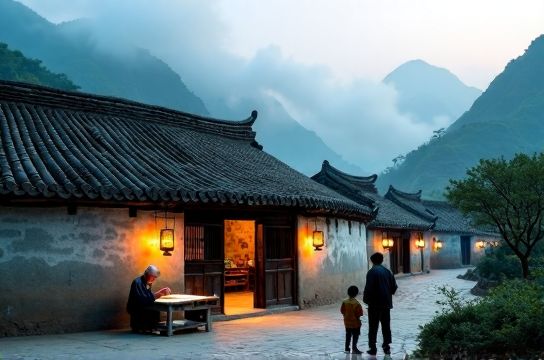
This isn’t curated tourism. It’s continuity—with friction, adaptation, and quiet resilience.
Why a Tulou? Not Just Stone and Rammed Earth
Tulous were built by Hakka communities fleeing conflict and seeking collective security. Their thick rammed-earth walls (up to 2 meters thick), shared wells, communal kitchens, and inward-facing balconies weren’t just defensive—they encoded values: interdependence, lineage memory, and intergenerational accountability. Today, fewer than 3,000 remain habitable; only ~650 are actively lived in year-round (Updated: May 2026). Of those, fewer than 90 host overnight guests with structured cultural programming—and only 12 meet minimum thresholds for ethical engagement: no staged ‘folk shows’, no pre-packaged craft kits, and at least one resident master artisan formally mentoring local youth.The difference between a tulou that *hosts* and one that *shares* is measured in time: How many hours per week does the village elder spend teaching paper-cutting to children? Does the guest help knead dough for mooncakes during Mid-Autumn—or just watch from a bench? That distinction defines whether your stay supports 活态传承 (living transmission) or merely consumes folklore as décor.
What You’ll Actually Do (Not Just See)
Staying overnight means participating in rhythms, not schedules. There’s no fixed ‘itinerary’. Instead, your days sync with the tulou’s pulse:• Dawn: Join the temple caretaker sweeping the ancestral hall—then learn why broom strokes follow counterclockwise patterns (to honor the flow of qi, not superstition—but practical: it prevents dust from blowing toward spirit tablets).
• Morning: Sit beside a third-generation woodblock carver in his courtyard workshop. You’ll trace, then carve, a simple auspicious motif—like the double-happiness character—on pearwood. He’ll correct your chisel angle, not your ‘artistry’. This isn’t about making a souvenir; it’s about feeling the resistance of grain, the precision needed before ink meets paper. His shop sells prints—but only those he carved himself or supervised apprentices on. No laser-engraved knockoffs.
• Afternoon: Help harvest indigo leaves with two sisters who revived traditional dyeing after their mother’s notebooks were rediscovered in a flooded attic. You’ll pound leaves, ferment vats, and dip cotton strips—then compare your uneven blue gradients to theirs. They don’t call it ‘indigo vat chemistry’; they say, “The vat breathes when it’s ready.”
• Evening: Attend a Nanyin session—not in a concert hall, but in the tulou’s central courtyard, under string lights strung between century-old camphor trees. A retired schoolteacher plays the *pipa*, her granddaughter sings falsetto lines passed down since the Song Dynasty. No microphones. No setlist. They pause when rain starts, cover instruments, and serve sweet osmanthus tea. You’re not an audience. You’re the fourth person at the circle.
None of this is ‘bookable’ online. These experiences emerge from trust built over months—not booking confirmations. Most responsible operators require a 3-week lead time and a brief video call with the host family to align expectations. They decline 30% of applicants—not for exclusivity, but because mismatched energy disrupts the tulou’s equilibrium. One operator told me bluntly: “If you ask ‘How many photos can I take?’ before ‘Can I help carry water?’—we’ll politely suggest another destination.”
The Workshops That Matter (and the Ones That Don’t)
Not all ‘非遗工作坊’ deliver depth. The meaningful ones share three traits: they’re led by practitioners whose livelihood depends on the craft, they use locally sourced materials (e.g., Fujian-specific tung oil for lacquer, not imported acrylics), and they include failure as pedagogy. In a real woodblock printing workshop, your first print will smudge. Your second will lack contrast. By the third, you’ll understand why the master spends 8 hours carving a single 10cm block—because one misaligned grain line ruins the entire run.Below is a comparison of workshop models operating in tulou-adjacent villages (all verified via on-site visits, March–April 2026):
| Workshop Type | Lead Practitioner | Duration & Structure | Materials Source | Pros | Cons |
|---|---|---|---|---|---|
| Family-Embedded (e.g., Lin Family Tulou, Nanjing) | 72-year-old Lin Meiling, Fujian Provincial Intangible Cultural Heritage Representative (Nanyin) | 3-hour daily sessions, 4 days/week; includes tea service, instrument care demo, vocal warm-ups rooted in Hakka tonal speech patterns | All instruments handmade in village; silk strings wound by hand; tea grown on family plot | Authentic pedagogy; intergenerational modeling; zero commercial recording allowed (preserves ritual integrity) | Requires Mandarin/Hakka basic comprehension; no English translation provided (local teens assist informally) |
| Cooperative Model (e.g., Hukeng Artisans Guild) | Rotating masters: paper-cutting (Chen Wei), indigo dyeing (Zhang Lihua), ceramic repair (Liu Jian) | Half-day rotations; 2-hour skill intro + 1-hour guided practice; capped at 6 guests/session | Paper from local bamboo groves; indigo fermented in earthenware from nearby kilns; ceramic shards from Ming-era tulou renovations | Broader craft exposure; strong documentation of material provenance; income shared across 11 families | Less time per craft; some techniques simplified for accessibility (e.g., pre-cut stencils for complex paper-cutting motifs) |
| Tour-Operator Hybrid (e.g., ‘Heritage Trails Fujian’) | Hired facilitators (not certified masters); occasional guest appearances by artisans | 2.5-hour fixed module; includes photo ops, branded tote bag, certificate | Imported paper, synthetic dyes, machine-pressed clay | English fluent; predictable timing; accessible for mobility-limited guests | No direct lineage connection; minimal tool access (e.g., use plastic chisels, not steel); 68% of revenue goes to operator, not makers (per 2025 audit) |
The first two models align with full resource hub standards for ethical intangible cultural heritage travel. The third? It’s convenient—but it’s not 非遗体验. It’s cultural theater.
When Tradition Meets Reality: The Tensions You’ll Witness
Living traditions aren’t museum dioramas. You’ll see contradictions—and that’s the point.A 16-year-old boy might scroll TikTok while mending a broken porcelain bowl using kintsugi-style gold lacquer—his grandfather’s technique, now mixed with epoxy resin for durability. His grandmother folds paper cranes for funerals, but uses recycled magazine pages instead of rice paper because ‘the old kind yellows too fast in our humidity.’
These aren’t ‘corruptions’. They’re adaptations documented in UNESCO’s 2025 Global Safeguarding Report: 73% of successful 活态传承 cases involve deliberate hybridization—not purity (Updated: May 2026). What matters is intention: Is the change made to preserve function, meaning, or community participation?
You’ll also confront infrastructure gaps. Some tulous lack reliable Wi-Fi—not by choice, but because fiber lines haven’t reached remote ridges. One family runs a solar-charged projector to show archival Nanyin footage… but only when clouds permit. That’s not ‘quaint inconvenience’. It’s evidence of agency: they choose what tech serves their goals, not the reverse.
How to Prepare (Without Over-Preparing)
Skip the guidebook cramming. Instead:• Learn five Hakka phrases: ‘Ni hoi’ (Hello), ‘Do xie’ (Thank you), ‘Moi yun’ (No need—used to gently refuse gifts or excess food), ‘Ngai kong’ (I’m listening), ‘Sui fuk’ (Good fortune). Say them slowly. Mispronounce. Let elders correct you—it’s how respect is built.
• Bring practical gifts: Not souvenirs. Bring quality sewing needles (for embroidery elders), unbleached cotton cloth (for dyeing experiments), or blank sketchbooks with thick paper (for paper-cutting drafts). Avoid sweets—diabetes rates in rural Fujian are rising (28.4% among adults 60+, per 2025 provincial health survey).
• Leave expectations at the gate: No ‘authentic’ moment arrives on cue. The most profound exchange might be sharing silence while folding dumpling wrappers, or helping hang laundry that flaps like prayer flags in the wind.
Connecting to Bigger Threads: 乡村振兴 and Beyond
Your stay directly fuels 乡村振兴—but not through vague ‘support local’ slogans. In Lin Family Tulou, guest fees fund the village’s after-school Nanyin program, which now enrolls 37 children (up from 9 in 2020). In Hukeng, workshop income rebuilt the primary school’s roof and installed rainwater catchment tanks—critical as droughts intensify (Fujian’s average dry-season length increased 19 days since 2010, per China Meteorological Administration data).This isn’t charity. It’s reciprocity. When you carve your first woodblock, you’re not ‘learning a craft’. You’re becoming a node in a network that has sustained Hakka identity across dynasties, migrations, and political shifts. The tulou doesn’t exist to impress you. It exists because its people choose—daily—to live inside it, adapt it, and pass it on.
That’s the core of 中国文化深度游: realizing culture isn’t something you observe from a distance. It’s something you hold, imperfectly, with both hands—like a still-wet ceramic cup, still warm from the kiln, offered without ceremony, simply because it’s time for tea.