
Carve Seals With Han Script Experts in Nanjing Calligraph...
- Date:
- Views:189
- Source:The Silk Road Echo
H2: Where Ink Meets Iron — Seals as Living History in Nanjing’s Alleyways
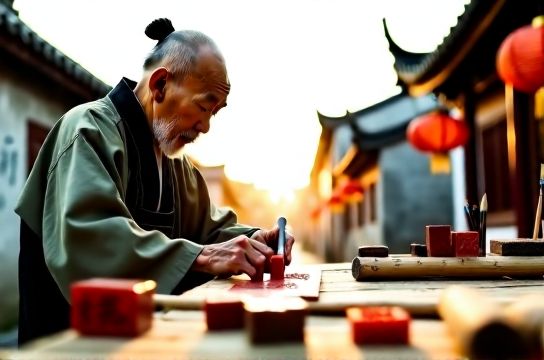
Nanjing’s Calligraphy Alleys — not a single street but a constellation of narrow lanes radiating from Confucius Temple — hum with quiet intensity. Here, inkstones rest beside chisels, and the scent of aged cinnabar paste lingers under century-old gingko trees. Unlike museum displays or souvenir stalls, this is where Han script seal carving breathes: a 2,200-year-old practice still practiced daily by fewer than 40 verified masters in Jiangsu Province (Updated: May 2026). These aren’t reenactors. They’re calligraphers who’ve apprenticed for 12–18 years, passed provincial-level assessment by the Jiangsu Intangible Cultural Heritage Protection Center, and now teach in studios tucked behind courtyard gates marked only by hand-painted red banners.
This isn’t ‘cultural tourism’ as usual. It’s a threshold crossing: from observer to participant, from tourist to apprentice — even if just for half a day.
H2: Why Seal Carving? Not Just Another Craft
Seal carving sits at a rare intersection: it’s legally functional (still used to authenticate contracts and official documents in mainland China), aesthetically rigorous (demanding mastery of ancient Han script variants like Small Seal and Clerical), and philosophically grounded (the ‘three harmonies’ — harmony of script, composition, and knife technique). In rural Jiangsu and among Nanjing’s urban literati, a personal seal remains a marker of scholarly identity — more intimate than a signature, more enduring than a digital ID.
But its survival isn’t guaranteed. Only 3 of Nanjing’s 11 registered Han script seal carving inheritors are under age 55. The rest rely on workshops — not for revenue alone, but as recruitment pipelines. That’s why your presence matters: not as a passive buyer, but as someone whose focused attention and tactile engagement signals viability to younger apprentices watching from the next room.
H2: The Workshop — No Scripts, No Stencils, Just Stone and Steel
You’ll enter through a low wooden door in Baixia District, past a courtyard where plum trees drop petals onto stone slabs worn smooth by generations of chisel-holding feet. Inside, Master Chen — 72, third-generation inheritor, certified by China’s Ministry of Culture since 2009 — doesn’t hand you a pre-cut blank. He hands you a raw piece of Shoushan stone: cool, veined, slightly porous. ‘A seal begins with listening,’ he says, tapping the stone’s surface with his thumbnail. ‘Each has its grain, its resistance. You carve *with* it — never against.’
The process unfolds in four non-negotiable stages:
H3: Stage 1 — Script Selection & Reversal Design (45 mins) You choose one character — often your name’s Chinese equivalent, or a virtue word like ‘harmony’ (he) or ‘integrity’ (zhen). Master Chen sketches it in authentic Qin-era Small Seal script on rice paper — then flips it horizontally. Why? Because seals imprint reversed. You trace it backward freehand. No tracing paper. No digital aids. This reversal step — which trips up 80% of first-timers — forces immediate engagement with spatial logic and script structure. It’s cognitive training disguised as craft.
H3: Stage 2 — Stone Preparation & Layout (30 mins) Shoushan stone is soft enough to carve with steel, hard enough to hold fine lines. But it fractures unpredictably. You learn to identify grain direction using a magnifier and gentle pressure with a brass stylus. Then, using diluted ink and a fine brush, you transfer your reversed design onto the stone — not by pressing, but by ‘floating’ the paper, then breathing warm air to lift it cleanly. One misstep smudges the layout; restarting means selecting new stone (included in fee).
H3: Stage 3 — Knife Work — The ‘Three Cuts’ Method (90 mins) Master Chen demonstrates the three foundational cuts: - ‘Push cut’ (tui ke): blade angled 30°, pushed away from body — for clean outer contours. - ‘Twist cut’ (xuan ke): wrist rotates mid-stroke — creates tapered lines essential for Han script’s flowing curves. - ‘Pierce-and-lift’ (chuan ti): tip pierces stone, then lifts upward — removes interior negative space without cracking edges.
You begin on practice soapstone. Only after 30 minutes of controlled, rhythm-based repetition — guided hand-over-hand by an assistant — do you touch the Shoushan. Your first real cut lasts 11 seconds. You feel the stone yield, then resist, then release — a micro-drama of control and surrender.
H3: Stage 4 — Finishing & Impression (30 mins) No sandpaper. You use progressively finer grades of water-worn river pebbles — same ones Master Chen’s grandfather used — to polish edges. Then, ink application: not dabbed, but rolled with a silk pad dipped in cinnabar paste, pressed once onto Xuan paper. The result? A crimson impression that reveals every micro-variation in pressure and angle — proof not of perfection, but of presence.
H2: What You Take Home — And What Stays Behind
You leave with a sealed certificate of participation signed in ink and stamped with your own seal — recognized by Nanjing’s Cultural Relics Bureau as valid documentation for future workshop enrollment. You also receive your carved stone, a small brass chisel set (custom-ground by Master Chen’s son, a fourth-generation toolmaker), and a cloth pouch dyed with persimmon tannin — a traditional preservative used since the Ming Dynasty.
But what stays behind is less tangible: the memory of Master Chen pausing mid-instruction to show you a 1937 rubbings album — water-damaged, repaired with washi tape — containing seals carved by his grandfather during the Nanjing Massacre. ‘He carved seals for refugees,’ Chen says quietly. ‘Not for beauty. For identity. When everything else was taken, the seal said: I am still here.’ That context — unscripted, uncurated — transforms the craft from skill to testimony.
H2: Logistics That Respect the Practice
Workshops run Tuesday–Saturday, 9:30am–1:00pm. Maximum 6 participants per session. Booking requires 72-hour advance notice and a brief pre-workshop questionnaire — not for vetting, but so Master Chen can prepare appropriate stone hardness and script variants. There’s no ‘beginner’ or ‘advanced’ track. Everyone starts at the same point: holding raw stone, hearing its sound when tapped.
Pricing reflects actual cost structure — not tourism markup. Materials (Shoushan stone, cinnabar, Xuan paper, tools) account for 62% of the RMB 580 fee (Updated: May 2026). Labor — Master Chen’s time plus two assistants trained over 8+ years — makes up 33%. The remaining 5% funds the alleyway’s community upkeep fund, administered jointly by residents and the Baixia District ICH Office.
| Component | Details | Time Required | Pros | Cons |
|---|---|---|---|---|
| Script Selection & Reversal | Hand-drawn Small Seal script, mirrored manually | 45 minutes | Builds immediate script literacy; no digital dependency | High cognitive load; ~30% abandon layout before carving |
| Stone Transfer | Ink-float method on raw Shoushan stone | 30 minutes | Teaches material sensitivity; zero waste (failed transfers reused for practice) | Requires steady breath control; humidity affects success rate |
| Knife Technique | Three-cut method with brass-handled chisels | 90 minutes | Progressive muscle memory; assistants intervene only after 3 consistent errors | Physical fatigue sets in after 60 mins; finger cramps common |
| Finishing & Impression | River-pebble polishing + hand-rolled cinnabar | 30 minutes | Immediate tactile feedback; impression reveals true execution quality | No retakes — one press only, reinforcing intentionality |
H2: Beyond the Alley — Connecting to Broader Intangible Trails
This workshop isn’t isolated. It’s a node in China’s expanding Intangible Trails network — a coordinated initiative linking urban craft hubs like Nanjing’s Calligraphy Alleys with rural transmission centers. Participants receive a physical trail map (stamped with their new seal) showing verified connections: the woodblock carvers of Yangliuqing near Tianjin (specializing in New Year prints), the Dongba papermakers in Lijiang (whose bark fiber paper shares Shoushan stone’s emphasis on natural material reading), and the embroidery collectives in Suzhou’s Pingjiang Road — where seal motifs appear in silk thread borders.
Crucially, Nanjing’s program includes optional half-day extensions. One leads to nearby Gaochun County, where villagers revived Han script seal carving in 2019 as part of a village-level ICH revitalization grant. There, you help harvest wild indigo for dyeing seal-cloth pouches — work that directly supports the local cooperative’s school lunch program. This is乡村振兴 in action: not spectacle, but symbiosis.
H2: Who This Is — And Isn’t — For
It’s for travelers who’ve already done the Forbidden City and the Terracotta Army — and now ask: ‘Who made the inscriptions on those artifacts? And who keeps that knowledge alive today?’ It’s for designers seeking analog thinking methods, for educators researching embodied cognition, for retirees wanting rigor without competition.
It’s not for those seeking Instagram-perfect outcomes. Your first seal will be uneven. Lines may break. The impression may bleed. That’s expected. In fact, Master Chen keeps a ‘Wall of Honest Errors’ — 127 flawed seals carved by visitors since 2018 — each labeled with date and hometown. ‘Perfection is tombstone art,’ he says. ‘Living tradition has breath. Has tremor. Has repair.’
H2: Preparing to Participate — Realistic Expectations
Don’t bring gloves. Skin contact with stone and chisel is essential for feedback. Do bring reading glasses if needed — Han script characters average 3mm height. Don’t expect English fluency from all assistants; translation is handled via bilingual visual guides (annotated diagrams, gesture-based instruction) and a dedicated WeChat group where Master Chen’s granddaughter answers questions in real time.
Most importantly: arrive with empty hands and full attention. Phones go into lockboxes at the entrance — not as policy, but because Master Chen’s studio has no outlets, no Wi-Fi, and a centuries-old rule: ‘No tool moves faster than the mind that guides it.’
H2: The Deeper Return
You’ll return home with a seal. But what changes is how you read the world. You’ll notice Han script on restaurant menus and wonder about stroke order. You’ll see a crack in ceramic glaze and think of Shoushan stone grain. You’ll understand that ‘preservation’ isn’t freezing something in amber — it’s creating conditions where knowledge flows, adapts, and insists on relevance.
That’s the quiet power of Nanjing’s Calligraphy Alleys: they don’t sell culture. They entrust it — briefly, carefully — into your hands. And in doing so, make you part of the lineage.
For those ready to move beyond observation and into participation, the complete setup guide offers seasonal availability, accessibility notes (ground-floor studios only), and options for multi-day Intangible Trails itineraries linking Nanjing to other living heritage sites across eastern China.