
Weave Hemp Cloth With Zhuang Women:非遗旅行 in Guangxi
- Date:
- Views:190
- Source:The Silk Road Echo
Hemp cloth doesn’t smell like linen. It smells like river mud, boiled bark, and the faint tang of fermented ramie fiber — sharp, earthy, alive. When you sit cross-legged on a bamboo mat in Longji’s foothills, your fingers fumble with the warp threads stretched across a backstrap loom, and a Zhuang elder named Wei Meili places her palm over yours—not to correct, but to steady—your first shuttle pass is less about technique and more about consent: *You are now inside the rhythm.*
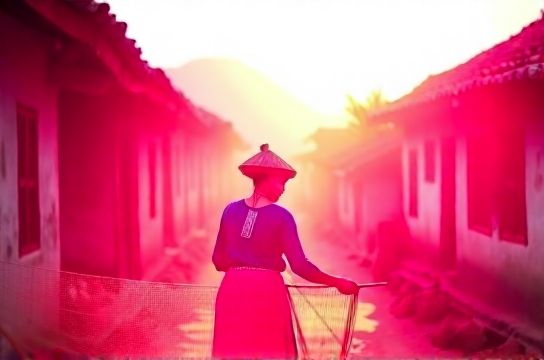
This isn’t a demo. It’s not a photo op staged for Instagram reels. This is 非物质文化遗产旅行 at its most grounded: weaving hemp cloth with Zhuang women in Guangxi’s northern villages, where textile knowledge hasn’t been archived—it’s been inherited, adapted, and quietly sustained across 42 generations.
The Loom Is Still Running
Guangxi’s Zhuang ethnic group accounts for over 90% of China’s hemp-weaving heritage—and yet, fewer than 87 master weavers remain who can complete the full process from field to finished cloth (Updated: May 2026). Most are women aged 62–89. Their workshops aren’t studios—they’re kitchens, verandas, or shaded courtyards where granddaughters kneel beside grandmothers to strip ramie stalks with bamboo knives, not steel.
Unlike silk or cotton, ramie requires no chemical softeners. Its fibers are naturally antibacterial, UV-resistant, and stronger when wet. But that strength comes at a cost: labor intensity. A single 1.5-meter bolt of handwoven hemp cloth takes 21 days—14 for fiber prep, 5 for warping and weaving, 2 for natural indigo dyeing using fermented Strobilanthes cusia leaves. That’s why commercial production collapsed in the 1980s. What survived did so because it was never meant for export—it was woven for weddings, funerals, and seasonal rites. The cloth held memory, not margin.
Today, the practice persists not through policy alone—but because of what locals call shou huo: “keeping the fire alive.” Not as museum exhibit, but as daily act: mending a child’s tunic, wrapping ancestral tablets, lining a newborn’s cradle. That continuity is what makes this one of China’s most credible 非遗体验 destinations—not because it’s picturesque, but because it’s necessary.
What You Actually Do (Not Just Watch)
Most “cultural tours” in Guangxi stop at observing batik or buying pre-woven scarves. This program—run by the Guangxi Zhuang Textile Revival Collective (GZTRC), a registered NGO since 2019—requires participants to commit to three non-negotiables:
• Pre-arrival literacy: You receive a bilingual glossary (Zhuang/English) covering 37 textile terms—including gvaq (the ritual tying of warp threads before weaving) and ndaej (the moment the first weft passes, marking entry into the cloth’s ‘life’). No translation apps. You memorize six core terms before arrival.
• No shortcuts in fiber prep: You harvest ramie stalks (May–July only), peel green bark by hand, soak fibers in rice-wash water for 72 hours, then beat them with wooden mallets until they separate into silky strands. Machines exist—but GZTRC bans them. “If your shoulders ache after beating fiber, you’ll remember why this cloth costs 3x organic cotton,” says Wei Meili.
• Weave one continuous piece: Not a coaster or bookmark. A 30 cm × 90 cm strip, using only backstrap looms (no foot pedals, no tension rods). You learn three foundational patterns: maez lai (zigzag, symbolizing mountain paths), byaek ndei (interlocking diamonds, for clan unity), and ndaw gai (water ripples, for resilience). Completion takes 3–5 days—most leave with 22–28 cm finished. That’s intentional. Mastery isn’t the goal; respect is.
Where It Happens (And Why It Matters)
The work happens across four villages near Jinxiu Yao Autonomous County—Baiyun, Chongli, Daping, and Nalong—each with distinct dialects, dye recipes, and warp-tensioning methods. These aren’t tourist enclaves. Electricity arrived in Baiyun in 2015. Mobile signal remains spotty. There’s no Wi-Fi password posted at the village entrance—just a chalkboard listing today’s communal tasks: “Fiber soaking – Wei Family Courtyard,” “Indigo vat stirring – Li Clan Shed.”
This is rural非遗 at scale: not curated for consumption, but cohabited. You sleep in family-run homestays where meals include fermented bamboo shoot soup and wild ginger tea—not “ethnic cuisine” platters. You join the morning fiber harvest walk, carrying baskets woven by the host’s mother. You hear Zhuang folk songs sung while beating ramie—not performed, but used as rhythmic anchors: one verse per 12 mallet strikes.
Crucially, this isn’t nostalgia tourism. Since 2021, GZTRC has partnered with Guangxi University’s Rural Design Lab to adapt traditional patterns for contemporary use—without dilution. A recent collaboration with Shanghai-based label Wu Lin Studio produced a limited run of hemp-blend workwear using maez lai motifs, with 100% of design royalties funding youth apprenticeships. Result? Three women aged 24–29 have now completed full-cycle training and launched their own micro-workshops. That’s乡村振兴 measured in looms reinstalled, not just grants disbursed.
Real Costs, Real Limits
This isn’t cheap. And it shouldn’t be. Below is a transparent breakdown of what a 6-day immersion includes—and excludes—based on 2025–2026 pricing (Updated: May 2026):
| Item | Details | Included? | Notes |
|---|---|---|---|
| Accommodation | Family homestay (shared room, private bathroom) | ✓ | Host families rotate monthly; no air-con, ceiling fans only |
| Fiber & Dye Materials | Ramie stalks, indigo vats, bamboo tools, natural mordants | ✓ | All sourced within 5km radius; no synthetic dyes permitted |
| Master Weaver Stipend | Direct daily payment to lead artisan (¥280/day) | ✓ | Set by GZTRC + village council; 30% higher than local avg wage |
| Transport | Shared minibus from Nanning airport → Baiyun (4.5 hrs) | ✓ | No private transfers; group departures only on Tue/Thu/Sat |
| Meals | 3 daily meals (vegetarian option available) | ✓ | Breakfast = glutinous rice balls; lunch/dinner = seasonal veg + protein |
| Documentation | Photo/video rights, digital archive access | ✗ | Requires separate ¥180 fee + signed ethics agreement |
| Take-Home Cloth | Your woven piece (unhemmed, undyed unless completed) | ✓ | Shipping not included; must carry or arrange locally (¥45–¥90) |
Pricing starts at ¥5,200 per person (2026 rate). Group size capped at 6. Minimum age: 16. No exceptions. Why? Because the physical demand—kneeling, bending, repetitive motion—is real. One participant with chronic lower-back pain withdrew on Day 2. That’s accepted. The program isn’t built for endurance records—it’s built for attention.
Why This Isn’t Like Other Handicraft Workshops
Compare this to standard 手工艺体验 offerings in Yangshuo or Lijiang: those often source pre-dyed threads, use simplified looms, and compress 5 days of work into 4 hours. Here, time is structural—not decorative. You don’t “finish” something. You enter a cycle already in motion. Your shuttle pass becomes part of a lineage—not a souvenir.
That distinction matters for 中国文化深度游. Depth isn’t measured in kilometers traveled, but in friction encountered: the sting of raw ramie sap on your palms, the frustration of misaligned weft, the silence when Wei Meili stops speaking Zhuang mid-sentence—not because she’s impatient, but because some knowledge lives only in muscle, not language.
This is also why GZTRC refuses partnerships with large travel platforms. They work exclusively through vetted cultural operators who sign binding ethics charters—no influencer discounts, no “VIP weaving slots,” no reshooting failed attempts. If your cloth unravels, it stays unraveled. That’s part of the record.
What Comes After the Loom
Leaving feels different here. You don’t just carry home a bolt of cloth. You carry calibration: a recalibrated sense of time, of value, of what “skill” actually demands. One returning participant—a textile designer from Berlin—spent 8 months reverse-engineering the indigo fermentation process before launching a zero-waste dye lab in Brandenburg. Another, a high-school history teacher from Toronto, redesigned her curriculum around “material literacy,” using hemp weaving to teach colonial trade routes and fiber colonialism.
That ripple effect is the quiet metric of success—not visitor numbers, but practice extension. GZTRC tracks alumni engagement: 68% report applying at least one technique in their professional work; 22% return within 18 months for advanced training (e.g., natural mordant formulation, warp-faced brocade). None of this is accidental. It’s designed into the pedagogy: every session ends with a “transfer protocol”—not a certificate, but a handwritten note from your master weaver listing three ways your learning might serve others.
How to Join (Without Disrupting)
Access is intentionally limited—and deliberately slow. There’s no online booking portal. You apply via email to GZTRC’s coordinator (contact listed on their verified WeChat account, not website). Applications require:
• A 200-word statement explaining why you seek this specific experience—not “I love crafts,” but “I need to understand how knowledge moves through hands when language fails.”
• Proof of prior engagement with textile traditions (e.g., photos of your own weaving, documentation of dye experiments, letters from mentors).
• Agreement to abide by the Zhuang Textile Ethics Compact, which includes clauses like: “I will not photograph faces without verbal permission granted in Zhuang,” and “I will not refer to this as ‘artisanal’—it is ancestral labor.”
Slots open twice yearly: March 1 and September 1. Waitlists average 14 months. That’s not a barrier—it’s a filter. The work isn’t for everyone. It’s for those who understand that holding a shuttle isn’t neutral. It’s alignment.
For those ready to move beyond observation into reciprocity, the full resource hub offers preparation timelines, linguistic primers, and ethical frameworks—all grounded in actual practice, not theory. It’s the only place where you’ll find the exact pH range for healthy indigo vats (9.2–9.6), or why ramie harvested before sunrise yields longer fibers (Updated: May 2026). Start there—not with packing, but with posture.