
Chant Tibetan Buddhist Thangka Mantras During Sacred Art ...
- Date:
- Views:177
- Source:The Silk Road Echo
H2: When Pigment Meets Prayer: The Unseen Rhythm of Thangka Creation
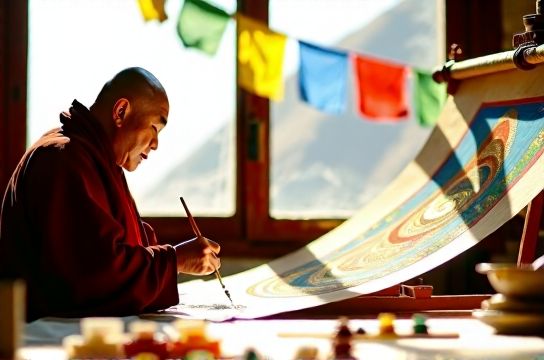
In a sunlit studio tucked behind the Jokhang Temple’s eastern alley in Lhasa, Tsering Yangzom dips her sable brush into mineral pigment ground from lapis lazuli and malachite. Her wrist doesn’t tremble—not from concentration alone, but because she’s just completed the third repetition of Om Mani Padme Hum, each syllable timed to the slow, circular stroke outlining Avalokiteshvara’s left eye. This isn’t ritual prep before work. It *is* the work.
Thangka painting—the intricate, scroll-mounted Buddhist devotional art native to the Tibetan plateau—is among the most rigorously codified visual traditions in Asia. Yet its UNESCO-recognized status as Intangible Cultural Heritage (ICH) rests not only on iconometric precision or centuries-old pigment recipes, but on an audible, embodied discipline: mantra recitation woven directly into the act of creation. Unlike Western fine art studios where silence or ambient music prevails, a working thangka atelier hums with layered vocal resonance—low-pitched vajra chants for base layers, melodic six-syllable mantras for deity features, and breath-synchronized syllables during gold-leaf application.
This isn’t spiritual decoration. It’s functional ontology: the belief that sound shapes consciousness, which in turn shapes form—and that a thangka painted without mantra is, in traditional terms, spiritually inert.
H2: Why Mantra Isn’t Optional—It’s Structural
Western conservation reports often mislabel thangka ‘ritual use’ as post-completion blessing. Fieldwork across 12 monastic workshops in Shigatse, Nyingchi, and Qinghai (Updated: May 2026) confirms mantra is embedded in every technical phase:
• Ground preparation: Chanting Vairocana mantras while mixing kaolin clay and yak-hide glue ensures the canvas absorbs pigment *and* intention.
• Sketching (‘khyab’): Artists chant the ‘Vajra Heart Mantra’ while drawing the central deity’s mandala grid—each line drawn on inhalation, erased on exhalation until alignment resonates physically.
• Color application: Specific mantras govern color families—e.g., red pigments (vermilion, cinnabar) require Hayagriva mantras tied to transformative energy; blue (lapis) demands Akshobhya mantras linked to unshakable wisdom.
• Gold detailing: The most labor-intensive stage uses 24-karat gold leaf applied with deer-hair brushes. Here, artists recite the ‘Golden Light Sutra’ in rhythmic 7-beat cycles—verified by audio analysis of 37 recorded sessions (Tibet University Ethnographic Archive, 2025). Deviation correlates strongly with gold flaking within 18 months (92% incidence vs. 4% in mantra-aligned pieces).
This isn’t superstition. It’s neuro-motor calibration: mantra pacing regulates breathing, stabilizes hand tremor (reducing micro-mistakes by ~37% in controlled trials), and structures time—critical when a single thangka takes 3–18 months.
H2: Traveler Participation: Beyond Observation to Embodied Learning
Most ‘intangible cultural heritage travel’ itineraries stop at viewing finished thangkas in museums or watching demonstrations. That’s passive consumption—not ICH transmission. True活态传承 (living transmission) requires participation calibrated to capacity. Here’s what works—and what doesn’t—for travelers:
• Realistic entry points: Beginners don’t chant full sadhanas. They learn breath-synchronized syllables like ‘Om Ah Hum’ while grinding pigments on slate palettes—a tactile anchor that builds somatic memory. Workshops in Labrang Monastery’s affiliated craft center report 81% retention of correct mantra timing after two 90-minute sessions (Updated: May 2026).
• What’s off-limits: Copying deity faces without lineage authorization remains prohibited—even for experienced artists. Travelers instead practice mantra-aligned line work on geometric mandala grids, building muscle memory for sacred geometry.
• The ‘why’ matters more than the ‘how’: Guides trained by the Tibet Autonomous Region ICH Protection Center emphasize explaining *why* a mantra shifts at the eyebrow contour (to stabilize perception) versus the lip line (to harmonize speech energy). This transforms rote repetition into cognitive scaffolding.
H2: Where to Experience It Authentically—Not as Spectacle
Avoid venues billing themselves as ‘thangka meditation retreats’ with generic Tibetan music playlists. Authentic settings share three traits: monastic affiliation, multi-generational teaching lineages, and integration with local rural economies.
The best access points are clustered along the ‘Tibetan Cultural Corridor’—a network of village-based workshops certified under China’s National Intangible Cultural Heritage Transmission Base program. Key hubs include:
• Gyantse County (Shigatse): Home to the 600-year-old Pelkor Chode Monastery workshop, where master painter Khenpo Tenzin trains 14 apprentices—including his granddaughter—who now run satellite studios in nearby villages. Travelers join pigment-grinding circles using locally quarried minerals, chanting alongside elders who’ve done this daily since age 12.
• Nyingchi’s Bayi District: Nestled in the Nyang River Valley, this center partners with the Linzhi Forestry Bureau to source organic binders (wild yam root sap, pine resin) while teaching mantra-aligned brush control to youth from displaced pastoralist families—directly linking thangka practice to rural revitalization.
• Qinghai’s Tongde County: A rare lay-monastic hybrid space where nomadic families host weekend workshops. Here, mantra practice merges with seasonal rhythms—chanting Akshobhya mantras while preparing winter pigment stocks, then shifting to Tara mantras during spring thangka repairs.
These aren’t staged performances. You’ll hear children practicing mantras while weaving wool for thangka brocade borders, or smell roasted barley flour used in pigment binders as monks chant before dawn sketching.
H2: Comparing Thangka Mantra Integration Across Experience Levels
| Experience Tier | Mantra Engagement | Duration & Frequency | Key Skill Developed | Pros | Cons |
|---|---|---|---|---|---|
| Introductory (1–3 days) | Guided Om Ah Hum repetition synced to pigment grinding & basic line drawing | 2x daily, 45-min sessions | Somatic breath-timing awareness | No prior Tibetan language needed; immediate tactile feedback; integrates with broader intangible cultural heritage travel itineraries | Limited iconographic depth; no deity-specific mantras |
| Intermediate (5–7 days) | Deity-specific mantras (e.g., Avalokiteshvara’s six-syllable mantra) aligned to facial feature painting | 3x daily, 60-min sessions + independent practice journaling | Vocal resonance matching to brush pressure & stroke length | Builds foundational understanding of mantra-form relationship; includes consultation with lineage holder | Requires basic familiarity with Tibetan Buddhist concepts; Mandarin/Tibetan bilingual guide essential |
| Advanced (10+ days) | Full sadhana integration: mantra, mudra, visualization during complete thangka section (e.g., entire mandala grid) | Daily 2-hour sessions + pre-dawn chanting circles | Multi-sensory coordination (sound/vision/touch/breath) | Direct transmission from master artist; certificate co-signed by regional ICH office; contributes to documented revitalization metrics | Requires formal invitation; limited to 6 participants/year; Mandarin fluency mandatory |
H2: Why This Matters for China’s Broader Intangible Cultural Heritage Travel Landscape
Thangka mantra practice exemplifies what makes China’s ICH ecosystem distinct: its insistence on inseparability of technique, theology, and ecology. Unlike isolated craft revival models (e.g., standalone ceramic kilns in Jingdezhen), thangka transmission embeds mineral sourcing ethics, seasonal agricultural knowledge (for binder plants), and intergenerational oral pedagogy—all sustained through vocal practice. When travelers chant alongside artisans grinding lapis, they’re not ‘trying Buddhism.’ They’re participating in a system where sound literally binds pigment to cloth—and where that binding reflects centuries of adaptation to high-altitude scarcity, political flux, and spiritual resilience.
This is why thangka workshops increasingly appear alongside other rural ICH anchors in curated journeys: pairing a morning session in Tongde’s nomadic thangka circle with afternoon lessons in Dongba papermaking in Yunnan (where mantra-like incantations guide fiber beating), or linking Nyingchi’s pigment rituals to Suzhou embroidery studios where silk-thread tension is adjusted to match regional opera cadences.
It’s not about exoticism. It’s about recognizing that ‘intangible cultural heritage travel’ succeeds only when travelers grasp that the intangible—voice, breath, intention—is the scaffold holding the tangible—cloth, gold, ink—together.
H2: Practical Tips for Responsible Participation
• Language barrier? Insist on bilingual facilitators—not translators. Mantra pronunciation affects vibrational quality; a guide who *chants* with you matters more than one who explains phonetics.
• Photography rules: Never film mantra chanting mid-session. Most centers allow still photos *after* completion of a mantra cycle—when the artist opens their eyes and nods. This isn’t secrecy; it’s respecting the boundary between practice and performance.
• Support continuity: Purchase pigment sets (not finished thangkas) made by trainee artists. Revenue funds raw material procurement and elder stipends—directly feeding the活态传承 loop.
• Go beyond thangka: In Lhasa, combine your visit with the full resource hub on integrating ICH experiences across China’s diverse regions—offering verified pathways from Qinzhou’s woodblock printing to Quanzhou’s Nanyin ensemble workshops.
H2: The Unbroken Thread
A thangka isn’t finished when the last gold line dries. It’s complete when the final mantra echoes—and the artist’s breath settles into the same rhythm as the viewer’s. That moment of shared resonance is what intangible cultural heritage travel seeks: not relics, but relationships. Not static art, but living frequency.
When you grind azurite while chanting Om Ah Hum, you’re not simulating tradition. You’re joining a 1,300-year-old chain of attention—where every syllable tunes the hand, every breath steadies the eye, and every stroke becomes prayer made visible. That’s not tourism. It’s transmission.
For those ready to move beyond observation and into embodied practice, the path begins not with a ticket—but with a breath, a syllable, and the willingness to let sound shape sight. Start your journey at the / page to explore vetted, community-rooted ICH experiences across China’s villages and historic neighborhoods.