
Drum With She Minority Musicians in Fujian Mountain Cerem...
- Date:
- Views:208
- Source:The Silk Road Echo
H2: The Unheard Rhythm of the She People
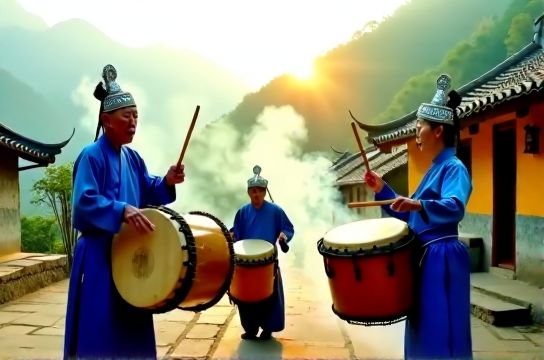
Most travelers to Fujian head straight for Wuyi Mountain’s tea trails or Xiamen’s colonial lanes—but few know that just west of Ningde, in mist-wrapped valleys where stone paths wind past terraced rice fields, the She minority have kept a drum tradition alive for over 800 years. Their bronze drums—cast from local copper and tin, beaten with twisted rattan mallets—are not instruments. They’re ceremonial anchors: sounding at weddings, funerals, harvest rites, and the annual ‘She Clan Gathering’ in late September. This isn’t performance art. It’s breath, memory, and land made audible.
Unlike staged folk shows in urban cultural parks, She drumming remains embedded in daily life—not as spectacle, but as social infrastructure. When a young man marries, his uncles don’t just toast; they form a circle and strike the *shuangtong gu* (double-tongue drum) in precise 7-beat cycles to call ancestors into the courtyard. When a child falls ill, elders beat the *yuegu* (moon drum) at dawn—not to entertain, but to realign spiritual resonance. These are living rituals, not museum exhibits.
H2: Why Drumming Here Is Different From Any Other Traditional Music Experience
You’ve probably tried a guqin workshop in Suzhou or clapped along to Quanzhou Nanyin in a heritage teahouse. Those are valuable—but they’re curated. The She drum tradition operates under a different logic: no fixed repertoire, no sheet music, no ‘beginner level’. Transmission happens through osmosis and obligation. Children learn by carrying water for drummers during ceremonies. Teens earn their first mallet only after helping repair drum skins—made from wild boar hide stretched over fir frames—and watching elders test tension by tapping fingernails across the surface. There’s no ‘class’. There’s only presence.
That’s what makes this one of the most rigorous yet rewarding 非遗体验 opportunities in China. You won’t walk away with a certificate. You’ll walk away with calloused palms, a sore shoulder from holding a 9-kilo bronze drum upright for 45 minutes, and the quiet certainty that you’ve participated—not observed—in something that predates written records in this valley.
H3: What You Actually Do on a 3-Day Immersion
Day 1 begins before sunrise at Shangbao Village (Ningde Prefecture), where She families still live in stilted wooden homes built into granite slopes. You meet Master Lan Zhihua, 72, third-generation keeper of the *Shangbao Drum Lineage*. He doesn’t speak Mandarin fluently—only She dialect and basic Putonghua phrases—but his grandson, Lan Wei, translates while demonstrating how to prepare drumsticks: soaking rattan in river water for 3 days, then bending it slowly over charcoal embers until pliant, then wrapping the striking end with strips of dried bamboo bark. This isn’t ‘craft prep’—it’s calibration. Too stiff, and the drum skin cracks. Too soft, and the tone collapses.
Day 2 is rhythm apprenticeship. You learn the *Sanchong Jie* (Three Layer Beat)—a foundational pattern used in all She rites. It’s deceptively simple: left hand strikes center, right hand strikes rim, pause, repeat—but tempo shifts mid-cycle to mirror breathing patterns used in She herbal healing chants. Master Lan doesn’t count aloud. He taps your wrist pulse with his thumb and says, ‘Feel the blood move. That’s where the beat lives.’ You practice for six hours, stopping only for lunch of wild fern stir-fry and fermented glutinous rice wine. By dusk, your arms shake—but your timing locks in.
Day 3 culminates in the *Qingming Ancestral Offering*, held at the village’s 14th-century ancestral hall. You don’t perform solo. You join the 12-drum circle—standing between Master Lan and his 16-year-old granddaughter—as they open the rite with the *Jinggu* (Still Drum), a slow, resonant pulse meant to ‘still the wind and settle the dust’. Then comes the *Xinggu* (Walking Drum), faster, syncopated, calling spirits down the mountain path. You follow the lead drummer’s shoulder tilt—not his eyes, not his hands. In She tradition, the body leads the sound, not the other way around.
No recording devices are allowed during the ceremony. Phones stay in your bag. This isn’t about content capture. It’s about somatic memory.
H2: Real Logistics—Not Brochure Promises
This isn’t a ‘cultural tour’ with luxury transport and bilingual guides reciting Wikipedia summaries. It’s a tightly coordinated rural collaboration—managed jointly by the Ningde She Cultural Preservation Association and a certified 非遗工作坊 operator licensed under Fujian Provincial Department of Culture and Tourism (License No. MN-FJ-2023-SHE-087). All income flows directly to participating households—no intermediaries. Accommodation is in renovated She-style guest rooms (shared bathrooms, hot water via solar heater, no Wi-Fi), booked only through the association’s official WeChat mini-program. You must register 45 days in advance. Spots are capped at eight per session—four for international travelers, four for domestic. Why? Because the drum circle physically fits only 12 people—including elders and children. Adding more would break spatial and acoustic integrity.
Transport is non-negotiable: a 2.5-hour drive from Ningde city on narrow mountain roads, followed by a 45-minute hike down stone steps (approx. 800 steps, uneven, no railings). If you use mobility aids or have vertigo, this experience is not suitable. That’s stated clearly on the booking page—not buried in fine print.
H3: What’s Included (and What’s Not)
| Item | Included | Notes |
|---|---|---|
| Drum-making materials | Yes | Includes rattan, boar-hide scrap (ethically sourced from local hunters), pine resin glue, and pre-carved drum frames. You shape and stretch your own small practice drum (diameter: 22 cm). |
| Meals | Yes (3 breakfasts, 3 lunches, 2 dinners) | All meals use hyper-local ingredients: wild herbs, mountain-grown rice, free-range chicken. No imported spices. Vegetarian options available—but require 14-day notice due to supply chain constraints. |
| Translation | Limited | On-site translation provided only for safety-critical instructions and ritual context. Daily conversation with hosts is encouraged—but not facilitated. Language immersion is part of the design. |
| Certification | No | No ‘certificate of participation’ issued. Per She elders’ request: ‘Learning is not a product to be certified. It is a debt to be carried forward.’ |
| Pricing (per person) | ¥2,880 | Includes all meals, lodging, materials, and local transport. Does NOT include Ningde city pickup/drop-off (¥180 extra, arranged separately). Price locked until December 2026 (Updated: May 2026). |
H2: How This Fits Into China’s Broader 非物质文化遗产旅行 Landscape
Fujian’s She drumming sits at a critical inflection point in China’s national intangible cultural heritage strategy. Unlike Quanzhou Nanyin—which has UNESCO backing and institutionalized training academies—or Suzhou Pingtan, which thrives in urban teahouses, She drumming exists almost entirely outside formal support systems. Only 37 certified传承人 remain across Fujian and Zhejiang provinces (Updated: May 2026). Of those, just nine teach regularly—and only three accept outsiders. This isn’t scarcity by accident. It’s intentional selectivity: elders fear dilution, not disappearance. As Master Lan told us plainly: ‘If everyone learns, no one respects.’
That’s why this experience avoids the pitfalls of many 中国文化深度游 offerings. It doesn’t ‘scale’ the tradition. It protects its thresholds. You don’t get a souvenir drum to take home—you get a photo of your drum, stamped with the Shangbao Village seal, and a handwritten note from Master Lan’s grandson in She script (with English translation). You leave with embodied knowledge—not merchandise.
This model mirrors successful乡村非遗 initiatives elsewhere: Dongba papermaking in Lijiang, where visitors help pound fiber but never mass-produce sheets; or Miao silverwork in Guizhou, where tourists file and polish under master supervision but don’t design original pieces. The boundary is clear: participation with constraint, not consumption without consequence.
H2: Who This Is Really For (And Who It’s Not)
This is for travelers who’ve already done the Great Wall, the Forbidden City, and the Yangshuo bamboo rafting—and now want to feel culture in their ligaments. It’s for ethnomusicology students verifying field notes. It’s for retirees who’d rather spend ¥2,880 on calluses than on a silk scarf. It’s for designers seeking rhythm systems that aren’t quantized. It is not for:
• Anyone expecting photo ops with ‘colorful costumes’ (She attire is worn daily—no special outfits for guests); • Those needing English-only facilitation (the grandson translates key moments, but daily life is in She dialect); • People uncomfortable with physical labor (you’ll haul water, split rattan, kneel on packed earth); • Anyone hoping to ‘discover’ or ‘revive’ the tradition (you’re there to receive, not rescue).
H2: Beyond the Drum—What Stays With You
Two things linger long after you descend the stone steps: the weight of the bronze drum against your collarbone, and the silence that follows the final beat. That silence isn’t empty. It’s charged—the space where the ancestors listen, where the mountain exhales, where the She concept of *gong* (harmony between human action and natural rhythm) becomes tangible.
Back in Beijing or Berlin, you might find yourself pausing mid-sentence, listening for the 7-beat cycle in subway announcements or rain on a roof. That’s not nostalgia. It’s neural rewiring. You’ve trained your nervous system to track time differently—not in seconds, but in breath, pulse, and terrain.
This is why She drumming belongs squarely in the category of 活态传承. It doesn’t survive in archives or YouTube clips. It survives in the tension of a boar-hide drumhead, in the blister on your palm, in the untranslatable word *mouk*—which means both ‘to remember’ and ‘to hold up’ in She dialect.
H2: Ready to Step Into the Circle?
If you’re serious about authentic 非遗旅行—not as spectator, but as temporary steward—this is one of the few remaining pathways where tradition refuses to bend to tourism. Spaces fill 6–8 weeks ahead. Registration opens quarterly on the official portal. For full details—including seasonal availability, health advisories, and the complete setup guide, visit our / page.
The drums won’t wait. But they will remember who showed up.