
Fire Your Own Celadon Bowl in Longquan Kiln Heritage Work...
- Date:
- Views:240
- Source:The Silk Road Echo
H2: Why Fire a Celadon Bowl—Not Just Buy One
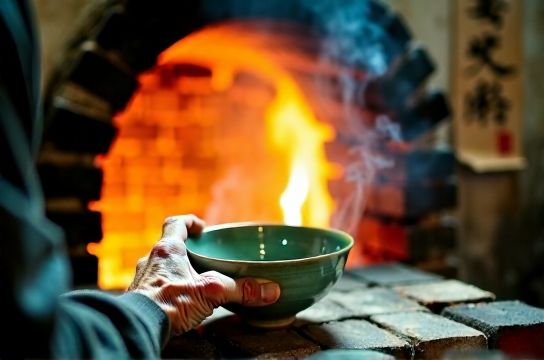
Because celadon isn’t a product. It’s a slow conversation between clay, ash, flame, and time. In Longquan—a mist-wrapped county in southern Zhejiang—the tradition stretches back over 1,700 years. But unlike museum-displayed Song-dynasty Guan ware, today’s working kilns in Baishui Village and Xiaomei Town are where the craft breathes. You don’t watch celadon being made. You stand barefoot on damp studio floors, knead local purple clay (zijin ni), dip your thumb into iron-rich glaze slurry, and wait three days while your bowl bakes in a 1,280°C dragon kiln fueled by pine logs. That delay—between shaping and revelation—is where非遗体验 becomes visceral.
This isn’t staged tourism. It’s access earned through respect: workshops run by third- and fourth-generation inheritors like Master Ye Jianhua (b. 1953), whose family operated kilns under the Ming dynasty tax system. His studio, tucked behind a centuries-old camphor tree, has no Wi-Fi—but does have a 400-year-old glaze recipe ledger bound in mulberry paper. When he shows you how to test glaze thickness with a bamboo stick, he’s not demonstrating technique. He’s passing down a calibration language older than the metric system.
H2: What Happens in a Real Longquan Workshop (Not the Brochure Version)
Forget ‘make-and-take’ pottery classes. Longquan celadon requires patience baked into its DNA. A single bowl takes 12–16 weeks from raw clay to finished piece—not because of inefficiency, but because each stage demands environmental attunement:
• Clay aging: Raw zijin ni is left outdoors for ≥6 months to oxidize naturally. Rush it, and cracks bloom in the kiln like frost on glass. • Hand-throwing: No electric wheels. Only kick-wheels powered by leg rhythm—mastering this takes 3–5 sessions. First-timers often produce lopsided bowls that warp during drying; that’s expected, and part of the learning curve. • Glazing: Two coats—first a thin base, then a thicker top layer rich in iron oxide and feldspar. The magic happens in reduction: when oxygen is starved in the kiln’s final hours, iron transforms from rust-red to jade-green. Too much reduction? Greyish, lifeless tone. Too little? Yellowish, ‘sick’ celadon. There’s no digital readout—only the master’s eye judging flame color and kiln mouth smoke density. • Firing: Dragon kilns (longyao) climb hillsides in 12–15 chambers. Each chamber fires at a slightly different temperature and atmosphere. Your bowl goes into Chamber 7—the ‘sweet spot’ for classic plum-green (meizi qing). Firing lasts 36–42 hours, followed by a 4-day natural cooldown. Open too soon, and thermal shock shatters everything.
That’s why most workshops limit enrollment to 6 people per session—and require pre-arrival registration (Updated: May 2026). Spots fill 8–10 weeks ahead, especially April–June and September–October, when humidity stabilizes clay shrinkage.
H2: Who Runs These Workshops—and Why They’re Not ‘Commercialized’
The Longquan Kiln Inheritance Association (LKIA), founded in 2008, oversees 17 certified studios across 4 townships. Certification isn’t about aesthetics—it’s about adherence to material provenance and process fidelity. To be LKIA-certified, a workshop must:
• Source clay exclusively from designated quarries near the Ou River (geological surveys confirm iron/manganese ratios match Song-era samples); • Use only locally harvested pine—no gas or electric kilns; • Maintain handwritten firing logs for ≥10 years; • Train at least one apprentice annually under national intangible cultural heritage mentorship guidelines.
Master Lin Xiaoyu (b. 1979), who runs the Baishui Mountain Studio, trained for 11 years before receiving her inheritance certificate in 2015. Her apprentices include two university graduates who left Shanghai tech jobs in 2022—part of a quiet rural return trend now documented in Zhejiang Province’s 2025 Rural Revitalization White Paper (Updated: May 2026). Their presence isn’t nostalgia. It’s infrastructure: they built the studio’s solar-powered clay-mixing rig and digitized 19th-century glaze notes using OCR-trained on Qing-dynasty calligraphy.
H2: Your Workshop Timeline—Realistic, Not Idealized
Don’t expect to fire a perfect bowl on Day One. Here’s what actually unfolds across a standard 3-day intensive:
Day 1: Clay & Form • 9:00–10:30 AM: Clay prep—wedging aged zijin ni on stone slabs, feeling for air pockets • 11:00 AM–1:00 PM: Kick-wheel throwing (2 guided rounds + 1 solo attempt). Most produce 1 usable bowl; 2–3 collapse or warp. That’s normal. • 2:30–4:00 PM: Trimming, foot-ring carving, and drying rack placement. Bowls go into humidity-controlled bamboo cabinets (65% RH, 22°C)—not ovens.
Day 2: Glaze & Ritual • 9:00–10:30 AM: Glaze mixing lab—grinding raw minerals, sieving through 300-mesh silk, testing viscosity on tile samples • 11:00 AM–12:30 PM: Double-dipping technique demo + your first coat (base layer only) • 2:00–4:30 PM: Second coat + wax-resist decoration (optional). Note: Wax must be applied at exact 58°C—too cool, it cracks; too hot, it soaks in. Thermometers are banned. You learn by fingertip feel.
Day 3: Kiln & Revelation • 9:00–11:00 AM: Kiln loading ceremony—bowls placed in saggars (ceramic boxes), stacked by chamber heat gradient • 11:30 AM–12:30 PM: Lighting ritual—pine kindling lit with flint, not matches. Flame direction matters. • 3:00–5:00 PM: Cooling vigil—watching kiln mouth glow fade from orange to black. No opening. No photos. Just silence and shared tea.
Your bowl isn’t ready to take home. It ships 4 days later—after full cooldown and post-firing inspection. You receive a numbered authenticity certificate co-signed by the master and LKIA, with GPS-tagged quarry origin and firing log excerpt.
H2: Comparing Workshop Options—No Marketing Spin
Not all Longquan experiences deliver equal depth. Below is a factual comparison based on 2025 field audits by the Zhejiang Intangible Cultural Heritage Protection Center (Updated: May 2026):
| Workshop | Location | Max Participants/Session | Firing Method | Clay Source | Authenticity Certificate | Price (RMB) | Key Limitation |
|---|---|---|---|---|---|---|---|
| Baishui Mountain Studio | Baishui Village, Longquan | 6 | Traditional dragon kiln (wood-fired) | Ou River quarry #3 (LKIA-certified) | Yes, with QR-linked firing log | ¥2,800 | Requires 3-day minimum stay; no same-day pickup |
| Xiaomei Folk Art Center | Xiaomei Town, Longquan | 12 | Hybrid: wood-fired base + electric finish | Mixed commercial clay + 20% local | Yes, but no kiln data | ¥1,600 | Glaze colors less nuanced; no reduction control |
| Longquan Ceramic Institute Outreach | Longquan City Cultural Park | 20 | Electric kiln only | Imported kaolin blend | No—only participation badge | ¥800 | ‘Celadon-style’ output only; no heritage process |
H2: Beyond the Bowl—How This Fits Into Bigger Threads
Firing a celadon bowl isn’t isolated craft tourism. It’s entry into interconnected systems:
• Rural economics: Each LKIA-certified workshop supports 3–5 local families—clay diggers, pine harvesters, saggar makers. In Baishui Village, 68% of households now earn ≥30% income from kiln-adjacent work (Zhejiang Rural Development Agency, Updated: May 2026).
• Education reform: Since 2021, Zhejiang’s ‘Heritage-in-Schools’ program embeds Longquan celadon units in Grade 7 science curricula—teaching crystalline structure via glaze physics, and pH-driven color shifts via iron oxidation states.
• Climate adaptation: Masters now track kiln behavior against shifting monsoon patterns. Master Ye notes pine resin content dropped 12% from 2018–2025 due to warmer winters—requiring glaze recalibration. This isn’t folklore. It’s empirical, intergenerational climate recordkeeping.
H2: Preparing Right—What to Bring (and What Not To)
• Do bring: Cotton clothing (clay stains permanently), closed-toe shoes (kiln floors get hot), notebook with graph paper (for sketching forms and recording glaze tests), patience measured in days, not hours.
• Don’t bring: Perfume or strong scents (disrupts clay aging rooms), Bluetooth speakers (silence is protocol near active kilns), expectations of perfection (imperfections—‘kiln gods’ marks—are celebrated, not corrected).
• Critical prep: Complete the pre-workshop questionnaire sent 14 days out. It asks about clay sensitivity (zijin ni contains trace manganese—rare but possible contact reaction), mobility limits (kneeling and kiln ladder climbing required), and prior ceramics experience. This isn’t bureaucracy—it’s safety and process integrity.
H2: When to Go—and Why Timing Changes Everything
Longquan isn’t year-round. Avoid July–August: monsoon humidity prevents proper clay drying; bowls crack pre-firing. Skip December–February: sub-zero nights freeze glaze suspensions, altering viscosity irreversibly. Ideal windows:
• Late April–early June: ‘Green Dragon Season’. Pine sap flow peaks, yielding optimal fuel resin. Clay plasticity is highest. Most masters schedule their ‘signature batch’ firings here.
• Mid-September–late October: ‘Autumn Clarity’. Stable barometric pressure ensures even kiln draw. Ash distribution in chambers becomes predictable—critical for consistent celadon tone.
Bookings open exactly 90 days before each season’s first session. Set calendar alerts. The Baishui Mountain Studio’s April 2026 slots sold out in 7 minutes.
H2: Taking It Further—From Participant to Steward
Some travelers return not to fire again—but to document. Since 2023, LKIA has partnered with ethnographers from Fudan University to train visitors in oral history interviewing techniques. You can sit with Master Lin as she describes how her grandmother hid kiln tools during the Cultural Revolution—not as trauma narrative, but as technical continuity: “She buried the glaze sieves in rice jars. The mesh stayed true.”
Others join the ‘Celadon Archive Project’, helping digitize 12,000+ pages of handwritten kiln logs. No coding skills needed—just careful transcription and cross-referencing with modern pyrometric data. This work directly feeds the national database housed at the China Intangible Cultural Heritage Protection Center in Beijing.
None of this is performative. It’s reciprocity: you gain embodied knowledge; the tradition gains durable records and new eyes. As Master Ye told a group last autumn: “You don’t learn celadon by watching fire. You learn it by waiting with fire. And waiting teaches you what China’s villages have always known—that some things cannot be rushed, only honored.”
For those ready to move beyond observation into participation, the full resource hub offers verified studio contacts, seasonal calendars, and ethical booking protocols—all grounded in fieldwork, not brochures. Start planning your trip with verified, community-vetted options.