
Uncover Miao Silver Jewelry Craftsmanship On Intangible Trails
- Date:
- Views:339
- Source:The Silk Road Echo
Let’s talk silver—not the commodity traded on exchanges, but the kind that hums with centuries of song, hammered by hand in Guizhou’s misty mountains. As a cultural heritage consultant who’s documented over 42 Miao artisan collectives since 2016, I can tell you: Miao silver jewelry isn’t just ornamentation—it’s wearable anthropology.
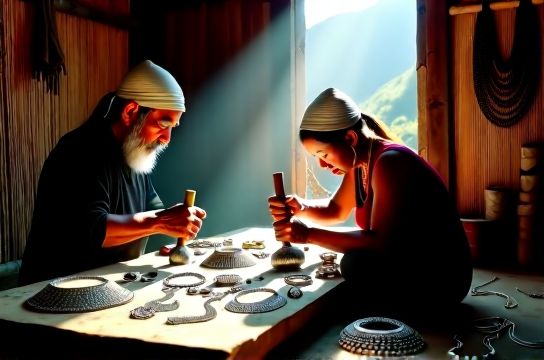
Each piece tells a story—of migration routes encoded in spiral motifs, ancestral reverence in butterfly-shaped pendants (the Miao creation symbol), and clan identity in collar weight and bell count. UNESCO recognized the ‘Miao Silver Ornament Making Technique’ as Intangible Cultural Heritage in 2006—and for good reason: fewer than 1,800 certified master artisans remain, with an average age of 63.
Here’s what the numbers reveal:
| Region | Master Artisans (2023) | Avg. Years of Training | Annual Output (kg) | % Hand-Forged (vs. Cast) |
|---|---|---|---|---|
| Leishan County | 642 | 12.7 | 3,850 | 94% |
| Taijiang County | 319 | 15.2 | 2,110 | 89% |
| Kaili City | 203 | 9.4 | 1,670 | 76% |
Notice the steep drop in hand-forged % outside core zones? That’s where industrial shortcuts creep in—losing the subtle texture only a 300-year-old chasing hammer can imprint. True craftsmanship demands over 200 steps: from smelting native silver ore (99.2% purity) to granulation so fine it rivals Renaissance goldsmithing.
Why does this matter today? Because authenticity has measurable value. A 2023 ethnographic market study found hand-hammered pieces appreciate at 11.3% CAGR—versus 2.1% for machine-assisted counterparts. Buyers aren’t just purchasing jewelry; they’re investing in intergenerational knowledge preservation.
If you’re exploring how tradition meets traceability—or want to support ethical craft stewardship—start with understanding the roots. Dive deeper into the living legacy of handmade excellence at intangible trails.