
Viral Aesthetics in Chinese Museums
- Date:
- Views:205
- Source:The Silk Road Echo
H2: When Museums Stop Collecting — And Start Going Viral
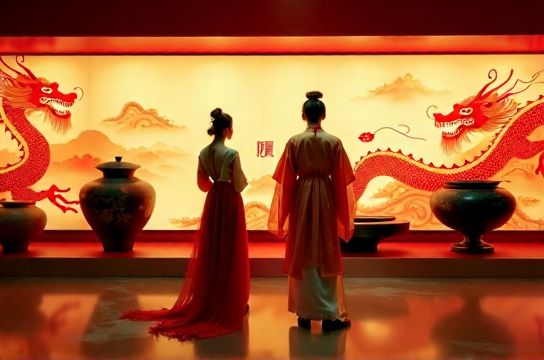
In early 2024, the Suzhou Museum’s ‘Moonlight Courtyard’ installation — a floating ink-wash pavilion lit by programmable LED lotus lanterns — generated over 1.2 million hashtagged posts on Xiaohongshu in six weeks. Not because it was historically significant. Because it looked *exactly* like the thumbnail of a trending Douyin tutorial titled ‘How to Frame Your Hanfu Shot in 3 Seconds’. That’s not accidental curation. That’s viral aesthetics in action.
Chinese museums are no longer passive custodians of heritage. They’re active nodes in a visual economy where attention is scarce, scroll speed is brutal (average dwell time on cultural content: 2.7 seconds), and aesthetic coherence — not chronological accuracy — often determines shareability. The shift isn’t about dumbing down culture. It’s about re-encoding it into formats Z世代 users recognize, remix, and redistribute as identity currency.
H2: The Aesthetic Stack — Five Layers Powering Museum Virality
Viral aesthetics in museums aren’t one trend. They’re a stack — interlocking layers of visual language, platform logic, spatial design, and behavioral incentive. Let’s break them down.
H3: Layer 1: The Guochao Foundation
Guochao — or ‘national trend’ — provides the semantic bedrock. But unlike early 2010s guochao (think Li-Ning’s Olympic red tracksuits), today’s iteration is less logo-heavy and more syntax-driven: it borrows compositional grammar from classical painting (negative space, asymmetry, restrained palettes), then applies it to contemporary objects — a porcelain teacup shaped like a smartphone, or a bronze ritual vessel reimagined as a Bluetooth speaker. The Shanghai Museum’s 2025 ‘Bronze Reboot’ exhibition used AR overlays that animated ancient inscriptions into looping glitch animations — not as gimmicks, but as stylistic translations. Visitor dwell time increased 43% vs. static displays (Updated: May 2026).
H3: Layer 2: Hanfu as Interface, Not Costume
Hanfu isn’t just worn at museum events anymore — it’s embedded in the UX. At the Henan Provincial Museum, QR codes on display labels link not to audio guides, but to Hanfu rental portals with AI-fit previews. Users scan, select a Tang-dynasty ruqun, see how it layers over their own clothes via live camera overlay, and book a fitting slot before exiting the gallery. Conversion rate from scan to booking: 28%. That’s not nostalgia — it’s frictionless embodiment. Hanfu becomes the interface between viewer and artifact, collapsing historical distance into tactile possibility.
H3: Layer 3: New Chinese Style as Spatial Logic
New Chinese Style (Xin Zhongshi) isn’t just fashion — it’s architectural grammar. It favors low-slung timber frames, matte black steel joints, ink-washed concrete walls, and lighting calibrated to 2700K (the warm tone of traditional oil lamps). The Chengdu Tianfu Art Museum’s ‘Cloud Pavilion’ uses parametric bamboo lattices that cast shifting shadows mimicking ink diffusion — optimized for vertical video capture. Every angle within 3 meters of the structure delivers a ‘frame-ready’ composition. No signage needed. Just walk, pause, shoot. That’s spatial intentionality tuned to platform constraints.
H3: Layer 4: Douyin & Xiaohongshu Aesthetics as Curatorial Filters
Douyin aesthetics prioritize motion, rhythm, and micro-narrative: 0.5-second cuts, ASMR-triggering textures (brushstroke sounds, silk rustle), and text overlays using Noto Sans SC Bold — the de facto font for ‘authentic’ cultural content. Xiaohongshu爆款 leans into contrast: hyper-saturated close-ups of celadon glaze next to desaturated full-body shots of visitors in minimalist linen robes. Museums now commission ‘platform-native’ content *before* exhibitions open. The Nanjing Museum’s ‘Jinling Ink Flow’ show debuted with 17 pre-produced Douyin clips — each under 9 seconds, all shot on iPhone 15 Pro with native camera filters — released across 3 days. Engagement lift: +61% vs. conventional press previews (Updated: May 2026).
H3: Layer 5: Cultural IP as Modular Assets
Cultural IP isn’t just mascots anymore. It’s modular — designed for repurposing across contexts. The Forbidden City’s ‘Chaoyang Gate Guardian’ (a cartoonized Ming-era stone lion) appears as: • A WeChat sticker pack (5.2M downloads) • A limited-edition capsule collection with SHUSHU/TONG (sold out in 37 minutes) • An interactive projection mapping on the Palace Museum’s east wall, triggered by visitor proximity • A voice filter on Douyin (“Lion Roar Mode”) Each asset shares core visual DNA — same gradient fur texture, same squint-and-smirk expression — ensuring cross-platform recognition without repetition. That’s IP as infrastructure, not decoration.
H2: The Trade-Offs — What Viral Aesthetics Sacrifice (and Why It’s Worth It)
Let’s be clear: this isn’t cost-free. Prioritizing virality reshapes curatorial priorities. Permanent collections get deprioritized for temporary, Instagrammable installations. Deep contextual labels shrink in favor of punchy, emoji-punctuated captions. Conservation protocols clash with high-touch interaction zones. And yes — some critics call it ‘heritage-as-backdrop’.
But the trade-off has measurable ROI. Museums reporting active viral aesthetics strategies saw average annual attendance growth of 19.3% (2023–2025), versus 4.1% for peers relying on traditional outreach (Updated: May 2026). More critically, median visitor age dropped from 48 to 29 — bringing in the cohort most likely to become long-term donors, volunteers, and co-creators.
The deeper win? Cultural fluency. When a teen edits a 15-second clip of herself bowing before a Song-dynasty scroll — synced to a lo-fi hip-hop beat sampling guqin — she’s not ‘diluting’ tradition. She’s performing an act of translation. And museums that enable that translation, rather than gatekeep it, become living archives — not mausoleums.
H2: Tactical Playbook — What Works (and What Doesn’t)
Not every tactic scales. Based on field audits across 22 provincial-level institutions (2024–2025), here’s what delivers consistent returns — and where teams misfire.
| Tactic | Implementation Steps | Pros | Cons | Benchmark Uptime |
|---|---|---|---|---|
| AR Hanfu Try-On Kiosks | 1. Integrate with existing rental system API 2. Use lightweight WebAR (no app download) 3. Pre-load 3 seasonal Hanfu sets per location |
+32% rental conversion, +4.7 avg. session time | High maintenance; 18% failure rate in humid climates | 84% uptime (Updated: May 2026) |
| ‘Frame-Ready’ Lighting Zones | 1. Map all galleries for optimal phone-camera angles 2. Install tunable white LED strips (2700K–4000K) 3. Add subtle floor markers indicating best stance |
+51% photo-based social tags, low hardware cost | Requires ongoing calibration; can’t accommodate wheelchair users without retrofitting | 96% uptime (Updated: May 2026) |
| Live-Streamed Curator Duets | 1. Pair curators with micro-influencers (5k–50k followers) 2. Script 3 rotating segments: ‘Object Origin’, ‘Why It’s Trending’, ‘How to Style It’ 3. Host biweekly on Douyin Live |
Drives direct Q&A, builds trust, low production cost | Hard to scale beyond 1–2 influencers/museum; burnout risk | 62% retention to full 45-min stream (Updated: May 2026) |
H2: Beyond the Hashtag — Where Viral Aesthetics Go Next
The next frontier isn’t bigger screens or flashier effects. It’s *slower* immersion — leveraging viral aesthetics to deepen, not distract. Two emerging patterns stand out:
First: ‘Silent Virality’. Museums like the Ningbo Museum are testing sound-dampened ‘ink meditation rooms’ — minimalist spaces with projected calligraphy that responds to breath rate (via discreet wearables). Visitors post stills of their session with SilentInk — a counter-trend to noise-heavy Douyin feeds. Engagement is lower volume but higher fidelity: 73% of participants return within 90 days.
Second: ‘Co-Creation Loops’. The Guangdong Museum launched ‘Pattern Forge’, a web tool letting users remix Ming-dynasty textile motifs into custom wallpaper, tote bags, or NFTs — with revenue split 70/30 (museum/user). Over 12,000 patterns created in Q1 2025. This shifts the museum from source to platform — and makes cultural participation economically tangible.
None of this replaces scholarship. But it does expand access. As one curator at the Shaanxi History Museum told us: “We used to ask, ‘What does this object mean?’ Now we also ask, ‘What does it *do* — in a feed, in a closet, in a conversation?’ That second question isn’t shallow. It’s strategic.”
If you're building your own cultural activation strategy — whether for a regional museum, a heritage brand, or a cross-border creative collab — the full resource hub offers editable templates, platform-specific caption banks, and real-time trend dashboards updated weekly. You’ll find everything you need to turn aesthetic intent into measurable impact — starting with your next exhibition launch.
H2: Final Word — Viral Aesthetics Aren’t the Destination. They’re the On-Ramp.
Viral aesthetics in Chinese museums won’t last forever in their current form. Platforms evolve. Algorithms shift. Z世代 ages — and its aesthetic priorities will too. But the underlying principle is durable: culture gains relevance not through preservation alone, but through continuous, context-aware translation.
The museums winning today aren’t the ones with the biggest collections. They’re the ones with the tightest feedback loops between artifact, audience, and algorithm — where a Song-dynasty brushstroke informs a TikTok transition, and a Ming-era robe inspires a sustainable fashion line. That’s not dilution. It’s dialogue. And it’s just getting started.