
Off the Beaten Path China: Torch Festival in Yunnan Villages
- Date:
- Views:248
- Source:The Silk Road Echo
Hiking into the mist-wrapped ridges of northwest Yunnan at dawn—your boots crunching on volcanic gravel, a wooden flute echoing from a stone hamlet clinging to a 2,800-meter slope—you’re not on a tour bus. You’re in Nujiang Lisu Autonomous Prefecture, where the Torch Festival isn’t performed for cameras but lit to ward off blight, honor ancestors, and bind kin across generations. This isn’t ‘cultural tourism’ as packaged in Lijiang’s souvenir shops. It’s real. And it’s fragile.
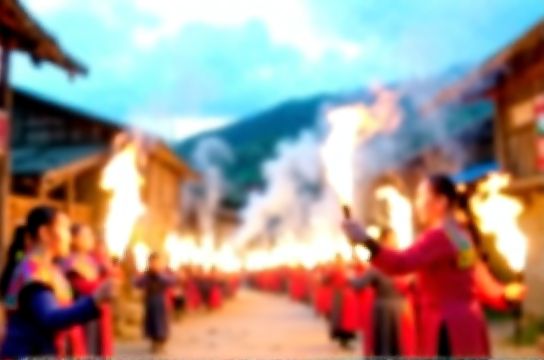
Most international hikers in Yunnan stop at Tiger Leaping Gorge or the Jade Dragon Snow Mountain trailheads—both legitimate, both crowded. Few push further west into Nujiang, where road access remains seasonal, mobile signal drops out for hours, and Mandarin is often a third or fourth language behind Lisu, Nu, and local dialects of Yi. That’s precisely why this corner qualifies as *off the beaten path China*: infrastructure lags, tourism investment is minimal, and authenticity isn’t curated—it’s inherited.
The Torch Festival (known locally as *Huǒ Bǎ Jié* among Han residents, but called *Gua La* by the Lisu, *Zi Ge* by the Nu, and *Duo Zi* by the Bai communities scattered across the high valleys) falls on the 24th or 25th day of the sixth lunar month—typically late July or early August. Unlike the commercialized version staged in Kunming’s Yunnan Ethnic Village, here the festival has no fixed start time. It begins when the village elder lights the first torch at the ancestral shrine—not at 7:00 p.m. sharp, but when the last millet stalk is threshed and the pigs are tethered for the night.
Why This Isn’t Just Another ‘Ethnic Minority Village’ Photo Op
Let’s be clear: many so-called ‘ethnic minority villages’ near Dali or Shangri-La have been rebranded, repainted, and re-ritualized for visitor flow. In contrast, villages like Bingzhongluo (Nujiang Prefecture), Xiaoshaba (Lanping County), and Qiaotou (Fugong County) retain functional continuity. Houses are still built with split-hewn pine logs and thatched roofs reinforced with river stones—not because it looks ‘traditional’, but because it withstands monsoon winds better than corrugated iron. Livestock pens double as storage for dried chilies and fermented buckwheat cakes. The women weaving indigo-dyed hemp cloth do so while nursing infants and negotiating goat sales—not for demonstration, but because it’s how cloth gets made.
That continuity shapes the Torch Festival. Torches aren’t mass-produced bamboo sticks dipped in paraffin. They’re hand-split pine resin cores wrapped in dried fern fronds and bound with twisted vine. Each family prepares 12–15 torches—not for spectacle, but to line paths, light barns, and circle granaries, per ancient agrarian logic: fire purifies, deters pests, and symbolically burns away misfortune accumulated over the year. Children don’t wear ‘costumes’; they wear their Sunday best—hand-embroidered vests passed down three generations, with motifs signifying clan origin, not tourist appeal.
Getting There: Logistics Are the First Filter
Forget Uber. Getting to these villages requires planning—and accepting trade-offs.
You’ll fly into Kunming (KMG), then take an overnight bus to Liuku—the capital of Nujiang Prefecture (6–7 hours, ¥180, departs 20:30 daily). From Liuku, shared minivans run irregularly to Fugong (2.5 hrs, ¥65) and Bingzhongluo (4 hrs, ¥90), but schedules depend on passenger count and road conditions. Landslides close Route G219 for an average of 11 days per monsoon season (Updated: April 2026). Local drivers will wait until 3–4 passengers commit—no fixed departures.
Once in Fugong or Bingzhongluo, you’ll need a local guide registered with the Nujiang Ethnic Tourism Cooperative—not for safety alone, but for access. Many villages require written permission from the village committee before outsiders may attend ceremonies, especially overnight. This isn’t bureaucracy; it’s protocol rooted in land stewardship and spiritual boundaries. A cooperative-registered guide (¥300–¥450/day, negotiable) handles permissions, translates during informal exchanges, and knows which households welcome guests for tea versus those observing ritual seclusion.
Hiking Trails That Double as Cultural Corridors
The real advantage of going *rural China travel* in Nujiang isn’t just culture—it’s terrain. These aren’t looped, signposted trails. They’re historic footpaths linking terraced fields, salt wells, and clan burial forests—some dating back to the Naxi-led Kingdom of Dali. Two routes stand out for Torch Festival timing:
• The Bingzhongluo–Xiaoshaba Ridge Traverse: A 22-km, two-day route crossing three watersheds. Day one climbs through walnut groves into cloud forest where Nu elders harvest wild orchids used in festival incense. Overnight in a homestay in Xiaoshaba (¥80/night, includes buckwheat pancakes and fermented tea). Day two descends past cliffside shrines where villagers hang fresh torches at dawn—just before the main evening procession.
• The Qiaotou–Laomudeng Gorge Loop: Less traversed, more physically demanding. Starts at Qiaotou’s old salt-trading post, follows the Nu River tributary upstream, and summits Laomudeng Peak (3,250 m) for panoramic views of the Three Parallel Rivers UNESCO site. You’ll pass Lisu hamlets preparing torch resin—watching men scale 30-meter pines with woven bark footholds, a skill taught at age 12. Permits required (¥20, issued same-day at Qiaotou Township Office).
Both trails qualify as *China hiking trails* only in the loosest sense: no trail markers, no emergency call boxes, no GPS reliability below 2,000 m due to canyon depth. Navigation relies on cairns, livestock trails, and asking elders for directional cues like “where the red-tailed shrike nests” or “past the third landslide scar.” This is *slow travel lijiang*—only slower, steeper, and quieter.
What to Expect During the Festival (and What Not To)
The Torch Festival lasts three days—but outsiders rarely witness all phases. Here’s what’s accessible, realistic, and respectful:
• Day One (Preparation): Observe resin collection, torch bundling, and altar cleaning. No photography inside shrines unless invited. Bring small gifts: quality tobacco (Yunnan’s ‘Hongtashan’ brand preferred), coarse salt (not iodized), or unbleached cotton thread—items used ritually, not souvenirs.
• Day Two (Main Night): Processions begin at dusk. Families light torches at home, then carry them to the central square—no choreography, no stage. Elders chant in Nu or Lisu; youth dance spontaneously to drum-and-bell rhythms. You may be offered *zhi ma* (fermented corn wine) in a shared cup—a gesture of kinship, not performance. Accept with both hands, sip once, and return respectfully.
• Day Three (Dispersion): Torches are extinguished in streams, ash mixed with soil and spread on fields. This is private, agricultural work—not ceremonial display. Do not follow families into fields unless explicitly invited.
What *not* to do matters more than what to do. Don’t offer money for photos. Don’t ask people to ‘repeat the dance.’ Don’t buy ritual objects (e.g., carved spirit tablets, consecrated beads) unless gifted. And never touch a lit torch unless handed one directly by a host—it’s not a prop; it’s a vessel.
Shopping With Integrity: Beyond Tourist Trinkets
Yes, there’s *旅游购物*—but it’s transactional, not extractive. In Bingzhongluo’s Saturday market, Lisu women sell hand-rolled *zha cai* (pickled mustard greens) in bamboo tubes (¥15/tube), not plastic bags. Nu artisans carve combs from yak horn—each takes 3 days, sells for ¥120–¥180, and funds winter wool purchases. The value isn’t ‘exoticism’; it’s verifiable craft time, material cost, and seasonal scarcity.
Avoid stalls selling ‘Torch Festival masks’ or ‘minority wedding hats’ made in Guangdong. Instead, seek out cooperatives like the Fugong Hemp Weavers Guild (established 2013), where you can watch the full process—from retting flax in mountain streams to weaving on foot-treadle looms—and buy scarves (¥220–¥360) with provenance tracked to individual weavers. Payment is cash-only; no QR codes, no Alipay. This is *authentic travel China*—not because it’s ‘unspoiled’, but because economic exchange hasn’t been outsourced to platforms.
Practical Realities: Comfort, Connectivity, and Compromise
Let’s address the elephant in the yurt: this isn’t comfortable. Homestays have compost toilets, shared cold-water washing areas, and solar-charged LED bulbs (power cuts common after 22:00). Wi-Fi is nonexistent outside Liuku town. Mobile coverage (China Telecom only) flickers in and out—useful for SMS, useless for maps. You’ll carry your own water filter (tap water is untreated spring runoff); bottled water isn’t reliably available beyond county seats.
Healthcare? The nearest clinic with X-ray capability is in Liuku (4+ hrs away). Carry a basic kit: altitude-sickness meds (Nujiang’s base elevation is 1,500 m, but trails top 3,200 m), antifungal cream (humidity breeds fungus), and oral rehydration salts. Malaria is not endemic here, but tick-borne rickettsiosis has been documented in Fugong’s forest zones (Updated: April 2026).
Still, the trade-off delivers something rare: agency. You’re not consuming a product—you’re participating in a system that predates tourism, survives despite it, and sets its own terms. When a Lisu grandmother teaches you to twist vine for torch binding—not for a ‘workshop fee’, but because ‘your fingers learn faster than your tongue’—that’s *原生态旅行*. Not pristine. Not passive. Alive.
How to Prepare: A Realistic Checklist
• Timing: Book flights to Kunming 90+ days ahead (domestic capacity tight July–August). Arrive in Liuku by 20 July to secure guides and permits.
• Documents: Chinese visa (tourist L-visa sufficient). No special permits for villages—but carry ID at all times. Foreigners registering overnight in Nujiang must report to local police within 24 hours (your homestay host handles this; confirm they’ve done it).
• Gear: Waterproof hiking boots (ankle support non-negotiable), quick-dry layers (days hit 28°C, nights drop to 12°C), UV-blocking sunglasses (glare off granite cliffs is intense), and a headlamp with spare batteries.
• Etiquette Prep: Learn three phrases in Lisu: *‘Nga la?’* (How are you?), *‘Mba kha!’* (Thank you!), *‘A mi na’* (May I take a photo?). Pronunciation matters less than effort.
• Budget Reality Check: ¥6,800–¥9,200 total for 10 days (flights, transport, guide, homestays, food, permits, gear rental). This excludes luxury add-ons—and rightly so. Luxury contradicts the ethos.
| Item | Details | Cost (CNY) | Notes |
|---|---|---|---|
| Kunming–Liuku Bus | Overnight, AC, 6.5 hrs | 180 | Book via Kunming South Bus Station app (English interface limited) |
| Local Guide (2 days) | Permits, translation, village access | 750 | Negotiable; includes lunch & tea. Paid in cash to cooperative, not individual |
| Homestay (per night) | Shared room, 3 meals, hot water (solar) | 80–120 | Price varies by village; Bingzhongluo slightly higher due to demand |
| Torch Festival Permit | Required for overnight in ritual villages | 0 | Issued free by village committee; guide arranges |
| Laomudeng Gorge Permit | For Qiaotou–Laomudeng route | 20 | Cash only; issued same-day at Qiaotou Township Office |
When to Go Back—And Why You Should
This isn’t a ‘one-and-done’ destination. The Torch Festival shifts yearly with the lunar calendar. Return in spring to see buckwheat planting rituals, or in autumn for the Nu harvest dance (*Ba Zha*), where rice stalks are tied into human-sized figures and paraded through mist. Each season reveals another layer—not of spectacle, but of reciprocity between people, land, and time.
There’s no master plan to ‘scale’ this experience. That’s the point. The Nujiang corridor remains *off the beaten path China* because it resists standardization—not due to neglect, but by design. Villages set guest quotas. Guides undergo annual cultural competency reviews. Even the homestay rates are collectively adjusted each March, based on crop yields and fuel costs—not market demand.
If you’re seeking polished convenience, go to Xitang Ancient Town. If you want curated charm, head to slow travel Lijiang. But if you want to walk trails where the map ends and the story begins—if you’re ready for *rural China travel* that asks more than it gives—then pack your boots, charge your power bank, and remember: the best moments won’t be photographed. They’ll be shared over a cup of bitter tea, in silence, as the first torch flares against the purple dusk.
For deeper logistical support—including bilingual permit templates, seasonal road condition updates, and verified homestay contacts—visit our full resource hub.