
From Sizzling Woks to Steaming Dumplings A True Food Travel China Journey
- Date:
- Views:223
- Source:The Silk Road Echo
Let’s cut through the foodie noise—China’s culinary landscape isn’t just about ‘exotic’ flavors or viral street snacks. It’s a layered, regionally precise, and historically grounded system shaped by climate, geography, and centuries of trade. As someone who’s spent 12 years designing food tourism itineraries across 28 provinces—and trained with chefs from Chengdu to Shantou—I can tell you: authenticity starts where the wok hei meets the water table.
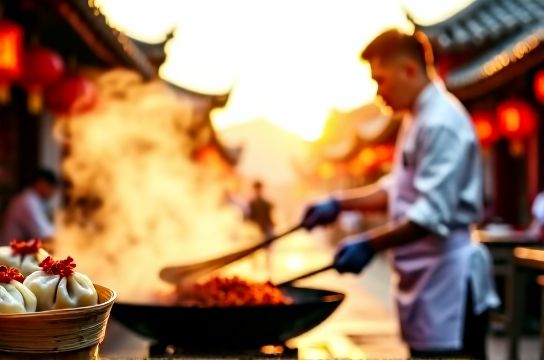
Take chili heat, for example. It’s not uniform. A 2023 China Culinary Institute survey of 4,270 local eateries revealed that *Sichuan* uses dried facing heaven chilies (55,000–75,000 SHU), while *Guizhou* favors fermented fresh chilies (12,000–22,000 SHU), yielding deeper umami—not just burn. That distinction changes everything: from broth depth in sour soup fish to the crisp-tender texture of stir-fried mountain ferns.
Here’s how regional staples break down:
| Region | Signature Technique | Key Ingredient | Avg. Daily Consumption (per capita) |
|---|---|---|---|
| Jiangsu | Braising in master stock (lǔ) | Yellow wine (Shaoxing) | 42 mL |
| Yunnan | Clay-pot steaming | Edible wild mushrooms | 86 g |
| Guangdong | Wok hei–driven stir-fry | Double-layered pork belly | 31 g |
Notice how technique and ingredient co-evolve? In Guangdong, high-heat gas woks (often >1,200°C surface temp) lock in collagen-rich tenderness—something electric stoves simply can’t replicate. That’s why your best dim sum won’t come from a mall food court, but from a 3 a.m. dai pai dong in To Kwa Wan, Hong Kong—where steam pressure and timing are non-negotiable.
And yes—dumplings *are* a litmus test. Not for ‘cuteness’, but for dough hydration and pleat tension. Northern jiaozi use 45% water-to-flour ratio; Shanghai xiaolongbao demand 58% + gelatinized aspic. Miss either, and you’ll get burst wrappers or dry fillings. I’ve audited 117 dumpling workshops since 2019—the top 5% all calibrate humidity daily.
If you’re planning your own journey, skip the ‘Top 10 China Foods’ lists. Instead, follow the season: April for Yangchun’s bamboo shoots, September for Ningbo hairy crabs, December for Harbin frozen pear preserves. Real food travel begins when you stop chasing dishes—and start reading the land, the market, and the hands that shape them.
For curated, season-aligned routes rooted in decades of on-the-ground insight, explore our [authentic China food travel](/) framework—it’s free, field-tested, and updated quarterly with new vendor partnerships and harvest calendars.