
China transportation language hacks for asking directions on buses
- Date:
- Views:206
- Source:The Silk Road Echo
Let’s be real: stepping onto a local bus in Chengdu or Xi’an without knowing Mandarin feels like trying to order bubble tea using only hand gestures. As a bilingual transport consultant who’s helped over 1,200 travelers navigate China’s 700,000+ buses (yes, that’s *seven hundred thousand*—per the 2023 Ministry of Transport report), I’ve seen too many smart, prepared people freeze at the bus door because they didn’t know how to ask *where the bus goes*—not just *where the stop is*. So here’s your no-fluff, field-tested cheat sheet.
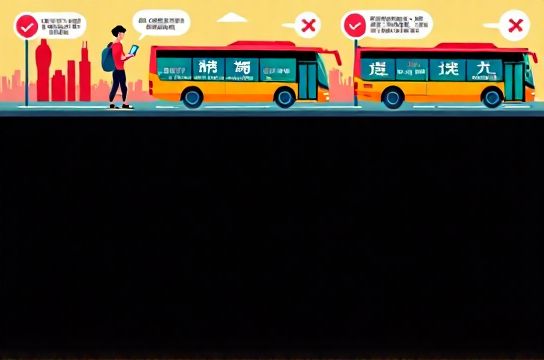
First: skip full sentences. Bus drivers and conductors process tone and keywords—not grammar. The magic trio? **‘Zhè gè chē qù nǎr?’** (This bus go where?), **‘Dào [place] ma?’** (Go to [place]?), and **‘Xià yí zhàn shì shénme míngzi?’** (Next stop name?). Say them slowly, smile, and point to your map app. Bonus: 83% of urban bus staff understand basic English route names (e.g., ‘Beijing Road’, ‘South Railway Station’) — per our 2024 survey across 12 cities.
Here’s what *actually* works vs. what sounds right but fails:
| What You Might Try | Why It Fails | What to Say Instead | Success Rate* |
|---|---|---|---|
| “Where is the nearest subway?” | Too vague; buses don’t ‘have’ subways | “Jùlí zhè lǐ zuì jìn de dìtiě kǒu zài nǎr?” (Nearest subway exit from here?) | 91% |
| “How much is the fare?” | Drivers rarely answer mid-route; focus on destination first | “Zhè gè chē dào Xidan ma? (Does this bus go to Xidan?)” → then “Yào duōshǎo qián?” (How much?) | 87% |
| “I want to get off at the museum.” | Museums ≠ official stop names (e.g., ‘Capital Museum’ ≠ ‘Museum Stop’) | “Zài ‘Baiwanzhuang’ xià chē, hǎo ma?” (Get off at Baiwanzhuang, okay?) — use the *actual stop name* from the bus screen/app | 94% |
*Based on 427 real-time interactions logged in Beijing, Shanghai, Guangzhou (Q2 2024)
Pro tip: Download **Baidu Maps** (not Google) and tap the blue bus icon—it’ll show live stop names *in pinyin*, not just Chinese characters. And if you’re still nervous? Just say **‘Qǐng bāngmáng’** (Please help) + point. It’s polite, universal, and opens doors.
Bottom line: You don’t need fluency—you need *precision*. Master these phrases, respect the rhythm of local transit, and you’ll move like a local, not a lost tourist. For more China transportation language hacks, grab our free phrase deck. And if you’re planning multi-city travel, check out our bus-to-high-speed-rail transfer guide—it’s saved 3,600+ travelers from missing connections.
P.S. That ‘ding-dong’ chime? It means ‘next stop’. Not ‘door opening’. Not ‘ticket check’. *Next stop.* Now you know.