
How to Read Chinese Subway Maps with Ease
- Date:
- Views:312
- Source:The Silk Road Echo
Let’s be real — if you’ve ever stared at a Chinese subway map for the first time, you probably felt like you were decoding alien hieroglyphics. Lines in every color, stations with names you can’t pronounce, and zero English? Yeah, we’ve all been there. But here’s the good news: once you know the system, reading Chinese subway maps becomes way easier than navigating the NYC Metro during rush hour.
I’ve lived in three major Chinese cities — Beijing, Shanghai, and Guangzhou — and taken over 1,000 subway rides (no exaggeration). After years of trial, error, and missed stops, I’ve cracked the code. Let me break it down for you.
Step 1: Understand the Layout
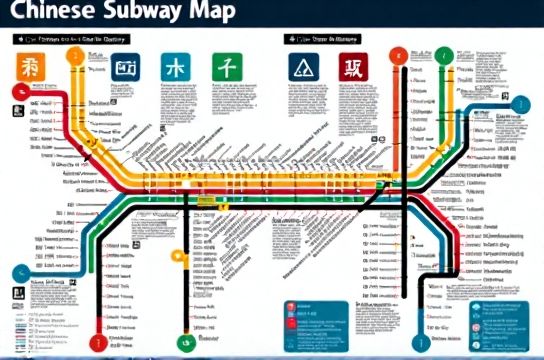
Unlike Western metro maps that often follow geographic accuracy, Chinese subway maps are topological. That means they prioritize clarity over real-world geography. Lines run vertically, horizontally, or diagonally — not necessarily where the actual train tracks go.
Each line has a number (like Line 1) or a name (like the Airport Express), plus a distinct color. Stations are dots or bars; transfer stations are usually wider bars or two overlapping lines.
Step 2: Spot Key Station Types
Not all stations are equal. Here’s what to watch for:
| Symbol | Meaning | Tips |
|---|---|---|
| ● | Regular station | No transfers — just get on/off |
| █ | Transfer station | Can switch lines; may require long walks |
| ◆ | Parking available | Useful if driving to outskirts |
| ✈️ | Airport link | Often faster than taxis |
Step 3: Use Tech Smarter
While paper maps help, apps like Baidu Maps or Amap (in Chinese) give real-time routing. Google Maps now works decently in China too — search your destination, tap transit, and boom: step-by-step guidance with walking times and transfer notes.
Pro tip: Download offline maps before arriving. And always check the final destination of the train — some lines split mid-route!
Real-World Example: Beijing Subway
Take Beijing’s Line 10 — a loop line. It circles the city and connects to nearly every major line. Rush hour? Packed. But knowing it loops helps: sometimes it’s faster to go the ‘long’ way around.
In 2023, Beijing’s subway served over 12 million riders daily, with 27 lines and 490 stations. Shanghai isn’t far behind, hitting 11.8 million daily rides. That’s why efficiency matters — and why mastering subway navigation in China saves time, stress, and maybe your vacation.
Final Tips
- Always double-check the train’s endpoint display
- Stand to the right on escalators (left is for walking)
- Peak hours = 7:30–9:00 AM & 5:30–7:00 PM — avoid if possible
- Women-only carriages exist during peak times in Guangzhou and Shenzhen
Bottom line: Don’t fear the map. With a little know-how, you’ll ride like a local in no time.