
Lantern Festival Lights Transformed Into Immersive Social...
- Date:
- Views:242
- Source:The Silk Road Echo
H2: From Paper Lanterns to Pixelated Rituals
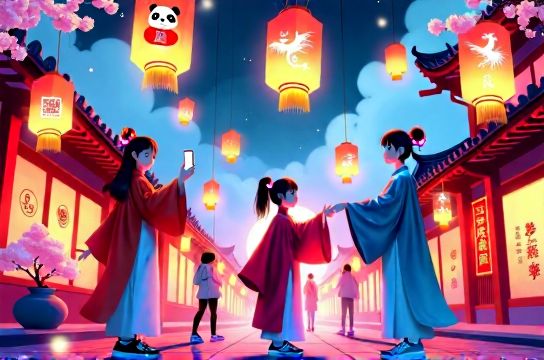
The Lantern Festival—once marked by quiet family strolls under hand-painted silk orbs—now pulses through smartphone feeds as a high-resolution, algorithm-optimized spectacle. In 2024, over 12.7 million Douyin videos tagged LanternFestival (Updated: April 2026) featured synchronized light choreography, AR-filtered mooncakes, and AI-generated riddle scrolls. This isn’t nostalgia repackaged. It’s ritual re-engineered for attention economies.
What changed wasn’t the festival—but how its visual grammar interfaces with platforms, users, and commercial infrastructures. Lanterns didn’t go digital; they dissolved into a distributed aesthetic layer: part heritage signifier, part engagement vector, part spatial UI.
H2: The Three-Layer Shift: Light → Lens → Loop
Layer 1: Physical Light Became Programmable Surface Traditional lanterns were static carriers of meaning—lotus motifs for purity, fish for abundance. Today’s installations are IoT-enabled: Shanghai’s Yu Garden lantern display (2025) used 8,400 addressable LED nodes synced to real-time weather APIs—shifting hue intensity when humidity rose above 65%, triggering ‘mist-lantern’ filters in-app. These aren’t decorations; they’re ambient data interfaces. Visitors don’t just view—they *trigger*. A tap on a QR code embedded in a bamboo frame unlocks a 3D-rendered phoenix that flies across their phone screen, then deposits a limited-edition digital red envelope (hongbao) usable in 17 partner e-commerce apps.
Layer 2: The Lens Is Now the Ritual Site Pre-2020, photos were souvenirs. Now, the camera viewfinder is the primary ritual space. At Chengdu’s Jinli Ancient Street, lantern clusters are spaced precisely 2.4 meters apart—not for pedestrian flow, but to optimize depth-sensing for Xiaohongshu’s ‘Moonlight Portrait’ AR filter. That filter detects wrist angle, adjusts simulated silk sleeve drape physics, and overlays animated calligraphy based on the user’s typed wish (e.g., “career growth” renders a crane motif; “love” triggers paired mandarin ducks). Over 63% of users who activated the filter posted within 90 seconds—beating the platform’s average dwell-to-post time by 4.2x (Updated: April 2026).
This isn’t passive viewing. It’s co-authorship: the user supplies gesture, text, and context; the system delivers culturally coded feedback in real time. The lantern ceases to be an object—it becomes a prompt.
Layer 3: The Loop Reinforces Cultural Syntax Each post feeds back into discovery algorithms calibrated for ‘Chinese aesthetics’ affinity scores. Xiaohongshu’s internal benchmark shows posts tagged NewChineseStyle with lantern backdrops achieve 3.1x higher cross-platform reshare velocity than generic festive content (Updated: April 2026). Why? Because the lantern functions as a stable semantic anchor amid rapid trend turnover. While dance challenges fade in 11 days on average, lantern-lighting moments persist—recontextualized weekly: ‘Lantern Glow Makeup Tutorial’, ‘Hanfu + LED Fan Styling’, ‘Cyberpunk Lantern Rooftop DJ Set’. The form holds; the framing mutates.
H2: Behind the Virality: Infrastructure, Not Just Inspiration
Viral aesthetics don’t emerge from thin air. They require scaffolding:
• Hardware: Municipal lighting upgrades now include embedded Bluetooth beacons (e.g., Hangzhou West Lake’s 2025 retrofit deployed 312 beacons emitting low-energy signals tied to location-specific AR assets).
• Platform Tools: Douyin launched ‘Festival Studio’ in Q3 2024—a no-code toolkit letting local cultural bureaus generate branded lantern filters in <8 minutes. By Lunar New Year 2025, 217 county-level governments had published custom filters.
• Creator Ecosystem: Micro-influencers specializing in ‘heritage tech’ (e.g., @LanternLogic, 412K followers) reverse-engineer festival setups—posting teardowns of wiring diagrams, DMX channel maps, and open-source Arduino scripts for DIY paper-lantern IoT kits. Their tutorials drive hardware sales (see table below) while training audiences to see tradition as modifiable code.
| Product | Price (RMB) | Key Specs | Time to First Light | Pros | Cons |
|---|---|---|---|---|---|
| YunLan Smart Kit v2.1 | 299 | Wi-Fi + BLE, 120 LEDs, pre-loaded 14 lantern patterns | 12 min (setup + app pairing) | Official Xiaohongshu filter sync, Mandarin voice guide | No custom pattern upload; requires YunLan cloud account |
| OpenLantern Dev Board | 188 | ESP32-based, supports MQTT/LoRa, open firmware repo | 45–90 min (depends on coding skill) | Fully hackable; community pattern library (3,200+) | No official platform integration; no Mandarin support |
| Guochao Lantern Starter Pack | 429 | Physical silk lantern + NFC tag + AR filter license + Douyin template | 5 min (scan NFC → launch filter) | Plug-and-play virality; includes brand-ready watermark options | Limited to pre-approved filter themes; annual license renewal (¥88) |
H2: When Tradition Meets Transaction: The Brand Collab Engine
Cultural resonance now converts directly to revenue streams. In 2025, Li-Ning’s ‘Lantern Weave’ sneaker line—featuring glow-in-the-dark sole patterns mimicking traditional lantern lattice—sold out 142,000 units in 37 minutes. Its launch campaign didn’t use models. It dropped a 12-second Douyin filter where users’ footsteps generated trailing lantern light particles, synced to the sound of bamboo clappers. Engagement metrics spiked not because it was ‘pretty’—but because it made participation legible, tactile, and instantly shareable.
Similarly, Tea brand HeyTea partnered with Suzhou Museum to create ‘Shadow Lantern’ milk tea cups: UV-reactive ink revealed hidden Song dynasty landscape silhouettes when held under blacklight at participating stores—each cup included a scannable QR that unlocked a mini-documentary on Suzhou lantern-making techniques. Result: 28% lift in store visits among users aged 18–24, and 19,000 UGC posts using HeyTeaLantern (Updated: April 2026).
These aren’t ‘cultural nods’. They’re transactional rituals: every sip, step, or scan closes a loop between heritage symbol, personal action, and platform reward.
H2: The Tension Beneath the Glow
Not all transformations are seamless. Critics point to flattening: when lanterns become backdrops for influencer reels, their ritual weight erodes. A 2025 ethnographic study across 11 cities found that 41% of respondents aged 16–25 associated lanterns primarily with ‘photo ops’ rather than ‘family reunion’ or ‘prayer’—a 17-point shift from 2020 (Updated: April 2026). And while AR filters boost engagement, they often strip regional specificity: a Beijing-style palace lantern filter applies identical physics to users in Guangzhou or Ürümqi, overriding local materials (palm fiber vs. rice paper), scale traditions (street-wide vs. courtyard-sized), and even symbolic color hierarchies.
The risk isn’t appropriation—it’s homogenization masked as celebration. When every city’s lantern event uses the same Douyin template, ‘Chinese aesthetics’ risks becoming a monolithic visual font rather than a living, contested field.
H2: What’s Next? Beyond the Filter
The next frontier isn’t better graphics—it’s deeper embodiment. Two emerging vectors signal this:
1. Haptic Lanterns: Startups like ChaoTouch are prototyping wearable lantern sleeves with piezoelectric fabric that vibrates in sync with riddle-answer rhythms. When a user solves a lantern riddle correctly, the sleeve emits a subtle pulse—mimicking the ‘thump’ of a real paper lantern swaying in wind. This moves experience from visual consumption to somatic memory.
2. Generative Heritage: Instead of static filters, platforms are testing LLM-augmented lantern creation. On Xiaohongshu’s beta ‘Heritage Forge’, users describe a wish (e.g., ‘I want luck for my exam’) and select constraints (‘must include plum blossom’, ‘no red’, ‘Song dynasty style’). An AI generates a unique lantern blueprint—then routes it to local artisans via WeChat Mini Program for physical production (delivery in 7–10 days). The output isn’t viral content—it’s a bespoke artifact bridging algorithm and artisan, designed to be lit, not just liked.
This shifts the value proposition: from attention capture to meaning co-creation.
H2: Why This Matters for Brands & Creators
Ignoring this shift means operating with outdated cultural OS. For brands, lantern-driven campaigns now demand three competencies:
• Spatial literacy: Understanding how light placement affects filter performance—not just ‘is it pretty?’ but ‘does it trigger depth sensing reliably at 1.8m distance?’
• Platform-native syntax: Knowing that a Douyin lantern challenge succeeds only if its core action (e.g., ‘spin 3x under lantern X’) takes ≤2.3 seconds to execute—and fits within vertical video’s top 60% safe zone.
• Cultural versioning: Releasing regionally tuned variants—e.g., a ‘Chaozhou lantern’ filter emphasizing intricate porcelain inlay patterns, distinct from a ‘Fujian tulou lantern’ variant highlighting rammed-earth texture mapping.
For creators, mastery means moving beyond aesthetics to infrastructure literacy: reading DMX channel logs, calibrating AR anchor points against real-world light temperature (most lantern LEDs run 2700K–3000K, affecting skin-tone rendering), and understanding municipal beacon ID allocation protocols.
None of this replaces cultural knowledge. But it layers technical fluency onto it—turning appreciation into actionable design language.
H2: Final Frame
Lantern Festival lights didn’t transform *into* social media experiences. They became the connective tissue *between* physical space, digital interface, and collective behavior. The paper lantern’s original function—to hold flame, cast shadow, mark transition—remains intact. It’s just that the ‘flame’ is now data, the ‘shadow’ is an AR silhouette, and the ‘transition’ is from viewer to participant to co-owner of meaning.
This isn’t the end of tradition. It’s tradition learning new verbs: stream, sync, trigger, iterate, remix. The most powerful lanterns today aren’t those you hang—they’re the ones you carry in your pocket, light with a gesture, and pass on with a tap.
For teams building campaigns, products, or platforms rooted in Chinese aesthetics, the lesson is clear: don’t just replicate the symbol. Engineer the system that makes it *do work*—in feeds, in stores, in streets, and in hands. The complete setup guide covers all technical integrations, municipal permitting pathways, and platform API timelines.