
Yinchuan vs Dunhuang: China City Comparison
- Date:
- Views:204
- Source:The Silk Road Echo
H2: Two Deserts, Two Worlds — But Which One Fits Your Trip?
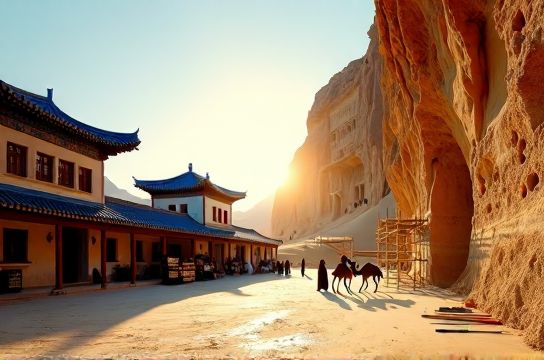
You’re planning a trip to Northwest China. You’ve heard about the sand dunes, the ancient caves, the halal lamb skewers sizzling over charcoal — but you only have 5–7 days. Do you split time? Or go deep in one place? Yinchuan and Dunhuang are both desert-adjacent, both historically layered, and both reachable via domestic flights from Xi’an or Lanzhou — yet they deliver radically different travel experiences. This isn’t just geography; it’s worldview versus worship, community rhythm versus archaeological awe.
Let’s cut past the brochures. We’ll compare them like a local tour operator would: on logistics, authenticity, sensory impact, and what actually holds up after Day 3.
H2: Geography & Access — Not Just Distance, But Density
Yinchuan sits in the fertile Ningxia Plain, cradled by the Helan Mountains to the west and the Yellow River to the east. It’s not technically *in* the desert — it’s a green oasis built atop a desert edge. Dunhuang, by contrast, is embedded in the Kumtag Desert — the easternmost reach of the Taklamakan. Its airport (DNH) handles ~1.2 million passengers annually (Updated: June 2026), with seasonal direct flights from Beijing, Shanghai, and Chengdu. Yinchuan Hedong Airport (INC) handled 9.8 million passengers in 2025 — nearly 10× Dunhuang’s volume — reflecting its role as a regional hub and provincial capital.
That matters for your itinerary: Dunhuang has no high-speed rail. The nearest G-train station is Jiayuguan (3.5 hours away by road). Yinchuan is on the Lanzhou–Yinchuan High-Speed Railway (G-series), connecting to Xi’an in 4h12m and Lanzhou in 2h07m (Updated: June 2026). If you’re coming from central or eastern China, Yinchuan is significantly easier to reach without overnight buses or charter vans.
But ease ≠ depth. Dunhuang’s isolation is part of its power. There’s no urban sprawl diluting the silence before sunrise at Crescent Lake. Yinchuan offers convenience — and more infrastructure for families, longer stays, or multi-generational groups.
H2: Culture — Hui Identity vs. Silk Road Syncretism
Yinchuan is the capital of Ningxia Hui Autonomous Region — China’s only autonomous region named after a Muslim ethnic group. Over 35% of its 2.3 million residents are Hui (Updated: June 2026, Ningxia Statistical Yearbook). That’s not window dressing. It’s visible in the 37 active mosques across the city — including the 600-year-old South Mosque, where Friday prayers draw 800+ worshippers. It’s audible in the call to prayer echoing over Tang-style courtyards, and edible in the strict halal certification stamped on every packaged snack in supermarkets.
Dunhuang’s cultural DNA is older, stranger, and far less homogenous. The Mogao Caves aren’t ‘Buddhist’ in a monolithic sense — they contain Nestorian Christian inscriptions, Manichaean sutras, Zoroastrian motifs, and Sanskrit, Tibetan, Uyghur, and Sogdian manuscripts. The site reflects 1,000 years of trans-Eurasian exchange — not a single living tradition. Today’s Dunhuang residents are predominantly Han Chinese (≈82%), with small Uyghur and Hui minorities. There’s no functioning mosque in central Dunhuang; the nearest major Hui community is in Guazhou County, 90 km east.
So here’s the practical distinction: In Yinchuan, you experience *living* Hui Muslim culture — daily rhythms, food ethics, intergenerational language use (many elders speak Northwestern Mandarin with Arabic loanwords like 'habibi' for 'dear'), and quiet resistance to assimilation. In Dunhuang, you engage with *archaeological* pluralism — breathtaking, yes, but mediated through conservation protocols, timed entry slots, and mandatory guided tours (no flash photography, no touching murals, no solo access to most caves).
Neither is ‘more authentic’. They’re different categories: one is ethnolinguistic continuity; the other is material heritage preservation.
H2: Food — Halal Precision vs. Oasis Ingenuity
Yinchuan’s food scene is defined by halal rigor and regional specificity. Lamb is king — but not just any lamb. It’s grass-fed, dry-aged for 48 hours, and cooked in three signature ways: hand-pulled noodles with stewed lamb ('yangrou paomo' style, though Ningxia calls it 'shouba mian'), roasted whole lamb on open pits ('kao quan yang'), and fermented lamb dumplings ('suan yang jiaozi') served with vinegar-fermented garlic paste. Street vendors in Shuimogou Night Market weigh meat on brass scales and recite Quranic verses before slicing — not performance, but practice. Vegetarian options exist (stir-fried fiddlehead ferns, yellow millet cakes), but they’re secondary. Expect zero pork, zero alcohol in halal restaurants — and zero ambiguity about certification.
Dunhuang’s cuisine is born of scarcity and trade. With little arable land, chefs rely on preserved, dried, and rehydrated ingredients: sun-dried apricots from Yangguan Pass, desert cress (‘sha gan cai’), and camel-milk yogurt. The iconic dish is 'da bing' — a thick, unleavened flatbread baked in clay ovens, often stuffed with minced mutton, cumin, and pickled mustard greens. It’s hearty, portable, and designed for caravans — not fine dining. You’ll find decent halal options near the tourist core (e.g., Dunhuang Muslim Restaurant on Shazhou Road), but standards vary: some use frozen lamb, others substitute beef for cost — and none carry the institutional halal oversight seen in Yinchuan’s certified kitchens.
Bottom line: If dietary compliance is non-negotiable (e.g., for observant Muslim travelers or those with strict allergen needs), Yinchuan wins hands-down. If you want culinary storytelling rooted in survival and trade routes — Dunhuang delivers texture, not theology.
H2: Sites & Sensory Impact — Community vs. Monument
Yinchuan’s top sites are human-scaled and participatory:
• Western Xia Tombs: 10km west of the city, these pyramid-shaped mausoleums of Tangut emperors sit amid scrubland — accessible by e-bike or shared van. No crowds. You can walk the perimeter, feel wind off the Helan Mountains, and chat with local guides who recite Tangut poetry translations.
• Haibao Pagoda Temple: A Ming-era Buddhist-Hui hybrid structure where Hui artisans carved Quranic verses into wooden lintels alongside lotus motifs. Open daily; no ticket required.
• Helan Mountain Rock Art: 4,000+ petroglyphs dating back 4,000 years — accessible via 2WD track. Fewer than 30 visitors per day. Bring water, GPS, and respect.
Dunhuang’s highlights are institutionally managed and emotionally overwhelming:
• Mogao Grottoes: 492 extant caves, 45,000 sqm of murals, 2,000+ painted sculptures. Entry requires advance booking (via www.mogaoku.com) and a mandatory 90-minute museum orientation. You see only 8–10 caves per visit — selected weekly by conservation staff. The experience is reverent, hushed, and deliberately paced. No photos inside. You leave with a deeper understanding of pigment chemistry (vermilion from cinnabar, lapis lazuli imported from Afghanistan) than spiritual insight.
• Crescent Lake & Echoing Sand Dunes: A surreal geological accident — a freshwater lake in the middle of moving dunes. Best experienced at dawn, when temperature inversion creates mirror-like reflections. Camel rides are regulated (¥80/person for 30 mins, licensed operators only). Don’t expect solitude: peak season sees 6,000+ daily visitors (Updated: June 2026, Dunhuang Tourism Bureau).
H2: Logistics & Travel Realities — What the Brochures Won’t Tell You
Accommodation in Yinchuan is abundant and mid-range: ¥220–¥480/night for clean, English-speaking hotels near the Drum Tower. Dunhuang has fewer reliable options — especially outside July–October. Many guesthouses close November–March. Book ahead.
Transportation: Yinchuan has a functional metro (Line 1, 12 stations), Didi coverage, and bike-share zones. Dunhuang relies on taxis (¥15–¥30 between town and Mogao) and pre-booked minivans (¥200–¥350/day for 4–6 people to cover Mogao, Crescent Lake, and Yumen Pass).
Weather is decisive. Both cities average <200mm annual rainfall, but Yinchuan’s humidity hovers at 45–55% year-round — comfortable for walking. Dunhuang hits 15–20% humidity in summer, with surface temps exceeding 70°C on dune crests. Mornings and evenings are essential. Pack saline nasal spray — seriously.
| Feature | Yinchuan | Dunhuang |
|---|---|---|
| Airport Passengers (2025) | 9.8 million | 1.2 million |
| HST Access | Yes (Lanzhou–Yinchuan line) | No — nearest G-station: Jiayuguan (3.5 hrs by road) |
| Halal Certification Rigor | Mandatory municipal oversight; QR-code traceability on packaging | Voluntary; limited third-party verification |
| Mogao/Yinchuan Site Access | Western Xia Tombs: walk-in, no booking | Mogao Grottoes: must book 7+ days ahead online |
| Peak Season Crowds | Moderate (Drum Tower area busiest May–Oct) | High (Mogao queues 60–90 mins April–Oct) |
H2: Who Should Choose Which — And Why
Choose Yinchuan if: • You prioritize halal integrity, family-friendly infrastructure, or want to understand how Islam adapts within Han-majority China. • You’re combining with Xi’an or Lanzhou and value seamless rail links. • You prefer cultural immersion over monument-worship — chatting with mosque elders, learning to knead lamb-filled buns, or watching Hui calligraphers ink Arabic onto rice paper.
Choose Dunhuang if: • You’re an art historian, archaeology student, or simply need to stand in front of 8th-century Bodhisattva murals and feel time collapse. • You seek stark, cinematic landscapes — dunes at golden hour, starfields unblurred by light pollution, the silence of a 1,200-year-old manuscript room. • You accept logistical friction (booking stress, transport gaps, seasonal closures) as part of the pilgrimage.
H2: The Hybrid Option — Is It Viable?
Yes — but only with realistic expectations. The road distance is 820 km (10–12 hrs by bus; not recommended). The flight hop (INC → DNH) takes 1h15m but has only 3–4 weekly departures outside summer. Most travelers who attempt both do so via Lanzhou as a pivot: fly Lanzhou → Yinchuan (1h), then Lanzhou → Dunhuang (1h20m). Total added transit time: ≈14 hours, plus ¥1,600–¥2,400 airfare round-trip (economy, Updated: June 2026).
Unless you have 10+ days and deep stamina, we recommend choosing one — then using the saved time to go deeper. In Yinchuan, that means hiring a Hui guide for a full-day Helan Mountain rock art trek. In Dunhuang, it means booking the ‘Special Tour’ to Cave 220 (normally closed) or spending a sunrise-to-sunset session with the Dunhuang Academy’s mural conservation team (requires application 30 days ahead).
H2: Final Verdict — Not ‘Better’, But ‘Truer To Your Intent’
There’s no universal ‘best tourism city’ here. Yinchuan delivers consistency, accessibility, and lived cultural resilience. Dunhuang delivers irreplaceable scale, fragility, and historical vertigo. One asks you to witness community endurance; the other asks you to bear witness to time itself.
If your goal is to understand how minority identity functions in contemporary China — start in Yinchuan. If your goal is to confront the physical evidence of Eurasian civilizational dialogue — begin in Dunhuang. Either way, you’ll leave with more questions than answers — and that’s exactly how it should be.
For travelers needing end-to-end support — from visa letters to certified Hui guides or Mogao pre-booking assistance — our full resource hub provides vetted local partners, real-time permit alerts, and bilingual itinerary templates (Updated: June 2026).