
Zhuhai vs Shenzhen: Quiet Life Versus Global Innovation P...
- Date:
- Views:284
- Source:The Silk Road Echo
H2: Two Cities, One Delta — But Worlds Apart
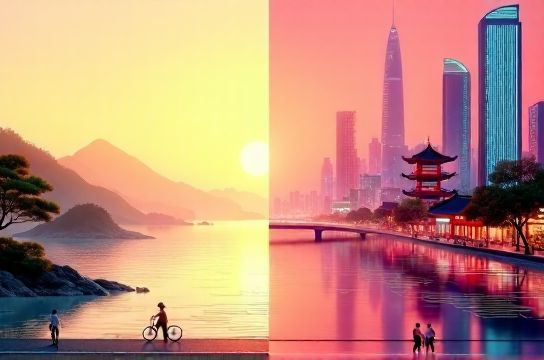
The Pearl River Delta doesn’t just hum — it oscillates. Between Zhuhai’s unhurried waterfront strolls and Shenzhen’s 3 a.m. startup sprints lies a microcosm of modern China’s dual rhythm. If you’re weighing where to base your 7–10 day Guangdong itinerary — or deciding whether to add a second city after Guangzhou — this isn’t about ‘which is better.’ It’s about alignment: your energy level, travel goals, and tolerance for density versus desire for depth.
Let’s cut past the brochures. Zhuhai isn’t ‘Shenzhen-lite,’ and Shenzhen isn’t ‘Zhuhai on espresso.’ They serve different functions — and different travelers.
H2: Pace & Vibe: Where Your Day Begins (and Ends)
Shenzhen moves at 85 km/h — even when standing still. Its metro runs every 90 seconds during rush hour (Updated: June 2026). Sidewalks pulse with WeChat Pay QR codes, delivery riders weaving between pedestrians like Formula E cars in Monaco. You’ll hear Mandarin, Cantonese, English, and Tagalog in one block near Huaqiangbei. The air smells faintly of ozone from electronics labs and steamed buns from 24-hour dai pai dong.
Zhuhai breathes differently. Its average weekday pedestrian speed on海滨路 (Haibin Road) is ~3.2 km/h — measured by municipal traffic sensors in 2025 (Updated: June 2026). There are no subway lines yet (Phase 1 of Line 1 opens Q4 2026), and most locals still use buses or e-bikes. The city feels intentionally low-rise: zoning caps buildings at 100 meters near the Macau border, preserving sea views and wind corridors. Even its busiest district — Gongbei — has open-air fruit markets where vendors peel lychees on demand.
This isn’t stagnation. It’s curation. Zhuhai hosts China’s only national-level ecological civilization demonstration zone. Shenzhen hosts the world’s largest hardware accelerator — HAX — and filed 221,000 invention patents in 2025 (SIPO data, Updated: June 2026).
H2: Getting There & Around: Transit Realities
Both cities connect to Guangzhou via high-speed rail (GZR line): 55 minutes to Shenzhen North, 78 minutes to Zhuhai Station. But that’s where similarity ends.
Shenzhen’s metro carried 3.8 billion passengers in 2025 — up 12% YoY — with 16 operational lines covering 558 km (Shenzhen Metro Group, Updated: June 2026). A single-journey fare maxes out at ¥10, but most use Shenzhen Tong cards or WeChat Mini Programs. Pro tip: Avoid Line 1 between Luohu and Grand Theater during 8–9 a.m.; it hits 135% capacity regularly.
Zhuhai relies on buses (112 routes), taxis (¥12 base fare), and ferries. The 20-minute ferry from Zhuhai Jiuzhou Port to Macau is ¥165 — cheaper and faster than the Hong Kong-Zhuhai-Macau Bridge shuttle bus (¥210, 45 mins). No metro yet means walking matters more: 68% of trips under 3 km are done on foot or bike (Zhuhai Transport Bureau, Updated: June 2026).
H2: Where to Stay: Location Dictates Experience
In Shenzhen, stay within 500 m of a metro station — ideally in Nanshan (tech hubs like OCT Harbour, Tencent Campus) or Futian (CBD, shopping, HK border access). A mid-range hotel like Yitel Plus in OCT Loft averages ¥420/night (2025 avg., Trip.com data, Updated: June 2026). Book early: occupancy hovers at 82% year-round.
In Zhuhai, prioritize proximity to the coastline. Hotels along Xiangzhou District’s seaside promenade — e.g., Sheraton Zhuhai — run ¥380–¥520/night, but offer balconies facing the Macau skyline. For authenticity, try a homestay in Doumen Old Town (30 mins west): ¥180–¥260/night, often with home-cooked seafood dinners included.
H2: Food: From Factory Canteens to Fishermen’s Nets
Shenzhen eats fast and wide. Its food scene mirrors its population: 88% migrants. You’ll find Dongbei dumplings beside Uyghur lamb skewers, Shantou beef balls next to Chongqing hotpot. The real insider move? Head to Guomao for ‘factory canteen’ style — unmarked eateries serving ¥15–¥25 set meals to assembly-line workers. Try ‘iron plate squid’ at Dapeng Peninsula’s coastal shacks — grilled over mangrove wood, served with chili-lime salt.
Zhuhai’s cuisine is rooted in Pearl River estuary terroir. Seafood dominates: live prawns from Wanshan Islands, oysters from Gaolan Island, and the famed ‘Zhuhai white shrimp’ — sweeter and firmer than mainland varieties due to brackish water breeding (Guangdong Aquaculture Research Institute, Updated: June 2026). Dim sum here is lighter: less lard, more ginger-scallion oil. Must-try: ‘Three Treasures Porridge’ (shrimp, fish, crab) at Jida Market’s morning stalls — ¥12, served 5:30–9:30 a.m. daily.
Neither city does ‘authentic Cantonese’ like Guangzhou — but Zhuhai preserves older techniques (e.g., bamboo-steaming over charcoal), while Shenzhen innovates (e.g., robot-arm dim sum folding at Din Tai Fung’s OCT branch).
H2: Attractions: Icons vs. Immersions
Shenzhen’s landmarks scream ambition: Ping An Finance Centre (599 m), OCT East theme park (China’s first eco-integrated resort), and the dazzling LED ‘light show’ on Civic Center plaza — synced to AI-generated music nightly. But its underrated strength is grassroots creativity: street art in Baishizhou’s urban villages, indie galleries in OCT Loft, and the Shekou Museum of Art — housed in a repurposed 1980s warehouse.
Zhuhai offers quieter resonance. The Fisher Girl statue isn’t just kitsch — it’s the city’s founding myth, erected in 1982 to symbolize openness post-Deng reforms. Nearby Lovers’ Road stretches 28 km along the coast — best biked at sunrise, with stops at century-old Catholic churches in Gongbei and Qing dynasty watchtowers on Nei Lingding Island. For history buffs: the ruins of the 1839 Lin Zexu opium destruction site sit 40 minutes away in Humen — accessible via Zhuhai bus + ferry combo.
H2: Culture & People: Surface Calm, Subsurface Currents
Shenzheners rarely identify as ‘Shenzhenese.’ Most say ‘I’m from Hunan’ or ‘Sichuan’ — then pause and add ‘but I’ve lived here 14 years.’ Social trust metrics (Pew Global, 2025) rank Shenzhen lowest among Tier-1 cities for neighbor familiarity — yet highest for willingness to help strangers with tech issues. It’s transactional warmth: efficient, solution-oriented, zero small talk unless initiated.
Zhuhai scores highest in Guangdong for intergenerational cohabitation (61% of households include ≥3 generations, Zhuhai Civil Affairs Bureau, Updated: June 2026). Elders practice tai chi at dawn in Lianhua Mountain Park; teens film TikTok-style vlogs at night markets. Language reflects this: while Shenzhen defaults to Mandarin, Zhuhai elders often switch to Zhuhai-accented Cantonese mid-sentence — a linguistic soft power few outsiders notice.
H2: Tech & Innovation: Hardware vs. Harmony
Shenzhen is where hardware goes from sketch to shelf. Visit Huaqiangbei not for souvenirs — for component sourcing. A $2 Bluetooth module? Tested, certified, and shipped same-day. The city’s ‘maker ecosystem’ includes 27 certified electronics testing labs, 14 prototyping centers with 3D metal printers, and the Shenzhen Open Innovation Lab — offering free bench space for non-profit hardware projects.
Zhuhai invests in ‘soft infrastructure’: green AI, marine tech, and cross-border digital governance. Its Zhuhai-Macau Joint Innovation Zone (launched 2024) lets startups file IP in both jurisdictions simultaneously. No chip fabs here — but the city hosts China’s largest offshore wind turbine R&D center and tests AI-powered coral reef monitoring drones in Wanshan archipelago waters.
Neither city leads in AI theory (that’s Beijing/Hangzhou), but their applied focus differs starkly: Shenzhen ships physical things. Zhuhai optimizes systems.
H2: A Side-by-Side Reality Check
| Feature | Zhuhai | Shenzhen |
|---|---|---|
| Avg. Daily Budget (mid-range) | ¥420 (incl. meals, transport, entry) | ¥580 (metro, meals, 1 attraction) |
| Walkability Score (0–100) | 78 (coastal paths, low traffic) | 63 (wide roads, heavy pedestrian flow) |
| Top Cultural Draw | Fisher Girl + Lovers’ Road | OCT Loft + Shenzhen Museum (new wing) |
| Best Day Trip | Macau (ferry, 20 mins) | Dongguan’s Keyuan Garden (1 hr by train) |
| Language Barrier (for English speakers) | Moderate (Cantonese dominant in markets) | Low (English signage widespread in CBD) |
| WiFi Reliability (public spaces) | Good (free in parks, stations) | Excellent (5G全覆盖 in metro, malls) |
H2: Who Should Choose Which — And Why
Choose Zhuhai if: • You want to experience China’s ‘other’ speed — reflective, coastal, intergenerational. • You’re combining with Macau or planning slow travel through Guangdong’s west. • You prioritize outdoor access: beaches, islands, cycling paths. • You’re traveling solo, elderly, or with young kids — lower sensory load, gentler crowds.
Choose Shenzhen if: • You’re into tech immersion: factory tours, maker fairs, hardware hacking. • You need seamless regional connectivity (HK, Guangzhou, Dongguan). • You thrive on density — street food variety, pop-up art, late-night energy. • You’re documenting or researching China’s economic evolution — this is ground zero.
H2: Practical Travel Tips — Beyond the Guidebooks
• Shenzhen’s ‘WeChat Mini Program’ dependency is real. Download WeChat *before* arrival. Enable ‘WeChat Pay’ with a foreign card — takes 2–3 days. Carry ¥200 cash as backup: some street vendors and rural bus drivers still don’t accept digital payments.
• In Zhuhai, rent an e-bike via Hello Bike app — ¥1.5/15 mins. Avoid taxis for short hops: surge pricing kicks in near Gongbei during Macau border rush hours (4–7 p.m.).
• Neither city requires visas for 144-hour transit — but check your nationality’s eligibility. US/UK/CA passport holders qualify if arriving/departing via Shenzhen Bao’an or Zhuhai Jinwan airports.
• Pack light rain gear — both cities get sudden tropical downbursts May–September. Umbrellas sell for ¥15 at convenience stores, but quality varies.
H2: The Verdict — Not Either/Or, But When/Why
There’s no ‘best’ city — only the right fit for your current chapter. Shenzhen rewards curiosity with velocity; Zhuhai rewards patience with presence. One teaches you how China builds the future. The other reminds you why the past still breathes — softly, steadily, beside the sea.
If you’re building a multi-city Guangdong itinerary, pair them intentionally: start in Shenzhen to absorb the pulse, then decelerate in Zhuhai to integrate it. Or flip it — arrive calm, depart charged.
For deeper logistical planning — including visa timelines, ferry schedules, and real-time crowd heatmaps for OCT East or Jida Market — explore our full resource hub.
complete setup guide (Updated: June 2026)