
Yantai vs Weihai: China City Comparison
- Date:
- Views:228
- Source:The Silk Road Echo
H2: Two Shandong Coastlines, Two Different Souls
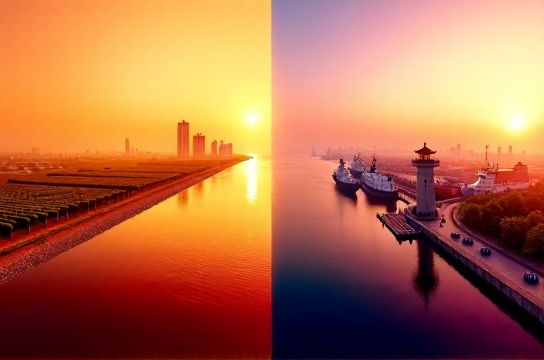
Yantai and Weihai sit just 130 km apart along China’s northern Yellow Sea coast — both polished port cities with clean air, seawall promenades, and deep roots in modern Chinese state-building. But scratch the surface, and they diverge sharply: Yantai leans into viticulture, industrial pragmatism, and domestic tourism infrastructure; Weihai breathes naval legacy, treaty-port quietude, and a slower, more reflective pace. Neither is ‘better’ — but choosing wrong can misalign your trip’s core intent.
This isn’t about ranking ‘best’ cities. It’s about matching terrain to traveler type: Are you here for tasting notes or treaty clauses? For barrel rooms or battle maps?
H2: Wine Culture vs Naval History — The Defining Divide
Yantai’s identity is bottled — literally. Home to China’s oldest modern winery (Changyu, founded 1892), it hosts over 140 wineries today, including international joint ventures with French and Australian partners. Vineyards sprawl across the Penglai plateau (just north of Yantai proper), where maritime fog, granite soils, and 2,200 annual sunshine hours create conditions unusually favorable for Cabernet Sauvignon and Chardonnay (Updated: June 2026). The local government actively promotes ‘China’s Bordeaux’ branding — complete with an annual International Wine Expo and a dedicated Wine Culture Museum near Zhifu Island.
Weihai tells a different story — one written in steel and treaties. It was the base of the Qing Dynasty’s Beiyang Fleet, famously destroyed during the 1895 Battle of Weihaiwei — a defeat that catalyzed imperial collapse. Today, Liugong Island preserves artillery batteries, a reconstructed naval academy, and the Beiyang Fleet Memorial Hall. Unlike Yantai’s celebratory tone, Weihai’s historical narrative is somber, layered, and deeply educational — less about pride, more about reckoning. Its treaty-port past (ceded to Britain 1898–1930) left Edwardian-era villas, a British-built lighthouse, and an unusually preserved colonial streetscape in the Huancui district.
Neither city trades in nostalgia alone. Yantai anchors its wine sector with R&D partnerships at Ludong University and hosts China’s only national-level Grape & Wine Quality Inspection Center. Weihai invests heavily in naval archaeology — its underwater survey team has mapped over 17 shipwrecks from the 1894–1895 Sino-Japanese War, with three now accessible via guided dive programs (permit required; max 8 divers/week) (Updated: June 2026).
H2: Scenery & Infrastructure — Same Coast, Different Rhythm
Both cities boast 200+ km of coastline, but their shorelines serve distinct purposes. Yantai’s seafront is engineered for volume: the 30-km Yantai Golden Seaside Boulevard hosts mass fitness events, seasonal beer gardens, and cruise terminals handling ~450,000 passengers annually (2025 data, Shandong Port Group). Beaches like Moon Bay are wide, sandy, and family-oriented — think inflatable castles, rental bikes, and seafood barbecue stalls.
Weihai’s coastline is narrower, rockier, and intentionally low-density. The 50-km Coastal Scenic Road winds past secluded coves (e.g., Chengshantou Cape — easternmost point of mainland Shandong), abandoned lighthouses, and tidal pools rich in abalone and sea cucumber. No cruise ships dock here. The sole passenger terminal handles ferries to Dalian and Incheon only — no international cruise lines operate in Weihai (confirmed with Weihai Port Authority, Updated: June 2026).
Public transport reflects this divergence. Yantai runs a functional BRT system (Bus Rapid Transit) with 5 corridors and real-time GPS tracking on all major routes — ideal for hopping between wineries and downtown. Weihai relies on conventional buses and a compact, free public bike-share network (12,000 bikes, 850 stations), optimized for short hops between historic sites and seaside cafes. Neither city has metro — but Yantai’s rail station connects to Beijing (4h 22m G-train) and Shanghai (6h 18m), while Weihai requires a transfer at Qingdao or Yantai for high-speed service.
H2: Food — Seafood, But With Different Accents
Yes, both serve razor clams, sea urchin roe, and braised abalone. But preparation philosophy differs.
Yantai cuisine is pragmatic and wine-forward. Local chefs pair dishes explicitly with regional vintages: smoked mackerel with dry rosé from Penglai; steamed pomfret with crisp, unoaked Chardonnay. Restaurants like Changyu Icewine Castle Restaurant offer fixed-price tasting menus (¥298–¥588) with vertical wine flights. Street food skews hearty — ‘Yantai-style’ baozi stuffed with shrimp-and-pork, sold from carts near the South Mountain Market.
Weihai food is quieter, preservation-minded. Fermentation dominates: ‘Weihai shrimp paste’ (zheng xia jiang), aged 6–12 months in ceramic crocks, appears in dumpling fillings and dipping sauces. ‘Salt-cured squid’ — air-dried over pine smoke — is a common bar snack paired with local millet beer (not wine). At Xiaoguoshan Fisherman’s Wharf, vendors sell ‘cold-sea jellyfish salad’ tossed tableside with sesame oil and aged vinegar — a dish unchanged since the 1920s.
Vegetarian options are limited in both cities (<5% of menu items at mid-range restaurants), but Weihai edges ahead with Buddhist vegetarian restaurants near Guanghua Temple — a legacy of its early 20th-century Japanese community. Yantai’s vegan scene is newer, centered on university-area cafés serving soymilk-based ‘red wine foam’ lattes.
H2: Accommodation & Visitor Flow — Who Shows Up, and Why
Yantai draws domestic group tours — 68% of its 2025 overnight visitors came via organized packages (Shandong Tourism Bureau data). Hotels cluster near the port and Penglai: 4-star chains (Home Inn Plus, Jinjiang Inn) dominate, with average room rates ¥260–¥380. Boutique options exist (e.g., Chateau Laffite Yantai, a converted winery villa), but they’re booked 92% of the time May–October (Updated: June 2026).
Weihai attracts independent travelers, retirees, and academic groups — especially historians and marine archaeologists. Its lodging mix is more residential: 52% of stays occur in licensed homestays (min-su), often former British-era villas retrofitted with Wi-Fi and underfloor heating. Average nightly rate: ¥190–¥320. No international hotel brands operate in Weihai proper — the nearest Hilton is in Qingdao (110 km away).
Language support follows suit. Yantai’s major attractions have English signage and audio guides (standard since 2021 upgrade). Weihai provides English brochures at key sites, but staff fluency is spotty outside Liugong Island’s main museum — bring a translation app or hire a certified guide (¥320/day, bookable via the Weihai Cultural Tourism Bureau website).
H2: A Side-by-Side Reality Check
| Feature | Yantai | Weihai |
|---|---|---|
| Primary Identity Hook | China’s wine capital — production, tourism, R&D | National naval memory site — education, preservation, reflection |
| Best For | Families, wine enthusiasts, group travelers, food-wine pairing seekers | History scholars, solo travelers, photographers, slow-living advocates |
| Transport Access | Direct G-trains to Beijing/Shanghai; domestic flights to 12 hubs | No direct high-speed rail; bus/train to Qingdao/Yantai required (1.5–2 hrs) |
| English Support | Strong at wineries, museums, hotels; staff trained post-2020 | Limited outside Liugong Island; guide strongly recommended |
| Peak Season Crowds | July–August (domestic school holidays); book winery tours 3+ weeks ahead | May & October (mild weather, fewer groups); Liugong Island queues rarely exceed 20 mins |
H2: Which City Fits Your Trip — And When to Combine Them
Choose Yantai if: • You want hands-on wine experiences (crushing grapes in harvest season, blending workshops) • You’re traveling with kids or elders and need reliable infrastructure, chain hotels, and clear signage • Your itinerary includes Qingdao or Beijing — Yantai slots neatly as a rail stop or extension
Choose Weihai if: • You prioritize depth over density — one well-researched site over five photo ops • You’re comfortable navigating with offline maps and basic Mandarin phrases • You value authenticity over polish — e.g., eating breakfast at a 4am fish market stall, not a themed café
Can you do both? Yes — but not superficially. The 130-km drive takes 1h 45m (G18 expressway), and the contrast is jarring enough to warrant intentionality. A realistic two-city rhythm: 2 days Yantai (winery + Golden Seaside + Penglai Old Town), then 2 days Weihai (Liugong Island morning, Coastal Scenic Road afternoon, Huancui heritage walk next day). Skip the ‘same-day hop’ — it sacrifices coherence for checklist tourism.
For first-time China travelers, Yantai is lower-friction. Its tourism ecosystem is mature, English-ready, and built for scale. For return visitors seeking nuance — especially those who’ve already done Xi’an’s walls or Shanghai’s Bund — Weihai delivers rare emotional resonance. Its silence isn’t emptiness. It’s space for reflection — something increasingly scarce in China’s fast-paced urban circuit.
H2: Practical Bottom Lines
• Visa note: Both cities fall under China’s 144-hour visa-free transit policy if entering via Beijing Capital, Shanghai Pudong, or Guangzhou Baiyun airports — provided you hold confirmed onward tickets to a third country. Weihai’s lack of international flights means you’ll need to land elsewhere first.
• Budget tip: Yantai’s wine tours start at ¥120/person (basic tasting + vineyard walk); premium private tours hit ¥580. Weihai’s Liugong Island admission is ¥130 (includes ferry); guided naval history walks cost ¥260 (small group, 4 hrs). Neither city charges entrance fees for beaches or coastal roads.
• Packing note: Bring layers — coastal Shandong sees 15°C swings between day and night, even in summer. Also pack walking shoes with grip: Weihai’s coastal paths are uneven granite; Yantai’s vineyard trails get muddy after rain.
• Final thought: These aren’t ‘competing’ cities. They’re complementary chapters in Shandong’s coastal story — one fermented, one forged. If your goal is cultural literacy, not just sightseeing, treat them as a diptych. For deeper planning tools, explore our full resource hub — it includes downloadable bilingual phrase sheets, seasonal event calendars, and verified local guide contacts.
H2: The Verdict — Not ‘Which Is Better,’ But ‘Which Is Next’
There is no universal ‘best travel city’ — only the right city for your current question. Yantai answers: ‘What does modern Chinese industry taste like?’ Weihai asks: ‘What does national memory feel like on the skin of the sea?’
If your China trip is your first, begin with Yantai. Its clarity builds confidence. If you’ve walked the Forbidden City’s stones and sipped tea in Chengdu’s alleys, let Weihai be your counterweight — quiet, precise, and unflinchingly human. Either way, you’re engaging with Shandong not as backdrop, but as protagonist.
(Updated: June 2026)