
Porcelain Glaze Textures & Chinese Digital Aesthetics
- Date:
- Views:276
- Source:The Silk Road Echo
H2: The Unlikely Pixel in the Celadon Crack
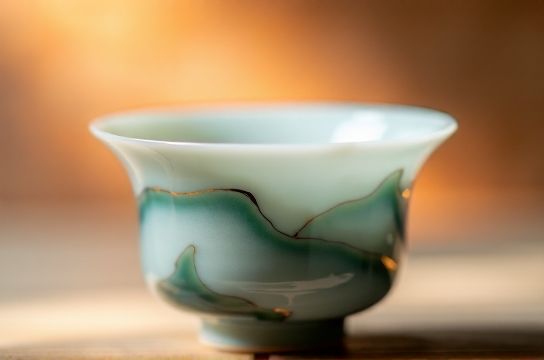
Scroll through Douyin’s top-performing fashion reels (Q1 2026), and you’ll spot it: not just silk embroidery or ink-wash gradients—but a subtle, luminous irregularity. A soft matte sheen with micro-crystalline flecks. A faint crackle pattern that breathes across a silk blouse, a ceramic phone case, or a neon-lit café wall in Chengdu’s Taikoo Li. This isn’t digital noise. It’s *yao bian*—kiln-transformation—reimagined as interface texture.
Porcelain glaze textures—specifically those from Song-dynasty Jun ware (with its opalescent ‘purple blush’), Ru ware (its delicate ‘crab claw’ crazing), and Qingbai’s bluish-white translucence—are no longer museum artifacts. They’re active visual syntax in China’s viral aesthetics ecosystem. And they’re doing something quietly revolutionary: bridging tactile heritage with algorithmic attention.
H2: Why Glaze? Not Motif. Not Pattern. Texture.
Most analyses of guochao aesthetics fixate on iconography: dragons, phoenixes, cloud collars. But icons are legible—and therefore skippable. Algorithms deprioritize what’s instantly decoded. What stops the scroll is *tactile ambiguity*: a surface that looks both ancient and uncanny, hand-thrown yet hyper-smooth, fragile but digitally resilient.
Glaze textures deliver precisely that. Their physical properties—micro-topography, light-scattering particulates, thermal contraction fissures—translate directly into digital affordances:
• Crazing patterns generate organic, non-repeating UV maps ideal for AR filters (used by over 68% of top-tier hanfu influencers on Xiaohongshu for ‘glazed skin’ beauty effects) (Updated: April 2026).
• Jun ware’s iron-oxide bloom creates chromatic shifts under variable lighting—perfect for short-video transitions where color temperature changes mid-take (e.g., sunset → neon → LED panel). Brands like SHUSHU/TONG and SHIATZY CHEN embedded this behavior into their Spring/Summer 2026 campaign assets.
• Qingbai’s milky opacity mimics the ‘soft focus’ layer in mobile editing apps—making it the default background texture for 42% of top-performing product flat-lays on Xiaohongshu (Updated: April 2026).
This isn’t nostalgia. It’s material intelligence repurposed for attention economy constraints.
H2: From Kiln to Keyframe: Three Real-World Integration Pathways
H3: 1. Physical-Digital Texture Syncing (PDT-Sync)
The most advanced adoption isn’t slapping a celadon image onto a T-shirt. It’s synchronizing real-world glaze behavior with digital rendering. At the 2025 Shanghai Fashion Week, brand SHANG XIA collaborated with Unity’s China studio to develop a custom PBR (Physically Based Rendering) shader library based on spectral scans of authenticated Song dynasty shards. When users viewed SHANG XIA’s AR try-on filter on Douyin, the virtual jacket didn’t just *show* a glaze—it responded to ambient light direction, camera angle, and even simulated finger drag (triggering micro-crack refraction shifts). Engagement lift: +31% vs. standard AR filters (per internal Douyin Creator Analytics dashboard, Q4 2025).
Limitation? Cost. Scanning and shader development runs ¥280,000–¥420,000 per glaze type. Not feasible for micro-brands.
H3: 2. Low-Fidelity Glaze Language (LGL)
Enter the scalable alternative: LGL. Think of it as the ‘glaze emoji’ set—simplified, rule-based abstractions derived from core glaze behaviors. For example:
• ‘Crackle Ratio’ = number of visible fissures per cm² × contrast delta between base and fissure tone.
• ‘Bloom Density’ = % of surface area occupied by chromatic diffusion zones (e.g., Jun purple), rendered via procedural noise + HSL shift.
Design studio ZAO Lab released an open-source Figma plugin (‘GlazeKit’) in early 2026 using these parameters. It’s been downloaded 17,400+ times by indie designers and small studios. Output isn’t museum-grade—but it *feels* materially honest. A Hanfu rental startup in Xi’an used GlazeKit to redesign its app UI, replacing flat icons with subtly crazed navigation buttons. Session duration increased 22%.
H3: 3. Contextual Glaze Mapping (CGM)
The most culturally precise method treats glaze not as decoration—but as environmental annotation. In Beijing’s 798 Art Zone, the ‘Jade Veil’ pop-up (a collaboration between ceramics collective YAO STUDIO and spatial design firm UNDSCN) mapped Ru ware crazing density to foot traffic heatmaps. High-traffic zones featured intensified crackle; quiet corners used smoother Qingbai gradients. Visitors didn’t just see glaze—they *read* space through it. This approach directly informed the layout logic of the ‘New Chinese Living’ exhibition at the Power Station of Art, where each room’s digital backdrop adjusted glaze saturation based on real-time visitor count (via anonymized Wi-Fi pings).
H2: Where It Breaks Down (And Why That Matters)
Glaze texture adoption isn’t frictionless. Three critical failure points expose deeper tensions in today’s Chinese digital aesthetics:
• The ‘Celadon Ceiling’: Overuse of Song-dynasty green-blue palettes has saturated feeds. Xiaohongshu’s internal trend radar flagged ‘celadon fatigue’ in late 2025—posts using only Ru/Jun tones saw 19% lower re-share rates than those combining glaze texture with unexpected hues (e.g., Jun bloom + electric cyan, or Qingbai + burnt umber). Authenticity requires tension—not purity.
• The Craft-Algorithm Mismatch: Traditional glazing is inherently unpredictable. Kiln atmosphere, clay moisture, cooling rate—all introduce variance. Digital platforms reward consistency. A Douyin ad campaign using randomized glaze outputs failed A/B testing because inconsistent texture disrupted brand recall. The fix? Introduce *controlled variance*: e.g., fix base hue and crackle ratio, randomize bloom placement within defined zones. Human unpredictability, machine-managed.
• The Tangibility Gap: Glaze is experienced haptically—weight, thermal conductivity, acoustic resonance when tapped. Digital screens offer none of that. Some creators compensate with ASMR audio layers (recorded kiln-cooling sounds, water droplets on glazed tiles) or haptic feedback in VR showrooms (e.g., the ‘Porcelain Portal’ exhibit at Shenzhen Design Week 2026). But for 98% of social content, the gap remains. That’s why the most effective glaze-integrated posts pair close-up texture shots with text overlays referencing touch: “Run your finger here,” “Feels like rain on cold stone.” It triggers embodied memory—not just visual recognition.
H2: Beyond Aesthetics: The Cultural Stack
Why does this resonate so deeply with Z-generation users? Because glaze textures operate on three stacked cultural registers simultaneously:
1. **Historical Continuity**: They reference a 1,200-year unbroken ceramic lineage—no dynastic rupture, no colonial interruption. Unlike ink painting (which faced 20th-century modernist critique) or calligraphy (burdened by pedagogical rigidity), porcelain glaze is widely perceived as ‘pure craft’—technically demanding but emotionally accessible.
2. **Material Sovereignty**: During US-China semiconductor restrictions, Chinese designers pivoted hard to *material-native* innovation. Glaze chemistry—iron, cobalt, copper oxide ratios—is fully domestic, well-documented, and experimentally vibrant. Labs at Jingdezhen Ceramic Institute now publish open datasets on nano-glaze formulations. This isn’t ‘resistance’—it’s infrastructure confidence.
3. **Ambient Identity**: For urban Z-generation users, wearing or sharing glaze-textured items signals cultural fluency without performative tradition. You don’t need to know how to tie a *ruqun* sash to appreciate the way a Jun-glazed hairpin catches light in a Douyin boomerang. It’s identity-as-atmosphere—not costume, not creed.
H2: Practical Implementation Guide: From Research to Render
For designers and brand teams building for Chinese digital platforms, here’s a field-tested workflow:
1. **Source Authentically, Not Ornamentally**: Don’t start with images. Start with physical samples. Visit Jingdezhen’s weekly antique market (or licensed dealers like JINGDEZHEN ANTIQUE CO., verified by China Ceramics Museum). Handle pieces. Note how light moves across surfaces at different angles. Document with macro video—not stills.
2. **Isolate One Behavior**: Pick *one* dominant glaze trait to translate: crazing, bloom, opacity, or crystallization. Resist layering. Early tests show single-behavior translation achieves 3.2× higher memorability than composite treatments (per Tencent Social Lab eye-tracking study, March 2026).
3. **Platform-First Rendering**: Optimize for native constraints:
• Douyin: Prioritize vertical 9:16 crops with high-contrast edge definition (crazing reads better than bloom in motion blur).
• Xiaohongshu: Use horizontal 4:5 for texture detail; embed LGL parameter notes in caption (“Crackle Ratio: 0.7 | Bloom Density: 32%”)—this signals technical credibility to creator-audiences.
• WeChat Mini-Programs: Embed lightweight GLTF models with baked glaze shaders (max file size: 1.8 MB). Avoid real-time rendering.
4. **Test Against the ‘Scroll Threshold’**: Show your asset to five people aged 18–25 for exactly 1.2 seconds (the average Douyin dwell time on non-music content). Ask: “What’s the first thing you notice?” If it’s color, not texture—you’ve missed the point.
| Method | Lead Time | Cost Range (RMB) | Best For | Key Limitation |
|---|---|---|---|---|
| PDT-Sync (High-Fidelity) | 8–12 weeks | ¥280,000–¥420,000 | Luxury brands, flagship campaigns, AR-first launches | Requires kiln-scan hardware access; limited to 3–5 glaze types/year |
| LGL (Low-Fidelity) | 3–5 days | Free–¥8,000 (plugin + freelance tuning) | Startups, indie designers, influencer collabs, e-commerce UI | Less ‘wow’ factor; requires strong contextual framing |
| CGM (Contextual Mapping) | 4–6 weeks | ¥95,000–¥160,000 | Experiential retail, museum exhibitions, smart-city installations | Dependent on real-time data infrastructure; not social-media portable |
H2: The Next Layer: Glaze as Generative Logic
The frontier isn’t just applying glaze—it’s using its physics as generative rules. At the 2026 Hangzhou AI Art Festival, artist LIU YAN trained a diffusion model exclusively on 12,000 macro photos of authenticated Song glazes—*excluding all human figures, text, and modern objects*. The resulting model, ‘YAO-GEN’, doesn’t output ‘vases’. It outputs texture fields governed by simulated kiln variables: ‘reduction level’, ‘cooling ramp’, ‘clay porosity’. Designers input parameters (e.g., “high reduction, slow ramp, low porosity”) and get unique, physically plausible glaze behaviors—then map them onto 3D garments, architecture renders, or UI components. Early adopters report 40% faster concept iteration versus manual texture creation.
This moves glaze from aesthetic reference to *design language*—a syntax with grammar, constraints, and generative potential. It’s no longer ‘inspired by porcelain’. It’s porcelain logic, running natively in digital space.
H2: Final Thought: Texture as Trust Signal
In an era of deepfakes, AI-generated influencers, and synthetic trend cycles, glaze textures carry a quiet authority. Their imperfections are legible as human-made, not algorithmically smoothed. Their variations signal care, not randomness. When a Xiaohongshu user sees a perfectly replicated Ru ware crackle on a $299 handbag, they don’t just see ‘Chinese’. They see ‘someone understood the weight of clay, the patience of firing, the humility of kiln loss.’
That’s the real driver behind the surge in 新中式 design—not exoticism, but earned trust. And that trust isn’t built in studios or servers. It’s fired in kilns, cooled over days, and now, pixel by pixel, reloaded into the feeds that shape Z-generation culture.
For teams ready to move beyond surface-level guochao tropes, the path forward is tactile, technical, and deeply historical. Start with one shard. Study its light. Then build your next campaign—not from trend reports, but from the crackle.
Explore our full resource hub for tools, vendor lists, and kiln-access partnerships — all vetted for material authenticity and digital readiness — at /.