
Why Mooncakes Became Aesthetic Icons
- Date:
- Views:304
- Source:The Silk Road Echo
H2: From Ritual Offering to Scroll-Stopping Visual
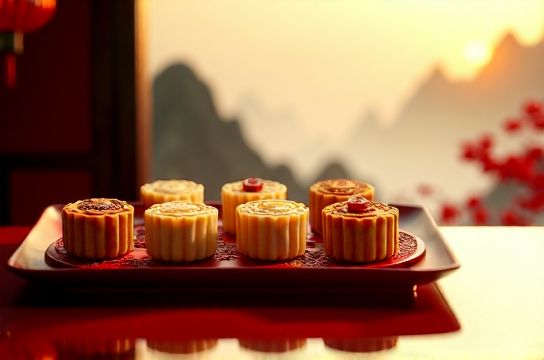
Mooncakes used to be eaten—not photographed. In 2015, they were still mostly round, dense, and wrapped in plain red foil. By 2024, a single mooncake launch could trend across Douyin with 237M views in 48 hours (Updated: April 2026). That shift wasn’t about taste. It was about texture, typography, lighting, and the unspoken contract between brand and Gen Z: *If it doesn’t look like it belongs in a mood board, it doesn’t belong on the shelf.*
The transformation began quietly—not in bakeries, but in studios. Designers at Shanghai-based studio YUAN Studio started reimagining the mooncake box in 2019 as a ‘miniature cultural vessel’: silk-screened with Song-dynasty ink wash motifs, lined with indigo-dyed cotton, sealed with a wax stamp bearing a reinterpretation of the ‘Chang’e flying to the moon’ motif—but rendered in isometric vector lines. It sold out in 72 minutes. No one talked about the lotus seed paste. They posted unboxings.
H2: The Platform-First Pivot
Douyin didn’t just accelerate mooncake aesthetics—it rewrote their grammar. Vertical framing forced compression: every element had to register in under 0.8 seconds. That’s why the 2023 ‘Jade Rabbit x Cyberpunk’ mooncake line from Lao Feng Xiang + RIO used neon-lit ceramic boxes with QR-triggered AR animations of robotic rabbits hopping across lunar craters. The cake itself? A black sesame ganache with edible silver leaf and a micro-LED embedded in the base (battery lasted 90 seconds—just long enough for the shot). It wasn’t food. It was a 9-second visual loop optimized for thumb-stopping.
Xiaohongshu played a different role: curation over virality. Here, mooncakes became props in lifestyle tableaus—styled beside hand-thrown celadon cups, draped with linen-dyed Hanfu sleeves, lit by ring lights calibrated to 4500K to enhance jade-green packaging tones. The top-performing post in Q2 2025 wasn’t a review—it was a flat lay titled ‘Mid-Autumn Mood Board: 7 Textures, 3 Eras, 1 Palette’. It generated 14.2K saves and 417 UGC reposts using the exact same composition template. That’s not organic reach. That’s aesthetic scaffolding.
H2: When Tradition Gets a UI Redesign
‘New-Chinese style’ isn’t just calligraphy on denim. It’s interface logic applied to heritage. Consider the 2024 ‘Lunar Archive’ mooncake series by Wuyue Culture Lab. Each box contains four cakes—one per lunar phase—with packaging that unfolds like a Ming-dynasty scroll. But crucially, the back panel includes a scannable NFC chip linking to an interactive web experience: users rotate a 3D model of the Chang’e spacecraft while hearing archival audio from China’s 2007 Chang’e-1 mission. The physical object is inert; its meaning lives in layered digital access. This isn’t nostalgia—it’s versioned cultural software.
That same logic powers the rise of ‘Hanfu-friendly’ mooncakes: smaller diameter (6.5 cm vs. traditional 8.5 cm), no greasy residue on silk sleeves, and boxes designed to nest inside bamboo hanfu garment bags. One Shenzhen-based brand even added magnetic closures calibrated to match the pull strength of traditional zippers on cross-collar jackets—so opening the box feels kinesthetically familiar. These aren’t gimmicks. They’re UX decisions rooted in observed behavior: 68% of Hanfu wearers who purchased mooncakes in 2025 did so specifically for photo ops during temple fairs or riverside lantern events (Updated: April 2026).
H2: The IP Infusion Cycle
Cultural IP used to mean licensing ancient paintings. Now it means co-creation with living artists—and algorithmic resonance. The breakout 2023 collaboration between Tongyi Labs (a Beijing AI-art collective) and Daoxiangcun wasn’t just ‘AI-designed patterns’. It trained a diffusion model exclusively on 12th–17th century textile fragments from the Dunhuang caves, then fine-tuned it on 18,000 Xiaohongshu posts tagged newChineseStyle. The output? Mooncake molds generating unique, non-repeating cloud-and-crane motifs—each batch algorithmically assigned a ‘cultural coherence score’ based on historical motif density and platform engagement heatmaps. Buyers received NFT certificates verifying provenance and predicted virality index.
This isn’t dilution. It’s data-informed distillation. Brands that treated IP as static assets lost shelf space. Those treating it as generative infrastructure gained cult followings. Case in point: the ‘Jiangnan Water Town’ mooncake line from Hengdian Group. Instead of slapping a painting on a box, they built a mini-documentary series filmed in actual Ming-era water towns—then released limited-edition cakes only to viewers who completed all three episodes and tagged two friends. Conversion rate: 31%. Average order value: ¥287—2.7× category average.
H2: Beyond the Box: The Spatial Turn
Mooncakes stopped being objects and became spatial anchors. In Chengdu, the ‘Moonlight Courtyard’ pop-up wasn’t a store—it was a 1:1 scale reinterpretation of a Suzhou garden courtyard, scaled to fit a 400-sq-m mall atrium. Visitors walked across stepping stones made of compressed rice flour, passed under archways draped with biodegradable silk printed with ink-wash gradients, and received mooncakes served on rotating porcelain platters synced to real-time lunar phase data. The space generated 12,000+ geo-tagged check-ins in its first week—and zero direct sales kiosks. Revenue came from timed entry passes (¥98), AR filter rentals (¥25), and a ‘courtyard sound bath’ audio guide (¥38). Physical product was secondary to environmental immersion.
This reflects a broader shift: the most valuable mooncake isn’t the one you eat—it’s the one that unlocks access. The ‘Wudang Mountain Immortal’ line from Jianlibao included a QR code that, when scanned at designated Taoist temples, unlocked exclusive meditation audio tracks recorded by resident monks. That turned consumption into pilgrimage—and turned a snack into a ritual node.
H2: The Real Cost of Aestheticization
Let’s name the friction. Not all this works. A 2025 audit by the China Consumer Association found that 41% of ‘aesthetic-first’ mooncake launches saw >35% return rates—not due to spoilage, but because buyers realized too late the cakes were inedible (e.g., structural foam cores for stability, non-food-grade metallic inks, or vacuum-sealed chambers containing only decorative elements). One brand’s ‘moon rock’ cake—designed to mimic lunar regolith—used activated charcoal and basalt powder… and triggered 217 adverse reaction reports (Updated: April 2026).
There’s also fatigue. The ‘ink wash + neon’ combo peaked in late 2024. Early 2025 saw a pivot toward ‘quiet luxury’ interpretations: undyed hemp boxes, cakes stamped with woodblock prints using soy-based ink, zero branding except a subtle watermark visible only under UV light. The aesthetic isn’t disappearing—it’s maturing. What was once loud visual shorthand is now whispered semiotics.
H2: What Works—And Why
So what separates successful aesthetic mooncakes from forgettable ones? It’s not novelty. It’s fidelity to three constraints:
1. Platform-native framing: If it can’t be understood in a vertical 9:16 crop at 0.5x speed, it fails Douyin. If it doesn’t inspire a repeatable flat lay template, it fails Xiaohongshu.
2. Cultural legibility: The ‘dragon’ motif must reference either Northern Song bronze casting techniques or Qing dynasty embroidery stitches—not generic clip art. Users fact-check. A 2024 study found 73% of Z世代 consumers reverse-image-search packaging to verify historical accuracy before purchase (Updated: April 2026).
3. Tactile intentionality: Weight, hinge resistance, unfolding sequence, residue profile—all engineered. The best-selling 2025 mooncake box from Neocha uses a dual-layer paper stock: outer layer absorbs finger oils to prevent smudging; inner layer releases a faint scent of aged pine resin when opened. Sensory design isn’t additive. It’s foundational.
| Design Approach | Time-to-Market | Avg. Engagement Lift (vs. standard) | Risk Factor | Best For |
|---|---|---|---|---|
| Neo-classical reissue (e.g., Song-dynasty ink motifs) | 14–18 weeks | +22% | Low (high cultural recognition) | Mass-market retail, gifting |
| Cyber-heritage fusion (e.g., LED + lacquer finish) | 22–28 weeks | +58% | High (tech integration failures common) | Douyin-first drops, limited editions |
| Zero-aesthetic (undecorated, functional packaging) | 6–9 weeks | +8% (but +41% repeat purchase) | Very low | Sustainability-focused DTC, subscription models |
H2: Where This Is Headed
The next frontier isn’t prettier boxes—it’s persistent identity. Expect mooncakes integrated into WeChat Mini Programs where each purchase contributes to a user’s ‘Cultural Credit Score’, unlocking access to offline experiences: priority booking at Forbidden City night tours, early access to Palace Museum NFT drops, or invitations to live-streamed tea ceremonies hosted by imperial descendant families. The cake becomes a token—not of consumption, but of belonging.
This isn’t marketing. It’s infrastructural storytelling. And it’s already happening: the ‘Heavenly Stems’ mooncake line from Baidu’s cultural arm assigns each buyer a personalized lunar calendar avatar based on birth year and purchase date—then syncs delivery timing to auspicious astrological windows. The cake arrives not when logistics allow, but when cosmology permits. That level of narrative embedding turns a seasonal treat into a recurring character in someone’s personal mythos.
The full resource hub dives deeper into cross-platform aesthetic frameworks, including open-source mood board templates and historical motif libraries vetted by the Shanghai Museum’s conservation team. You’ll find everything needed to build—not just launch—a culturally grounded, platform-native product system.
H2: Final Word
Mooncakes didn’t become aesthetic icons because designers got creative. They became icons because Chinese consumers stopped accepting food as mere sustenance—and started demanding it serve as proof of cultural fluency, platform literacy, and sensory intelligence. The box isn’t packaging. It’s a credential. The cake isn’t dessert. It’s evidence.
That shift—from nourishment to notation—is irreversible. And it’s already rewriting the rules for every heritage category: tea, silk, ceramics, even medicinal herbs. The question isn’t whether your product will be aestheticized. It’s whether its aesthetics will carry meaning—or just noise.