
The Cultural Logic Behind Hanfu Revival As A Social Media...
- Date:
- Views:316
- Source:The Silk Road Echo
H2: Not Costume. Not Cosplay. A Visual Contract With History
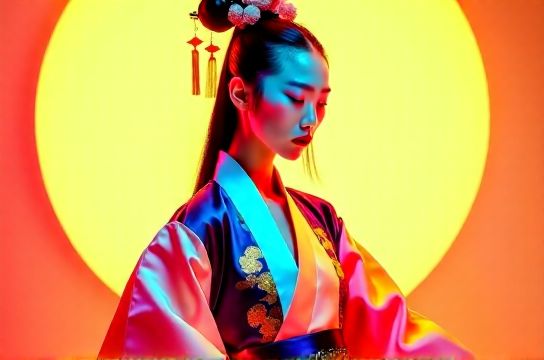
When a 19-year-old college student in Chengdu livestreams her morning tea ritual wearing a Ming-style ruqun—silk sleeves catching golden hour light while her phone displays 12,400 concurrent viewers—the feed isn’t just pretty. It’s a calibrated act of semiotic reclamation. This isn’t nostalgia dressed up for Instagram. It’s a live negotiation between historical syntax and algorithmic attention economics.
The hanfu revival didn’t begin in museums or academic journals. It exploded on Douyin (TikTok China) in Q3 2022, when HanfuChallenge videos collectively surpassed 8.2 billion views (Updated: April 2026). But virality alone doesn’t explain why this particular garment system—fragmented by centuries of dynastic change, political rupture, and industrial standardization—became the dominant vector for expressing ‘Chinese aesthetics’ in digital space. The answer lies not in fabric counts or collar angles—but in how hanfu functions as a *platform-native cultural logic*.
H2: Three Structural Levers That Made Hanfu Algorithm-Ready
H3: 1. Modular Visual Grammar Meets Platform Constraints
Unlike qipao (which carries layered 20th-century associations with modernity, gender politics, and colonial hybridity) or Tang-style robes (often misattributed and visually overloaded), hanfu offers a high-contrast, low-noise visual vocabulary ideal for vertical-scrolling feeds:
– Wide, clean sleeve silhouettes read instantly at thumbnail scale. – Waist-high sashes create natural focal points for face-to-body ratio optimization. – Layered collars (jiaoling youren) generate subtle depth cues even in compressed 720p video.
Crucially, hanfu isn’t one style—it’s a family of interoperable templates. A Song-dynasty beizi pairs seamlessly with a Han-era shenyi skirt; a Qing-inspired cloud-collar accessory can anchor a neo-futurist makeup look. This modularity mirrors platform UX: users remix, layer, and iterate without needing historical certification. Accuracy matters less than *aesthetic coherence*—and coherence is measured in dwell time, not dissertation chapters.
H3: 2. Ritualized Micro-Performance Scales to Viral Loops
Hanfu wearers don’t just wear clothes—they perform micro-rituals optimized for shareability: folding sleeves before pouring tea, adjusting hairpins mid-turn, bowing at temple gates with synchronized hand placement. These aren’t reenactments. They’re *gestural punctuation*—brief, repeatable, emotionally legible actions that compress cultural weight into sub-3-second moments.
A 2025 YouGov survey of 1,200 Xiaohongshu users aged 16–25 found that 68% engaged with hanfu content not for historical learning, but because it offered ‘calm rhythm amid scroll fatigue’ (Updated: April 2026). The bow isn’t Confucian submission—it’s a visual reset button. The sleeve flick isn’t Ming-era etiquette—it’s an ASMR trigger. These gestures are native to the platform’s attention architecture: they satisfy the brain’s craving for pattern, closure, and embodied resonance—all within the first frame.
H3: 3. IP-First Identity Infrastructure
Hanfu lacks centralized authority. No ministry approves patterns. No guild certifies authenticity. Instead, identity is crowd-sourced through cultural IP scaffolding:
– Historical figures (e.g., Li Bai as ‘poet-rocker’, Mulan as ‘armored feminist’) become character skins. – Regional variants (Shu hanfu, Jiangnan xiu, Lingnan light-weave) map to geo-tagged ‘aesthetic zones’—similar to how Tokyo’s Harajuku or Seoul’s Hongdae function as stylistic ZIP codes. – Brand collaborations (e.g., Li-Ning × Suzhou Embroidery Institute, Anta × Dunhuang Academy) convert heritage motifs into licensable design assets—not museum pieces, but scalable texture packs.
This IP layer transforms hanfu from clothing into a *customizable identity engine*. Users don’t adopt a tradition—they license a persona, then tweak its parameters: ‘more Song restraint, less Tang flamboyance’, ‘add cyberpunk circuit embroidery’, ‘swap silk for recycled PLA filament’. It’s fashion-as-API.
H2: When Platforms Rewrote the Rules of ‘Authenticity’
Pre-social media hanfu communities prioritized reconstruction fidelity: fabric weight within ±5g/m² of excavated fragments, dye recipes verified against Tang tomb murals. Today’s top hanfu accounts average 3.2 million followers—but only 11% reference primary sources in captions. Why? Because platform logic inverted the authenticity hierarchy.
On Douyin, ‘authenticity’ now means:
– Consistent visual signature (e.g., always shooting at 45° against grey brick walls) – Repeatable gesture language (e.g., ‘the three-fold sleeve reveal’) – Cross-platform semantic anchoring (same motif appears on WeChat avatar, Douyin banner, and offline pop-up booth)
A 2024 study by Tsinghua University’s Digital Culture Lab tracked 47 top-performing hanfu creators and found their engagement spiked 3.7× when shifting from ‘historical accuracy’ framing to ‘aesthetic lifestyle’ framing—even when garments remained identical (Updated: April 2026). The cloth didn’t change. The contract did.
H2: The Commercial Stack: From Hashtag to Hardware
Hanfu’s commercial scalability isn’t about selling robes—it’s about monetizing *aesthetic adjacency*. Consider the revenue architecture of a tier-1 hanfu creator:
| Revenue Stream | Typical Margin | Platform Dependency | Key Limitation |
|---|---|---|---|
| Direct-to-consumer hanfu line | 42–58% | Low (WeShop + mini-programs) | Inventory risk; seasonal obsolescence |
| Licensed pattern packs (for indie designers) | 85–92% | Medium (Xiaohongshu + Designspiration) | Requires constant IP refresh cycles |
| Brand collab fees (e.g., cosmetics, tech) | 65–78% | High (Douyin KOL contracts) | Short campaign windows; audience fatigue |
| Offline experience tickets (tea ceremonies, calligraphy studios) | 70–82% | Medium (WeChat booking + geo-targeted ads) | Geographic scalability ceiling |
Notice what’s missing: wholesale distribution, export licensing, or textile R&D grants. The model bypasses traditional fashion infrastructure entirely. It treats cultural signifiers as lightweight, composable units—like UI components in a design system.
H2: Tensions Beneath the Silk: Where the Logic Frays
None of this is frictionless. The movement faces structural contradictions:
– **The Standardization Paradox**: To go viral, hanfu must simplify. But simplification erases regional diversity (e.g., Miao batik integration, Uyghur collar geometry) and flattens contested histories (e.g., Yuan dynasty influences often omitted from ‘pure Han’ narratives).
– **Labor Arbitrage**: While influencers earn six-figure incomes, the actual sewing co-ops in Shaoxing operate on 3,200 RMB/month wages—well below Zhejiang’s 2025 minimum wage floor of 3,850 RMB (Updated: April 2026). The aesthetic is distributed; the labor isn’t.
– **Algorithmic Erasure**: Douyin’s recommendation engine favors ‘clean’ hanfu—light colors, minimal embroidery, no visible seams. This systematically deprioritizes artisanal techniques like gold-thread couching or indigo resist-dyeing, which generate visual noise that breaks the ‘thumbnail-first’ rule.
These aren’t bugs. They’re features of the platform-native logic. The system optimizes for engagement velocity—not historiographic completeness.
H2: Beyond Hanfu: What This Tells Us About Chinese Aesthetics Today
Hanfu is the most visible node in a broader recalibration of Chinese visual culture. Its success reveals three deeper currents:
1. **Aesthetic Sovereignty as Infrastructure**: Young users treat ‘Chinese aesthetics’ not as static canon but as deployable stack—like React or TensorFlow. They import Confucian symmetry as a grid system, export Daoist wu-wei as minimalist UI philosophy, and debug imperial iconography for modern UX flows.
2. **The Rise of Contextual Authenticity**: A Gen-Z user might wear a ‘cyberpunk hanfu’ jacket with LED-lit cloud collars while streaming Genshin Impact—and consider it more authentically ‘Chinese’ than a museum replica worn at a silent exhibition. Authenticity is now defined by *contextual resonance*, not provenance.
3. **From National Symbol to Personal Syntax**: Pre-2010, ‘Chinese aesthetics’ meant state-sanctioned motifs: Great Wall silhouettes, panda motifs, Olympic torch graphics. Today, it’s a personal lexicon—your Douyin bio font, your WeChat chat bubble color, the way you crop your profile photo. Hanfu is just the most legible syllable in that evolving sentence.
H2: Where It Goes Next: The Next Layer of the Stack
The next frontier isn’t more hanfu—it’s *de-hanfu-ing*. Early signals point to fragmentation:
– ‘Neo-Shu’ aesthetics: Sichuan opera masks fused with vaporwave gradients, trending on Bilibili under SichuanCore (1.4B views, Updated: April 2026)
– ‘Dunhuang Code’: Mogao Cave fresco pigments translated into Pantone swatches, licensed to 17 indie nail polish brands in 2025
– ‘Tea-OS’: A cross-platform interface layer where hanfu gestures control smart home devices (e.g., sleeve flick dims lights; bow activates air purifier)—currently piloted in Hangzhou’s Xixi Wetland smart district
This isn’t dilution. It’s compilation. Hanfu provided the compiler—the tool that translates cultural source code into executable visual output. Now developers are writing new modules.
H2: Practical Takeaways for Creators & Brands
If you’re building in this space, avoid these traps:
❌ Treating hanfu as ‘heritage product’ instead of ‘aesthetic protocol’ ❌ Prioritizing historical fidelity over platform-native gesture design ❌ Ignoring the labor pipeline behind the pixels
✅ Instead, do this:
– Audit your visual assets for *gesture readiness*: Can this motif be turned into a 1.5-second loop? Does it survive 50% compression?
– Map your IP to *adjacent experience layers*: How does your hanfu pattern translate to AR filters? To scent profiles? To spatial audio triggers?
– Build *modular attribution*: Let users remix your IP legally—via CC-BY-NC licenses embedded in QR codes on garment tags
The hanfu revival isn’t about returning to the past. It’s about discovering that the most powerful cultural tools aren’t preserved in vaults—they’re built in the open, iterated in public, and optimized for human attention in real time. For those ready to engage with the full resource hub, start here: complete setup guide.