
Harbin vs Xi'an Winter Ice Festival Versus Year Round Anc...
- Date:
- Views:171
- Source:The Silk Road Echo
H2: Harbin vs Xi’an — Not Just Seasons, But Systems of Meaning
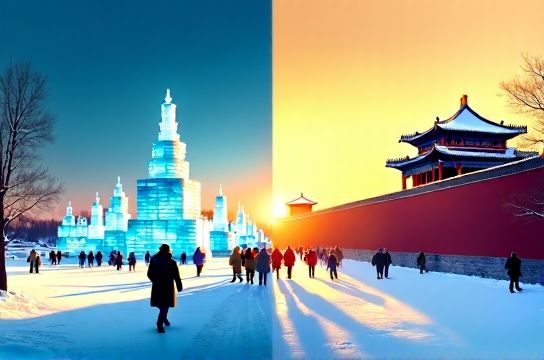
You’re booking a two-week China trip in December. Your travel partner wants glittering ice castles under sub-zero skies. You’re quietly Googling Tang dynasty murals and dumpling workshops in a 3,100-year-old city wall. Neither is wrong. But choosing between Harbin and Xi’an isn’t about picking ‘cold’ or ‘old’ — it’s about aligning destination DNA with your travel rhythm, stamina, and cultural appetite.
Harbin delivers one of the world’s most intense seasonal tourism experiences: a tightly choreographed, infrastructure-heavy, visually overwhelming winter festival. Xi’an offers layered, low-threshold access to millennia of Chinese civilization — walkable, edible, tactile, and open year-round. They represent divergent models of cultural presentation: event-driven spectacle versus ambient heritage.
Let’s cut past brochure language and talk logistics, sensory load, food authenticity, and what actually works on the ground — especially if you’re weighing them as primary destinations (not side trips).
H2: The Core Divide — Event Calendar vs. Living Timeline
Harbin’s identity peaks in January–February. Its Ice and Snow Festival (officially launched in 1963) now draws ~15 million visitors annually (Updated: June 2026), concentrated over six weeks. That’s not organic growth — it’s engineered density. The city’s entire winter transport, hotel inventory, and even street lighting shift into ‘festival mode’. Outside that window? Harbin is functional but muted: -25°C average lows persist through March, yet without illuminated sculptures or heated viewing platforms, much of the core appeal vanishes.
Xi’an, by contrast, has no ‘off-season’ for historical engagement. The Terracotta Army opened to the public in 1979 and remains China’s most visited archaeological site outside Beijing (12.8 million tickets sold in 2025, per Shaanxi Tourism Bureau). But more importantly, Xi’an’s history isn’t locked behind glass or ticket gates. It’s in the 14-km Ming Dynasty city wall you can rent a bike on at 7 a.m., the Muslim Quarter’s 1,300-year-old Great Mosque next to a halal bubble tea stand, and the fact that the Bell Tower sits squarely in the middle of rush-hour traffic — not as a museum piece, but as urban infrastructure.
This isn’t ‘traditional vs modern’ in the abstract. It’s operational reality: Harbin’s magic requires synchronization (timed entry, shuttle buses, thermal gear rental); Xi’an’s rewards wandering, repetition, and off-hours curiosity.
H2: Attractions — Sculpture vs Structure
Harbin’s top draw is the Sun Island Scenic Area, where 2,000+ artisans carve 200,000+ cubic meters of Songhua River ice into palaces, dragons, and anime characters — all lit by RGB LED systems rated for -40°C operation (Updated: June 2026). The Zhaolin Street Ice Lantern Fair adds intimate, hand-carved lanterns in historic Russian-style architecture — a quieter counterpoint. Real talk: these are technically impressive, but physically demanding. Average visitor walking distance across main zones: 8–12 km/day on snow-packed paths. Thermal socks aren’t optional — they’re baseline.
Xi’an’s headline sites demand different muscles. The Terracotta Army pits require careful pacing: three buried pits (No. 1 being the largest at 230 × 62 m), climate-controlled viewing corridors, and mandatory audio guides (available in 11 languages). But then there’s the Small Wild Goose Pagoda — free entry, zero crowds at sunrise, and a working Buddhist temple where monks chant daily. Or the Forest of Steles Museum: 11,000 stone tablets spanning 2,000 years, housed in quiet courtyards. No timed tickets. No thermal gloves needed. Just time and attention.
H2: Food — Frozen Theater vs Fermented Continuity
Harbin’s cuisine reflects its geography: Russian, Manchurian, and Korean influences fused by necessity. Try ‘liangpi’ (cold rice noodles) — but only in summer. In winter, it’s ‘guo bao rou’ (sweet-and-sour pork, deep-fried crisp), ‘red oil dumplings’ (boiled, then pan-fried), and ‘big bowl beef noodle soup’ served with pickled garlic so pungent it clears sinuses instantly. Key caveat: many ‘festival food stalls’ prioritize volume over craft. For authenticity, head to Daqing Road Market — open daily, unthemed, where vendors have cooked the same dish since 1987.
Xi’an’s food is archaeology you can chew. Roujiamo (‘Chinese hamburger’) uses bread baked in clay ovens unchanged since the Han Dynasty. Yangrou paomo (torn flatbread soaked in lamb stew) follows a ritual: you tear the bread yourself — no machines, no shortcuts — while the broth simmers for 12 hours. The Muslim Quarter isn’t a theme park; it’s a functioning neighborhood where Hui families run shops passed down five generations. Yes, the ‘tourist alley’ section gets crowded, but step into the side lanes — like Dajue Alley — and you’ll find 24-hour persimmon cake stalls and century-old vinegar breweries selling aged ‘Chujiang’ vinegar (pH 2.8, shelf-stable for 15 years).
H2: Logistics & Travel Flow — One-Week Intensity vs Two-Week Accretion
Harbin works best as a focused 4–5 day immersion. Why? Because beyond the festival grounds, options thin out. Public transit is reliable (Metro Line 2 connects airport to Central Street), but Uber-style apps struggle with driver availability below -20°C. Taxis often refuse short fares. Hotels near Saint Sophia Cathedral fill up 5 months ahead for festival dates — and rates jump 220% YoY (Updated: June 2026). A realistic budget: ¥850–¥1,400/night for mid-tier, including heated lobby and thermal curtain systems.
Xi’an is built for iteration. You can visit the Terracotta Army on Day 1, get lost in the Muslim Quarter on Day 2, return to the same dumpling stall on Day 5 and be greeted by name, then take a day trip to Mount Hua (2.5 hrs by high-speed rail) on Day 7. Metro covers 90% of core sites, and Didi (China’s Uber) operates reliably year-round. Hotel rates hold steady: ¥320–¥680/night for well-located 4-star properties, with minimal seasonal variance. Bonus: Xi’an North Railway Station connects to Beijing (4h 10m), Chengdu (3h 20m), and Shanghai (6h 45m) — making it a natural pivot point.
H2: Culture — Staged Spectacle vs Embedded Practice
At Harbin’s Ice Festival, culture is curated and contained. You watch ice ballet on a frozen river stage. You see performers in Qing Dynasty costumes — but those are rented costumes, used solely for photo ops. There’s little opportunity to engage with local Harbin residents beyond transactional exchanges (ticket purchase, dumpling order). This isn’t criticism — it’s design. The festival is an export product: built for Instagram, optimized for group tours, calibrated for foreign-language signage and QR-code menus.
Xi’an embeds culture in routine. At the Drum Tower, locals gather at 6 p.m. for spontaneous guqin (zither) performances — no tickets, no schedule. In the Gaoxin tech district, startups build AI tools to restore Tang poetry manuscripts from fragmented steles — bridging ancient text and machine learning. Even the city’s ‘modern’ face is historically literate: the Qujiang New District uses Song Dynasty urban planning principles (grid + waterways) in its layout. This isn’t ‘traditional vs modern’ — it’s continuity with adaptation.
H2: Who Should Choose Which — And When
Choose Harbin if: • You travel between late December and mid-February, and cold tolerance is high (you own proper gear); • You prioritize visual impact over deep interaction; • Your trip includes Russia, Mongolia, or Northeast Asia — Harbin is the logical gateway; • You’re comfortable with structured, time-bound experiences (e.g., pre-booked shuttle slots, fixed viewing windows).
Choose Xi’an if: • You want flexibility: arrive any month, stay 3 days or 3 weeks; • You value repeat visits, small-scale human moments, and food with generational roots; • You’re combining with other inland cities (Chengdu, Lanzhou, Dunhuang); • You prefer self-guided exploration over packaged itineraries.
H2: Practical Comparison Table
| Factor | Harbin | Xi’an |
|---|---|---|
| Peak Season Duration | Jan 5 – Feb 25 (6 weeks) | Year-round (optimal: Mar–May, Sep–Oct) |
| Avg. Winter Temp (Dec–Feb) | -22°C to -13°C (Updated: June 2026) | -2°C to 8°C (Updated: June 2026) |
| Top Site Entry Fee (2026) | Sun Island: ¥330 (includes shuttle, heating tent access) | Terracotta Army: ¥120 (no shuttle fee, audio guide ¥30) |
| Public Transit Reliability | High during festival (dedicated lanes), drops sharply off-season | Consistent year-round (6 metro lines, 99% on-time rate) |
| Food Authenticity Access | Market stalls > festival booths; Daqing Road = real deal | Muslim Quarter side alleys > main tourist drag; Dajue Alley = benchmark |
| Best For Solo Travelers? | Moderate — language barriers higher, fewer drop-in social spaces | High — English signage widespread, hostel culture strong, easy day trips |
H2: Final Recommendation — Don’t Choose One. Sequence Them.
Here’s what actually works: Fly into Xi’an first. Spend 4–5 days absorbing pace, food, and spatial logic. Then take the G87 high-speed train (approx. 8h, ¥685) to Harbin — yes, it’s long, but the landscape shift (plains → forests → frozen rivers) is part of the transition. You’ll arrive rested, culturally calibrated, and ready for Harbin’s intensity — not shell-shocked by it.
Or flip it: Do Harbin early in your trip when energy is high, then decompress in Xi’an’s slower cadence. Either way, treat them not as competitors but as complementary frequencies in China’s cultural spectrum.
For full resource hub with train timetables, thermal gear checklists, and Muslim Quarter vendor maps, see our complete setup guide.
H2: Bottom Line
Harbin proves China can engineer awe on an industrial scale. Xi’an proves China’s civilization doesn’t need staging — it breathes in the gaps between subway stops, simmers in clay ovens, and endures in the hands of a fifth-generation vinegar master. Neither is ‘better’. But if your goal is to understand how Chinese identity functions — not just how it looks in photos — start with Xi’an. Let Harbin be the exclamation point.