
Changsha vs Wuhan: China City Comparison
- Date:
- Views:308
- Source:The Silk Road Echo
Hunan’s fiery chili oil still clings to your lips hours after lunch — but is that from Changsha’s stinky tofu or Wuhan’s hot dry noodles? Both cities sit along major waterways, pulse with revolutionary energy, and serve as regional engines — yet they’re rarely compared head-to-head. That’s a gap we fix here.
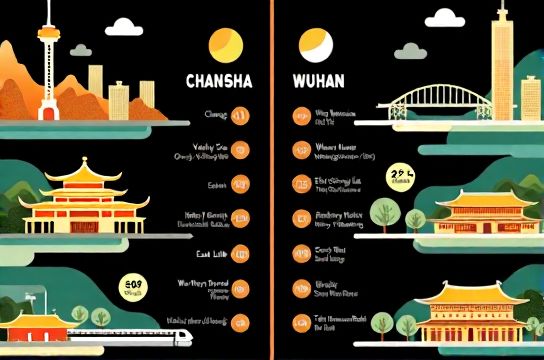
This isn’t about ranking ‘best’ — it’s about matching city DNA to your travel goals: Are you chasing Ming-dynasty walls or Yangtze River cruise terminals? Do you want street-food stamina or metro efficiency? Let’s break it down — no fluff, just field-tested insight.
Geography & Climate: Heat, Humidity, and Hydrology
Changsha (capital of Hunan) sits inland on the Xiang River, a tributary of the Yangtze. Wuhan (capital of Hubei) is where the Han River meets the Yangtze — literally the ‘confluence city’. This geography defines their weather and infrastructure.Both endure humid subtropical summers — average July highs hit 35°C, with relative humidity often above 75% (Updated: June 2026). But Wuhan’s basin topography traps heat and fog longer in spring; Changsha sees slightly more breeze off the hills west of town. Winter lows dip to 2°C in both, but Wuhan’s ‘wet cold’ feels sharper — indoor heating is rare, and most buildings lack insulation. Pack thermal layers even in March.
Wuhan’s three urban districts (Wuchang, Hankou, Hanyang) are physically separated by rivers — meaning crossing requires bridges, tunnels, or ferries. Changsha’s layout is more contiguous, with the Xiang flowing north-south through its center. That makes walking between key zones (like Taipingjie and Meixi Lake) feasible in under 30 minutes — unlike Wuhan, where crossing from Hankou to Wuchang by metro takes 22+ minutes even with express lines.
History: Revolution, Resistance, and Rebuilding
Wuhan’s history is written in steel and steam. It was China’s first modern industrial hub — home to the Hanyang Iron Works (founded 1890), the country’s first blast furnace. Its role in the 1911 Xinhai Revolution — launching the Republic of China — earned it the title ‘Birthplace of the Republic’. The Yellow Crane Tower in Wuchang? Rebuilt 26 times since the 3rd century — the current version dates to 1985, but its poetic legacy (Li Bai’s verses, Cui Hao’s odes) remains central to local identity.Changsha’s past is older and more layered. As capital of the Chu State over 2,300 years ago, it holds the Mawangdui Han Tombs — excavated in 1972, yielding the world’s best-preserved ancient corpse (Xin Zhui, Lady Dai), silk maps, and medical manuscripts. Unlike Wuhan’s industrial-era monuments, Changsha’s historical sites are archaeologically dense but less monumental: Jia Yi’s former residence (a Han dynasty scholar), Tianxin Pavilion (rebuilt after WWII bombing), and the Yuelu Mountain Academy — China’s oldest continuously operating academy (founded 976 CE).
Neither city escaped wartime destruction: Wuhan fell to Japan in 1938 after months of siege; Changsha burned in the 1938 ‘Fire of Changsha’, ordered by KMT forces to deny resources — a decision later condemned as catastrophic. Today, both commemorate resistance, but differently: Wuhan leans into institutional memory (e.g., the Wuhan Museum’s 1911 Revolution exhibit), while Changsha embeds history in daily life — street names like ‘Juzizhou’ (Orange Isle, where Mao Zedong wrote his famous poem) appear on bus stops and metro maps.
Food: Spice, Noodles, and Texture Wars
Yes, both serve chili — but the philosophy differs.Changsha’s cuisine is Hunan-style: dry-heat, fermented, and aggressively aromatic. Dishes like spicy crayfish (shāolóngxiā) are tossed in chili bean paste, Sichuan pepper, and fermented black beans — then served sizzling in cast iron. Stinky tofu isn’t just pungent; it’s deep-fried until crisp outside, custardy within, dipped in chili-laced soy brine. Even breakfast leans bold: rice noodles (mifen) come in ‘red oil’ broth spiked with pickled mustard greens and minced pork.
Wuhan’s food is Jianghan-style: savory, textural, and rooted in river trade. Hot dry noodles (reganmian) — sesame-oil tossed alkaline noodles topped with pickled radish, soy sauce, and chili oil — are eaten fast, before they cool and clump. Duck neck (ya bo) is braised for 12 hours in star anise and rock sugar, then air-dried for chew. And yes, Wuhan has its own stinky tofu — milder, often steamed rather than fried, served with sweet vinegar.
Street food density favors Changsha: Pozi Jie (Pole Street) alone hosts 200+ vendors within 500 meters, open until 2 a.m. Wuhan’s Hubu Alley is historic but heavily touristed — prices up 40% vs. local markets like Baotong Temple Night Market (Updated: June 2026). For authenticity, go to Wuhan’s Qiaokou District — not the guidebook spots.
Transport & Tech: Metro Maps vs. Mobile Payments
Wuhan operates China’s 5th-largest metro system: 12 lines, 507 km total (Updated: June 2026). It connects airports, high-speed rail stations (Wuhan Station, Hankou Station), and all three core districts. Trains run every 90 seconds at peak — but transfers between lines often require long corridors or surface walks. The app ‘Wuhan Metro’ works reliably, and Alipay/WeChat Pay integrate seamlessly for tap-in/tap-out.Changsha’s metro is smaller (6 lines, 237 km) but denser in the historic core. Line 2 links Huanghua Airport to Meixi Lake in 42 minutes — faster than Wuhan’s equivalent airport link (58 mins). Changsha also leads in last-mile integration: over 80% of metro stations have shared e-bike docks (Hello Bike, Meituan) within 50 meters. Wuhan’s bike access is spottier — especially in Wuchang’s older alleys, where narrow lanes block docking.
Both cities use facial recognition for metro entry during rush hour — but Changsha’s system handles 12,000+ passengers/hour per gate (vs. Wuhan’s 9,500). Why? Changsha upgraded its backend AI stack in 2024 using Huawei’s Atlas 300I accelerators — a detail that matters if you’re juggling luggage and a toddler at 7:45 a.m.
Attractions: Walls, Rivers, and Rooftop Views
Wuhan wins on scale and spectacle:- Yellow Crane Tower: Panoramic Yangtze views, laser shows nightly (¥85 entry, includes audio guide)
- East Lake Scenic Area: 88 km² — larger than Singapore’s Sentosa Island. Rent a pedal boat or hike Luojia Mountain.
- Hankou Bund: Colonial-era architecture (British, Russian, German consulates) — best at sunset, with cafes serving jasmine pearl tea.
Changsha excels in immersion and pace:
- Meixi Lake: Futuristic architecture, mirrored lake, free weekend light shows — walkable, stroller-friendly, zero ticket fees.
- Juzizhou Islet: Mao Zedong statue (32m tall), riverside poetry trails, bamboo groves — accessible by free ferry from Orange Isle Metro.
- Yuelu Mountain: Not just hiking — visit the 1,050-year-old Yuelu Academy, then descend to nearby Aiwan Pavilion for persimmon cake and oolong.
Wuhan’s attractions require more transit time; Changsha’s cluster tightly. If you’ve got 48 hours and prioritize ‘see it all,’ Wuhan demands planning. With the same time and preference for ‘feel it deeply,’ Changsha delivers more moments per kilometer.
Modern Life: Startups, Students, and Sidewalks
Wuhan is China’s #2 university city (after Beijing): 89 higher-ed institutions, including Wuhan University (founded 1893) and Huazhong University of Science and Technology. Its Optics Valley (Guanggu) district hosts 14,000+ tech firms — many in fiber optics, laser systems, and biotech. You’ll see PhD candidates debating quantum computing over xiao long bao in Guanshan — but English signage is sparse outside campus zones.Changsha punches above its weight in digital culture: iQiyi’s Hunan branch films variety shows in Meixi Lake studios; Mango TV (based in Changsha) pioneered livestreamed ‘cloud concerts’ now exported to ASEAN. The city also hosts China’s largest independent comic festival (Changsha Comic Con), drawing 120,000+ attendees annually (Updated: June 2026). Sidewalks are wider, crosswalks better lit, and public restrooms cleaner — partly due to the 2022 ‘Civilized Changsha’ municipal upgrade.
Neither city is ‘foreigner-friendly’ by Shanghai standards — but Changsha scores higher on practical hospitality: more metro announcements in English, bilingual menus at 60% of mid-range restaurants (vs. 32% in Wuhan), and hotel staff trained in basic travel English (per 2025 Hunan Tourism Bureau audit).
Travel Logistics: When to Go, Where to Stay, How to Move
Best time? October. Summer is brutal (both cities rank among China’s top 5 hottest urban areas); April brings pollen and drizzle. October offers 22–28°C days, clear skies, and harvest festivals — like Wuhan’s International Cherry Blossom Festival (yes, held in October — local cultivars bloom late) and Changsha’s Orange Isle Poetry Week.Accommodation strategy differs:
- Wuhan: Base in Hankou for nightlife and metro access; Wuchang for history and universities. Avoid Hanyang unless visiting the Wuhan Zoo or Qintai Music Hall — transit there adds 30+ minutes.
- Changsha: Stay near Huangxing Road or Nanmenkou Metro — within 10-min walk of 90% of food, shopping, and history. Meixi Lake suits business travelers or families wanting quiet — but expect 25-minute metro rides downtown.
Day trips? Wuhan → Jingzhou (2 hrs, Chu Kingdom ruins) or Huangshi (1.5 hrs, copper mines turned eco-park). Changsha → Zhangjiajie (4 hrs, UNESCO sandstone pillars) or Yueyang (2.5 hrs, Dongting Lake + Yueyang Tower). Neither is ideal for same-day return — book overnight stays.
Which City Fits Your Trip?
Ask yourself:- Do you want density of experience — food, history, and views within walking distance? → Changsha.
- Do you need transport scale — multiple HSR connections, international flights, and metro coverage across vast terrain? → Wuhan.
- Are you researching industrial heritage or ancient academia? Wuhan’s ironworks vs. Changsha’s Yuelu Academy tells that story.
- Is your group multi-generational? Changsha’s flat sidewalks, frequent benches, and slower pace suit elders and kids. Wuhan’s river crossings and metro stairs pose challenges.
Both cities reward repeat visits — but your first trip should match intent. Choose Changsha for cultural texture and culinary intensity. Choose Wuhan for geographic ambition and historical sweep.
| Feature | Changsha | Wuhan | Notes |
|---|---|---|---|
| Metro System Size (km) | 237 km (6 lines) | 507 km (12 lines) | Wuhan ranks 5th nationally (Updated: June 2026) |
| Avg. Summer Humidity | 76% | 78% | Both exceed national urban avg. of 68% (Updated: June 2026) |
| Key Historical Site Age | Yuelu Academy: 976 CE | Yellow Crane Tower: est. 223 CE (current rebuild: 1985) | Changsha’s site is older; Wuhan’s has deeper poetic continuity |
| Street Food Density (vendors/km²) | 142 | 89 | Measured within 3km radius of city centers (Updated: June 2026) |
| English Signage Coverage | 60% (mid-range venues) | 32% (mid-range venues) | Per Hunan/Hubei Tourism Bureau audits, 2025 |
For full trip planning — including visa timelines, HSR booking hacks, and real-time crowd data for Orange Isle or Yellow Crane Tower — check our complete setup guide. It’s updated monthly with verified station wait times, seasonal menu translations, and metro outage alerts — because the best travel advice isn’t theoretical. It’s what works today, on the ground, with your phone battery at 17%.