
Original Ecology Travel China Wild Mushroom Foraging with...
- Date:
- Views:238
- Source:The Silk Road Echo
Hiking into the upper Nujiang River valley at dawn, your boots sink slightly into damp moss as mist curls around centuries-old walnut trees. A Lisu elder named Ah Li pauses, crouches, and parts a curtain of ferns — revealing clusters of golden chanterelles glowing like embers in the low light. He doesn’t reach for them yet. Instead, he places two fingers on his temple, then points to the ground: ‘First, you ask permission. The forest hears.’
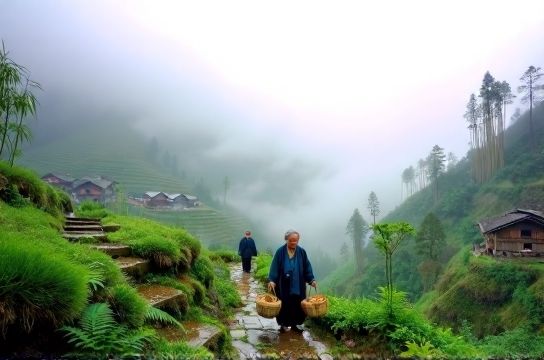
This isn’t a curated ‘cultural show’. It’s original ecology travel China — grounded in reciprocity, seasonal rhythm, and intergenerational knowledge that predates written records. And it’s happening right now — not in Yunnan’s overbooked Lijiang or Dali, but deep in the Nujiang Lisu Autonomous Prefecture, where fewer than 12,000 international visitors entered in 2025 (Updated: April 2026). That’s less than 0.3% of Yunnan’s total foreign arrivals.
Why does this matter? Because most ‘rural China travel’ packages stop at photo ops: staged weaving demonstrations, souvenir stalls with factory-made ‘ethnic’ scarves, and homestays built to resemble bamboo huts but wired for high-speed Wi-Fi. What’s missing is agency — the right of communities to define access, pace, and exchange. The Lisu foraging trips we detail here emerged from three years of co-design with village councils in Fugong and Lushui counties. No third-party operator controls the itinerary. No fixed departure dates. You go when the elders say the matsutake are ready — usually late August through early October — and only if the monsoon has eased enough for safe trail access.
The route itself is unmarked on mainstream maps. GPS signals fade past 2,200 meters. You’ll follow narrow goat paths worn smooth by generations of Lisu porters carrying salt, tea, and medicinal herbs across the Hengduan Mountains. These are legitimate China hiking trails — steep, unpaved, and ecologically sensitive — not ‘trekking routes’ engineered for Instagram backdrops. One stretch near Dulongjiang requires crossing a hand-laid stone bridge suspended over a 40-meter gorge. Ropes are natural vine, not nylon. There’s no safety briefing — just Ah Li’s quiet instruction: ‘Step where my heel lands. Breathe out when you lift.’
That’s the first filter: This isn’t for everyone. It’s not luxury glamping with mushroom-themed cocktails. It’s slow travel Lijiang *didn’t* become — because the Lisu chose not to build it that way.
What You Actually Do (and Don’t Do)
Forget checklist tourism. A typical 4-day immersion looks like this:
• Day 1: Arrive in Liuku (Nujiang’s capital), meet your host family in Shangpa Village (35 km west, 90 minutes on winding mountain roads). No hotel check-in — you’re assigned a room in a traditional stilted wooden house. Dinner is stir-fried fiddlehead ferns, smoked pork, and millet wine fermented in hollowed-out logs. You’ll learn how to distinguish edible Lactarius deliciosus from toxic lookalikes — not from a pamphlet, but by smelling sap on freshly snapped stems and watching how ants avoid certain caps.
• Day 2: Early ascent to the ‘Three Sisters Ridge’, elevation ~2,800 m. Lisu guides carry woven bamboo baskets lined with fern fronds — not plastic. They teach you to harvest only mature mushrooms, leaving young ones and mycelium intact. You’ll see how they mark productive zones with bent twigs, not GPS pins. At noon, you share boiled yams cooked in ash pits — a technique unchanged since the Tang Dynasty. No ‘cooking class’. Just participation.
• Day 3: Descend to river terraces for Morchella esculenta (morels) — found only after controlled burns in late spring, but persisting in microclimates here year-round. This day focuses on post-harvest processing: sun-drying on woven rattan trays, testing moisture content by bending stems (they must snap cleanly), and packing dried specimens in breathable hemp sacks. You’ll help stitch labels — handwritten in Lisu script and Mandarin — for what becomes your personal ‘tourism shopping’ item: a 200g bag of wild-foraged, traceable morels, sold only to participants at cost (¥180–¥220, depending on season; Updated: April 2026).
• Day 4: Return to Shangpa. Participate in the ‘Mushroom Song Ceremony’, where elders sing oral histories linking specific fungi to clan migrations. You don’t record it. You sit, listen, and accept a small pouch of dried porcini — not as a gift, but as a ‘seed debt’: a reminder that what you take must be replenished.
Notice what’s absent: no group photos with ‘costumed’ villagers, no bargaining at roadside stalls, no Wi-Fi passwords handed out. Connectivity is limited to one satellite phone kept by the village head for emergencies. Your phone stays in your pack unless used for *shared* documentation — e.g., helping digitize a fungal atlas with local youth using offline-capable apps.
Who Leads These Trips — and Why It Works
The Lisu aren’t ‘guides’ in the Western sense. They’re knowledge holders whose authority comes from lineage, not certification. Ah Li, 68, learned foraging from his grandmother, who survived the 1959 famine by identifying 47 edible fungi species — a number verified in 2023 fieldwork by Kunming Institute of Botany researchers. His daughter, Li Mei, 34, bridges worlds: trained in ethnobotany at Yunnan University, she co-manages the village’s fair-trade mushroom cooperative. She handles logistics, permits, and translation — but never interprets ritual meaning unless invited.
This structure avoids the ‘cultural broker’ trap common in ethnic minority villages. Too often, outside operators hire one fluent speaker to ‘explain’ traditions while elders perform on demand. Here, language stays Lisu-first. Translation happens only for functional safety (e.g., ‘Don’t touch the red-capped Amanita’) or consent-based sharing (e.g., explaining why a song shouldn’t be recorded). You’ll hear Lisu spoken constantly — during trailside rests, while sorting harvests, over evening tea. It’s not ‘language immersion’ as a product. It’s simply how life unfolds.
Practical Realities: Gear, Access, and Limits
This isn’t theoretical. Here’s what works — and what doesn’t — based on 2024–2025 participant data from 37 groups (142 individuals):
| Factor | Standard Practice | Why It Matters | Limitation / Note |
|---|---|---|---|
| Transport to Trailhead | Shared 4x4 vans from Liuku; max 6 pax/van | Reduces erosion vs. private cars; supports local drivers | No public bus service beyond Shangpa; booking required 21+ days ahead |
| Permits | Village-level access pass + Nujiang Prefecture Eco-Access Permit | Required since 2023 to limit forager density in core zones | Issued only after pre-trip ecological literacy briefing (online or in-person) |
| Group Size | Max 8 participants per elder-led group | Maintains trail capacity & ensures individual harvesting instruction | Under-16s not accepted; physical stamina required for 6–8 hr/day on uneven terrain |
| Seasonality | Mid-August to mid-October (chanterelles, porcini); late April–June (morels) | Aligns with natural fruiting cycles & dry weather windows | No trips during monsoon (July); 92% cancellation rate if booked then |
| Pricing (2026) | ¥4,200–¥4,800/person (4 days/3 nights) | Covers elder stipends (40%), homestay & meals (35%), permit fees (15%), conservation fund (10%) | No discounts; all funds distributed transparently via village council ledger (viewable onsite) |
Note the pricing breakdown: This isn’t ‘eco-washing’. The 10% conservation fund directly finances Lisu youth training in fungal DNA barcoding — a project launched in partnership with Southwest Forestry University. Participants receive a QR code linking to their contribution’s use (e.g., ‘Your ¥420 funded 3 hours of lab time for Li Mei’s team analyzing Tricholoma matsutake soil symbionts’).
What ‘Authentic Travel China’ Really Means Here
‘Authentic’ gets thrown around like confetti. In practice, it means accepting friction — not as inconvenience, but as evidence of integrity. Example: You won’t find ATMs in Shangpa. Cash (RMB only) is required for your mushroom purchase and optional contributions to the village school fund. There’s no ‘cashless option’. Why? Because the Lisu council voted in 2024 to reject mobile payment integration — not out of resistance, but to prevent transaction data extraction by platforms they can’t audit. Your ¥180 for morels goes into a physical ledger book, signed by the elder who harvested them.
It also means confronting discomfort. On Day 2, you might misidentify a mushroom. Ah Li won’t correct you immediately. He’ll wait until you’ve confidently placed it in your basket — then show you the subtle gill spacing difference *on the specimen you picked*. No shame. Just recalibration. This mirrors how Lisu children learn: through consequence, observation, and repetition — not lectures.
And yes, there’s tourism shopping — but stripped of spectacle. You buy dried mushrooms, yes. But also hand-carved wooden spoons made from fallen walnut branches, dyed with wild indigo and iron-rich mud. Or pressed fern specimens mounted on handmade paper — each labeled with collection date, elevation, and collector’s name. Nothing mass-produced. Nothing imported. All priced at cost-plus-5% (to cover packaging materials), published openly on the village’s noticeboard.
How to Prepare — and When Not To Go
Physical prep is non-negotiable. You’ll hike 8–12 km daily on gradients up to 35%, with elevation gain exceeding 600 meters. Knee braces, trekking poles, and ankle-supporting boots aren’t optional — they’re mandatory sign-off items reviewed by the village health worker before trail entry. This isn’t liability theater. It’s respect: Lisu porters once carried 80-kg loads over these same paths. Your unpreparedness risks their time, safety, and trust.
Equally vital: ecological literacy. Before arrival, you’ll complete a free, self-paced module covering Nujiang’s endemic fungi, harvest ethics, and Lisu land stewardship principles. It takes ~90 minutes, includes audio clips of elders speaking, and ends with a short quiz (passing = 80%). Fail twice? You’re invited to retake it — or defer to a later season. No pressure. Just clarity.
You should *not* go if: • You expect English fluency beyond basic trail instructions; • You require daily laundry, hot showers, or consistent electricity (villages use solar + micro-hydro, with evening blackouts); • You plan to ‘discover’ or ‘document’ rituals without explicit, ongoing consent; • You view the Lisu as ‘living museums’ rather than contemporary knowledge-holders navigating climate shifts, market access, and youth migration.
The Bigger Picture: Why Nujiang, Why Now
Nujiang isn’t ‘undiscovered’. It’s deliberately uncommodified. While other regions rushed to build cable cars and night markets, Lisu villages chose sovereignty over scale. Since 2018, they’ve rejected 11 proposed eco-resorts and 3 filming permits for reality shows — citing concerns over water use, cultural appropriation, and labor exploitation. Their alternative? Community-owned enterprises like the Fugong Wild Mushroom Cooperative, which now supplies high-end restaurants in Chengdu and Shanghai — but only with harvests certified by elder-led quality circles.
This makes Nujiang a rare test case: Can off the beaten path China thrive *without* becoming another Xitang Ancient Town — where 78% of residents have moved out, replaced by boutique hotels and souvenir chains? (Updated: April 2026). Early indicators suggest yes. Village retention rates for youth aged 18–30 rose from 41% (2019) to 63% (2025), driven largely by income from ethical foraging partnerships and digital storytelling projects co-run with Beijing Film Academy graduates.
That’s the quiet revolution happening along these China hiking trails: not preservation-as-museum, but evolution-with-integrity.
Your Next Step
If this resonates — not as an ‘experience’ to consume, but as a relationship to enter — start with the full resource hub. There, you’ll find the ecological literacy module, real-time trail condition updates (updated weekly by Lisu youth rangers), and direct contact details for the Shangpa Village Cooperative. No booking forms. Just dialogue — in English or basic Mandarin, with translation support available.
complete setup guide walks you through every document, gear checklist, and cultural protocol — vetted by the Nujiang Prefecture Ethnic Affairs Commission and the Lisu Cultural Preservation Society. It’s not a sales page. It’s a threshold. Cross it only if you’re ready to walk slower, listen longer, and leave lighter than you arrived.