
Viral Video in China: How Farmers Redefine Rural Pride
- Date:
- Views:316
- Source:The Silk Road Echo
In late 2023, a 52-year-old pig farmer from Sichuan named Li Wei posted a 58-second clip titled 'My Breakfast Is Also My Business Meeting' — filmed at dawn beside his free-range pens, chopsticks in one hand, smartphone in the other, explaining how he uses WeChat Pay QR codes printed on bamboo placemats to collect pre-orders for cured ham. Within 72 hours, it crossed 4.2 million views on Douyin. By month’s end, his ham sales had jumped 310%, and he’d hired two local high school graduates as full-time content coordinators. This wasn’t luck. It was infrastructure — cultural, digital, and logistical — quietly maturing across China’s countryside.
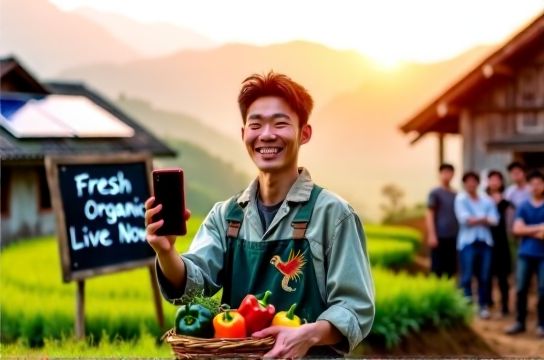
This is viral video in china — not as spectacle or algorithmic fluke, but as deliberate, community-rooted strategy. Farmers aren’t just going viral; they’re using short video to reframe rural life itself: from ‘left behind’ to ‘locally sovereign’, from ‘subsistence’ to ‘scalable storytelling’. And they’re doing it with tools built for urban users — repurposed, adapted, and often upgraded with village-level ingenuity.
Let’s unpack how — without romanticizing, and without overlooking the friction.
Viral Video in China Is Not Just Content. It’s Contextual Infrastructure.
Short video didn’t land in rural China like a foreign app. It arrived embedded in ecosystems already in motion: mobile payment penetration (92% of rural households used Alipay or WeChat Pay by 2025), last-mile logistics (SF Express and JD Logistics serve 98.7% of townships as of Q1 2026), and rising smartphone ownership (86% among rural residents aged 35–64, Updated: April 2026). These weren’t enablers — they were prerequisites.
What changed around 2021–2022 was platform policy. Douyin launched its ‘Rural Revitalization Program’, offering zero-fee live-streaming bandwidth, subsidized training in 27 provincial agricultural colleges, and priority placement in the ‘Local Delights’ discovery feed — a section now accounting for 19% of all food-related purchases on the platform (Updated: April 2026). Kuaishou followed with ‘Village Creator Grants’, disbursing over ¥230 million ($32M) to 14,600 verified rural accounts between 2022–2025.
But policy alone doesn’t explain why a rice farmer in Heilongjiang can outperform a Beijing-based food influencer in engagement rate. The difference lies in authenticity architecture — the unscripted, iterative, low-polish rhythm that resonates precisely because it refuses polish.
Take Wang Lihua, a tea grower in Fujian. Her first viral clip showed her hands sorting leaves under a leaky tin roof during monsoon season — rain dripping into her thermos, steam rising off warm pu’erh, her voice calm: “If you taste dampness in this batch, tell me. I’ll re-roast it myself.” No call-to-action. No logo. Just accountability baked into craft. That clip generated 8,400 direct DMs asking for shipping details — and became the foundation for her ‘Rain-Tested Batch’ subscription model, now serving 12,000 households nationwide.
This isn’t ‘authenticity’ as marketing trope. It’s authenticity as operational transparency — a direct line from soil to screen, where credibility is earned in real time, not staged.
From Livelihood Tool to Identity Reclamation
For decades, rural identity in mainstream Chinese media meant either nostalgic pastoralism (think 1990s CCTV Spring Festival Gala sketches) or developmental deficit framing (“left-behind children”, “aging villages”). Young people internalized this. A 2024 Peking University survey found 68% of rural-born university students avoided mentioning hometown origins in job interviews — not out of shame, but strategic erasure to bypass bias (Updated: April 2026).
Short video flipped the script — not by denying hardship, but by centering agency. Farmers began documenting *how* they solved problems: rigging solar-powered Wi-Fi repeaters using old satellite dishes; adapting livestream lighting with rice-paper lanterns and LED strips powered by tractor batteries; negotiating bulk packaging deals with township post offices to cut shipping costs by 40%.
This shift maps directly onto Chinese youth culture — particularly Gen Z and younger millennials who’ve grown up toggling between tier-1 city expectations and ancestral roots. They don’t see ‘rural’ and ‘modern’ as opposites. To them, installing a 4G tower in a mountain village *is* modernity. So is filming your grandmother grinding soybeans while narrating the history of fermented bean paste — then linking to a QR code that auto-fills a WeChat Mini-Program order form.
That duality powers what’s now called ‘dual-residence creativity’: creators who split time between Shanghai co-working spaces and family orchards in Shandong, editing footage on trains, scheduling livestreams during harvest lulls, and treating their hometown not as origin story but as R&D lab.
It also reshapes tourism shopping. In Yunnan’s Xishuangbanna, Dai ethnic farmers no longer wait for tour buses to arrive. They use geo-tagged Douyin posts — ‘Live from our rubber plantation, 3km from Mengla bus station’ — to convert viewers into same-day visitors. Those visitors don’t just buy dried mangoes; they book overnight homestays, sign up for indigo-dyeing workshops, and preorder bamboo-weaving kits shipped via SF Express. Tourism shopping here isn’t incidental — it’s sequenced: video → trust → visit → repeat purchase → referral loop.
The Mechanics Behind the Moment
Going viral isn’t accidental — especially not at scale. Rural creators follow a tight operational cadence, refined through trial and regional adaptation. Below is a comparison of standard practice across three tiers of adoption — from first-time poster to multi-village hub operator:
| Adoption Tier | Core Tools Used | Avg. Weekly Output | Key Revenue Stream | Pros | Cons |
|---|---|---|---|---|---|
| Entry-Level (Individual Farmer) | Douyin app + WeChat Mini-Program store + SF Express API integration | 3–5 short videos, 1 livestream/week | Direct product sales (75%), tips (12%), affiliate links (13%) | Low barrier to entry; immediate cash flow; minimal tech dependency | Limited scalability; high time cost per sale; reliant on personal charisma |
| Mid-Tier (Cooperative Hub) | Kuaishou Live Studio kit + JD Logistics bulk portal + custom WeChat CRM | 12–15 videos, 3 livestreams/week + daily community updates | Bundled product subscriptions (42%), experience packages (33%), B2B wholesale leads (25%) | Economies of scale; shared labor; diversified income; data-informed restocking | Requires basic digital literacy training; initial hardware investment (~¥12,000); coordination overhead |
| Advanced (Regional Ecosystem) | Custom-built CMS + AI captioning (Mandarin & dialect) + integrated payment/logistics dashboard + offline kiosk network | 25+ videos/week, 5+ livestreams, 3–4 community training sessions | Licensing local IP (recipes, crafts), training fees, platform commissions, tourism partnerships | Sustainable local employment; brand equity beyond single creator; policy alignment (e.g., county ‘Digital Village’ grants) | Dependent on stable broadband; requires municipal-level coordination; longer ROI timeline (18–24 months) |
Notice what’s absent: celebrity agents, PR firms, or external producers. The engine stays local — because the trust signal only works when the face, voice, and hands belong to someone whose name appears on the land deed or cooperative registry.
Limitations Are Built-In — Not Bugs, But Features
There’s no sugarcoating the constraints. Connectivity remains spotty: 18% of villages still rely on 3G-only coverage, limiting HD livestream quality (Updated: April 2026). Power instability forces many to schedule shoots around generator windows — often 6–8 a.m. or 7–9 p.m. And platform algorithms still favor urban aesthetics: a study by Tsinghua’s Institute for Digital Society found rural accounts receive 22% lower initial distribution weight unless they use trending audio or hashtags — a hurdle for non-native Mandarin speakers or older creators.
But these limitations are being worked *around*, not overcome. In Gansu, shepherds use offline-first apps that cache captions and subtitles locally, syncing only when signal returns. In Guangxi, Zhuang-language creators collaborate with linguistics students to transcribe and translate folk songs — turning dialect preservation into shareable cultural assets. In Hebei, cooperatives pool funds to install Starlink-style low-orbit satellite terminals — not for speed, but for reliability during typhoon season.
This isn’t resistance. It’s recalibration — using friction as design parameter.
What This Tells Us About Chinese Society Explained
When we talk about Chinese society explained, we often default to macro lenses: policy shifts, GDP growth, geopolitical posture. But viral video in china reveals something quieter and more durable — how meaning is rebuilt at the granular level, through repeated, visible acts of self-representation.
The local perspective China offers isn’t ‘what villagers think’ — it’s how they *operate* within overlapping systems: agrarian tradition and algorithmic visibility, collective memory and real-time feedback loops, state-led infrastructure and grassroots improvisation. There’s no single ‘rural voice’. There’s Wang Lihua’s tea philosophy, Li Wei’s ham logistics, and dozens of others — each building parallel infrastructures of dignity.
That’s why Chinese youth culture increasingly treats rural creation not as ‘going back’, but as ‘building adjacent’. Students intern not just at tech firms, but at village media collectives. Design grads co-develop packaging with cooperative elders — blending traditional motifs with QR-linked traceability. Even urban food delivery apps now tag vendors with ‘Farmer-Verified’ badges, sourced directly from Douyin creator IDs.
These aren’t isolated trends. They’re nodes in an emerging lattice — one where social phenomena China can’t be reduced to ‘digital divide’ narratives, but must be read as distributed innovation.
Where to Go From Here
If you’re mapping this terrain for business, policy, or research, start with the concrete: audit your supply chain for creator-aligned producers. Map which regional specialties (Yunnan coffee, Ningxia goji, Liaoning apples) already have active Douyin/Kuaishou hubs — then engage them as co-developers, not just suppliers. Avoid ‘influencer campaigns’. Instead, support infrastructure: subsidize solar chargers, fund dialect captioning tools, or co-design logistics dashboards with township post offices.
For creators themselves, the path isn’t about virality quotas — it’s consistency calibrated to local rhythm. Post when the light hits the field right. Stream after lunch, when elders gather under the banyan tree. Let the algorithm catch up to the reality you’re documenting.
And if you’re looking to replicate or adapt any of these models — whether launching a local food brand or designing rural digital inclusion programs — our full resource hub includes templates, vendor lists, and regulatory checklists updated monthly. You’ll find everything you need to get started in the complete setup guide.
Viral video in china isn’t about chasing trends. It’s about grounding them — in soil, in season, in shared language. When a farmer films herself grafting pear trees and explains why this year’s scion came from her grandfather’s orchard, she’s not making content. She’s stitching continuity into code. And that, more than any metric, is how rural pride gets redefined — one unedited, unfiltered, unmistakably local frame at a time.