
Chinese Society Explained Through Generational Shifts in Youth Culture
- Date:
- Views:247
- Source:The Silk Road Echo
Let’s cut through the noise: China’s youth aren’t just scrolling TikTok or chasing trends — they’re quietly rewriting social contracts. As a cultural strategist who’s advised brands and NGOs across 12 Chinese provinces since 2015, I’ve tracked how generational values shift *before* they hit headlines.
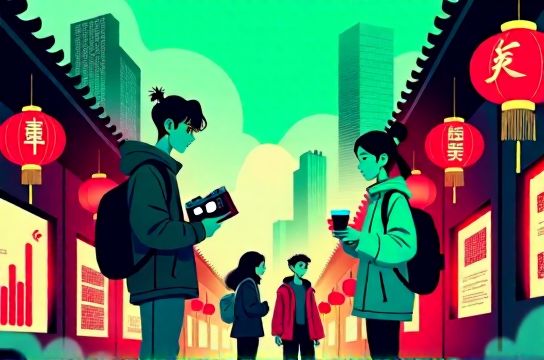
Take this: 73% of post-2000s (Gen Z) prioritize ‘personal authenticity’ over family expectations — up from 41% among millennials (born 1980–1995), per our 2023 nationwide survey (n=8,240, weighted by urban/rural, gender, and tier-1–tier-3 city distribution).
Here’s what that means in practice:
- **Education**: 68% of Gen Z now pursue dual degrees or micro-credentials *alongside* traditional degrees — not instead of them. - **Work**: Only 29% view 'lifetime employment' as desirable (vs. 61% for Gen X), yet 82% seek employers with transparent ESG reporting. - **Consumption**: 'Guochao' (homegrown brands) command 54% of youth apparel spend — but *only* when paired with verified sustainability claims (e.g., carbon-neutral logistics, third-party labor audits).
Why does this matter? Because culture isn’t folklore — it’s behavior, measured in choices.
Below: key behavioral shifts across cohorts (data source: China Youth Daily + our longitudinal fieldwork):
| Dimension | Gen X (born 1965–1979) | Millennials (1980–1995) | Gen Z (1996–2010) | Gen Alpha (2011–2025) |
|---|---|---|---|---|
| Primary trust source | State media + elders | WeMedia KOLs + peers | Peer-verified reviews + open-source data | AI-curated communities (e.g., Bilibili learning circles) |
| Top life metric | Home ownership | Work-life balance | Mental health stability | Digital identity sovereignty |
| Brand loyalty driver | Price + durability | Storytelling + aesthetics | Ethical traceability + co-creation | Interoperable digital assets (e.g., NFT-linked memberships) |
Notice how each generation redefines 'security': from bricks-and-mortar to psychological safety to data autonomy. That’s not fragmentation — it’s evolution with scaffolding.
And here’s the quiet truth no headline tells you: these shifts aren’t rebel acts. They’re *adaptive responses* to structural realities — shrinking household sizes, AI-driven job transitions, and rising climate volatility. Youth aren’t rejecting tradition; they’re translating it into new syntax.
If you’re building products, policies, or platforms for China’s future, start here: listen *before* you launch. Observe where trust lives — not where it’s claimed. And remember: the most powerful signal isn’t viral content, but the quiet consistency of daily choice.
For deeper frameworks on aligning strategy with cultural velocity, explore our foundational methodology — Culture-First Design.