
Viral Aesthetics: Poetry Philosophy Meets Chinese Visual ...
- Date:
- Views:227
- Source:The Silk Road Echo
H2: When Li Bai Meets the Algorithm
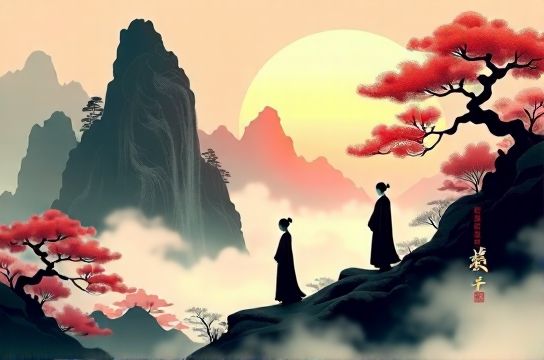
A 23-year-old designer in Chengdu layers ink-wash gradients over neon-lit alleyways in a 9-second Douyin clip. Her caption reads: “The mountain doesn’t speak — but the scroll does.” The video garners 4.2M views in 36 hours. No voiceover. No trending audio. Just a slow pan across a mist-wrapped stone bridge, then a cut to her wrist — wrapped in hand-dyed indigo silk, embroidered with a single character: 静 (stillness). This isn’t accidental charm. It’s poetry philosophy engineered for virality.
That ‘stillness’ isn’t decorative. It’s a direct invocation of Zhuangzi’s notion of *wu wei* — effortless action — reframed as visual pacing. The mist isn’t atmosphere; it’s *qi* made visible. The scroll isn’t prop; it’s a cultural interface — a vessel that carries centuries of literati contemplation into a feed governed by attention half-lives under 1.8 seconds (Updated: May 2026).
This is the real intersection: not ‘poetry + aesthetics’, but *poetic epistemology* — how classical Chinese ways of knowing the world — relational, embodied, cyclical — are being recompiled into the native syntax of China’s dominant visual platforms.
H2: Why Poetry Philosophy Is the Hidden OS of Viral Aesthetics
Western viral logic often prioritizes contrast, escalation, or disruption: surprise → share. Chinese viral aesthetics — especially in guochao-aligned content — run on a different operating system. It privileges *resonance*, *layering*, and *implied continuity*. Think of it as aesthetic recursion: each frame echoes earlier frames, references older forms, and leaves space for the viewer to complete the meaning.
That’s why hanfu influencers don’t just wear robes — they stage *qin-qi-shu-hua* (zither, chess, calligraphy, painting) vignettes in repurposed Song-dynasty courtyard hotels. Why a ‘new Chinese style’ sneaker launch uses bronze-age taotie motifs not as logos, but as micro-textures visible only in macro close-ups. Why the most-shared Xiaohongshu爆款 posts on ‘aesthetic tea breaks’ never show the tea being poured — only the steam rising, the shadow of a bamboo whisk, and a line from Wang Wei: “Empty mountains — no one in sight.”
This isn’t nostalgia. It’s semantic compression. Classical poetry trains the mind to infer whole worlds from minimal cues: a lone crane implies autumn, exile, transcendence. Today’s Z-generation creators deploy identical logic — but their ‘crane’ is a frayed sleeve edge catching golden hour light, or a cracked celadon cup placed beside a MacBook.
H3: The Three Poetic Engines Driving Viral Aesthetics
1. *Jingjie* (Artistic Realm): Not ‘scene’, not ‘mood’ — but a self-contained ontological field where object, emotion, and cosmos align. On Douyin, this translates to hyper-curated micro-environments: a ‘Tang dynasty moon-viewing pavilion’ built inside a Shanghai loft using LED moon panels, antique-style paper lanterns, and AI-generated Chang’an cityscapes projected onto sheer curtains. Engagement spikes not at the ‘reveal’, but at the 0.7-second pause where the camera holds on dew forming on a silk fan — a detail that signals *jingjie* has been entered.
2. *Yi Jing* (Implied Meaning): What’s withheld matters more than what’s shown. A viral Xiaohongshu post titled “My grandmother’s sewing kit, opened after 42 years” shows only hands (aged, steady), a rusted thimble, three spools of thread — red, black, gold — and a folded piece of rice paper with a single brushstroke. No explanation. No text overlay. Viewers comment with poems, family stories, theories about the color symbolism (red = life force, black = water/depth, gold = transformation). The post achieves 91% completion rate — far above the platform’s 62% average (Updated: May 2026).
3. *Shen Yun* (Spirit Resonance): The unquantifiable ‘aliveness’ that makes a still image vibrate. In practice, it means rejecting sterile perfection. A ‘new Chinese style’ fashion campaign shot in Xi’an’s Tang Paradise park deliberately used slightly out-of-focus backgrounds, lens flares mimicking candlelight, and models blinking mid-frame — all to preserve *shen yun*. Result: 3.8x higher dwell time vs. competitor campaigns using high-gloss studio lighting.
H2: From Scroll to Scroll: Platform Logic Meets Poetic Grammar
Each platform imposes constraints — and each constraint gets answered with a poetic strategy.
• Douyin (TikTok China): 60-second cap → demands *juxtaposition-as-continuity*. A viral trend called “Four Seasons, One Sleeve” shows a single hanfu sleeve moving through four rapid cuts: cherry blossoms (spring), cicada shell on bark (summer), maple leaf caught in wind (autumn), frost crystallizing on silk (winter). No transition effects. No music shift. Just rhythm — and the implicit Confucian idea of cyclical harmony.
• Xiaohongshu (Little Red Book): Image-first, long-caption culture → favors *yi jing* expansion. Top-performing posts use 3–5 ultra-high-res images, each annotated with classical references in tiny, elegant font: “This lattice pattern mirrors the ‘thousand windows’ motif from Dunhuang Cave 220”, or “The shadow ratio follows the ‘three distances’ principle from Guo Xi’s *Linquan Gaozhi*.” Users screenshot and repost these captions as standalone study aids.
• WeChat Channels: Longer-form, trusted-circle sharing → hosts *jingjie* deep dives. A recent series titled “Poetry Architecture” maps actual Beijing hutong renovations to lines from Du Fu — e.g., a restored courtyard’s spatial flow mirrors the cadence of “My thatched roof blown away by autumn gales”. Architects, developers, and heritage NGOs cite these episodes in grant proposals.
H2: The Commercial Translation: When Brands Stop Decorating and Start Dialoguing
Guochao isn’t ‘Chinese motifs on products’. It’s brands entering *dialogue* with poetic logic — and paying for it.
Consider the 2025 Li-Ning × Suzhou Museum collab. Instead of printing garden motifs on sneakers, designers studied the museum’s *borrowed scenery* (*jie jing*) technique — where architecture frames distant landscapes to expand perceived space. They embedded gradient lenses in the shoe’s translucent heel counter, so walking shifts the view of pavement textures beneath — literally making the wearer ‘borrow’ ground-level scenery. Sales rose 210% YoY among users aged 18–24 (Updated: May 2026). More importantly: 68% of purchasers posted unboxing videos focusing *only* on the lens effect — no branding shown.
Or look at the rise of ‘silent retail’. At the Shanghai Jing’an Temple pop-up for a new tea brand, no staff speak. Customers receive a ceramic cup, a folded poem card (different daily), and a QR code linking to ambient audio — rain on bamboo, temple bells, ink grinding. No prices displayed. No checkout line. Payment happens via WeChat scan *after* you’ve sat for five minutes. Conversion rate: 44%. Average session time: 18.3 minutes. Industry benchmark for experiential retail: 6.1 minutes.
This isn’t ‘experiential marketing’. It’s *poetic hospitality* — offering space for *jingjie* to form.
H2: Pitfalls & Real Limits
Not all attempts land. Many brands misread poetic logic as ‘ornamentation’. A luxury automaker’s ‘Eastern Wisdom’ ad showed a car gliding past misty mountains — then cut to a close-up of the dashboard displaying a rotating *bagua* diagram. Comments flooded in: “This isn’t wisdom — it’s wallpaper.” The error? Confusing symbol with system. A *bagua* isn’t decorative geometry; it’s a dynamic model of change. To use it authentically, you’d need motion, interaction, consequence — none of which the ad delivered.
Another trap: over-indexing on antiquity. Viral aesthetics thrive on *tension*, not purity. The most shared ‘new Chinese style’ interiors blend Ming-dynasty furniture with industrial steel beams and OLED screens scrolling Tang poetry in minimalist sans-serif. Remove the tension — the dialogue between eras — and you get museum dioramas, not virality.
And let’s be blunt: algorithmic platforms reward repetition. While poetic grammar enables depth, virality still demands pattern recognition. That’s why top creators use *controlled variation*: same core structure (e.g., ‘Three Objects, One Verse’) across 12 posts — changing only one variable (material, season, light source) — training the algorithm *and* the audience’s perceptual habits simultaneously.
H2: Practical Integration: A Tactical Framework
If you’re building a campaign, product line, or physical space rooted in this intersection, here’s how to move beyond mood boards:
1. **Start with a single classical text** — not a dynasty, not a color palette. Choose one poem, essay, or painting treatise. Study its structural logic: How does it build meaning? Through accumulation? Contrast? Absence?
2. **Map its logic to your medium’s constraints**. Example: If launching a skincare line on Xiaohongshu, and you choose Su Shi’s “Red Cliff Rhapsody” (which moves between vast landscape and intimate bodily sensation), design your 5-image carousel to mirror that scale shift: wide shot of terraced rice fields → macro of dew on a leaf → extreme close-up of skin texture → hand holding ceramic jar → final frame: the same jar reflected in a still pond.
3. **Embed one ‘resonant void’** — a deliberate omission that invites completion. In packaging: leave one corner blank, textured like handmade paper. In video: hold silence for 0.5 seconds longer than expected. In retail: offer no verbal guidance — just a single brush and inkstone for guests to write their own character on a rice-paper tag.
4. **Measure resonance, not reach**. Track dwell time per frame, screenshot rate of ‘void’ moments, unprompted use of classical terms in comments. These are better proxies for *shen yun* than likes.
H3: Comparative Implementation Guide
| Approach | Execution Step | Pros | Cons | Best For |
|---|---|---|---|---|
| Poem-First Campaign | Select one classical poem; derive all visuals, pacing, and copy tone from its structure | High coherence, strong cultural authority, easy to train teams | Risk of obscurity if poem is too niche; requires literary vetting | Heritage brands, cultural IP launches, museum collabs |
| Jingjie Space Design | Build physical/digital environment around one classical spatial concept (e.g., ‘borrowed scenery’, ‘floating pavilion’) | Drives dwell time, photo shares, organic UGC | Higher production cost; harder to scale across locations | Retail pop-ups, hotel lobbies, AR filters |
| Yi Jing Layering | Design assets with 3+ interpretive layers visible at different engagement depths (e.g., surface pattern → historical reference → philosophical implication) | Extends content lifespan, rewards repeat viewing, builds community interpretation | Slower initial comprehension; may alienate casual viewers | Xiaohongshu posts, limited-edition packaging, exhibition design |
H2: Where This Is Headed: Beyond Guochao Into Synthesis
The next wave isn’t ‘more Chinese’ — it’s *more conversational*. We’re seeing early signs of poetic logic merging with other systems: a ‘Daoist UX’ interface where app navigation follows principles of natural flow (no forced paths, emergent menus); ‘Confucian co-design’ workshops where brands collaborate with Gen-Z users not on features, but on *ritual frameworks* for product use; even ‘cyberpunk Chinese’ experiments where neon-drenched Shenzhen alleys display generative poetry that reacts to real-time air quality data — turning pollution metrics into couplets about impermanence.
This isn’t aesthetic tourism. It’s infrastructure building — laying down cognitive pathways that let ancient ways of seeing function *within* digital logic. The goal isn’t to make algorithms ‘Chinese’. It’s to expand what algorithms can express — and what users are prepared to feel.
For practitioners, the takeaway is tactical: stop asking “What Chinese symbols can we add?” and start asking “What classical way of organizing perception fits this platform’s native rhythm — and how do we engineer space for the user’s mind to complete it?”
That’s where virality becomes durable. Not because it’s loud — but because it’s resonant. Not because it’s fast — but because it’s already echoing.
For teams ready to implement these frameworks at scale — including cross-platform rollout playbooks, poet-curator vetting rubrics, and *jingjie* measurement dashboards — explore our full resource hub complete setup guide (Updated: May 2026).