
Why Cultural Confidence Is the Hidden Engine of China's A...
- Date:
- Views:204
- Source:The Silk Road Echo
H2: The Aesthetic Shift Wasn’t Accidental — It Was Anchored
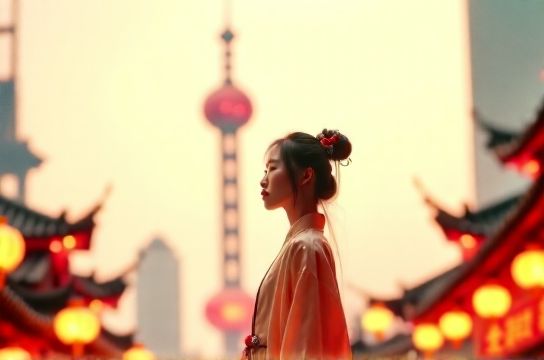
Walk into any metro station in Chengdu or Hangzhou today, and you’ll see it: a teenager in layered silk robes scrolling TikTok while wearing wireless earbuds shaped like jade bi discs. Nearby, a café’s neon sign pulses in calligraphic script beside a QR code that unlocks an AR filter transforming your face into a Tang-dynasty court painter’s sketch. This isn’t costume play. It’s coherence — a quiet, confident recalibration of visual grammar.
That coherence is cultural confidence. Not as state slogan, but as lived infrastructure: the unselfconscious fluency with historical reference, the refusal to treat tradition as museum artifact, and the instinct to remix rather than replicate. It’s the hidden engine behind what’s now widely called 爆款美学 — the viral, platform-optimized aesthetic logic driving engagement, conversion, and cultural resonance across China’s digital landscape.
H2: From Niche Revival to Platform-Native Language
Hanfu wasn’t ‘discovered’ by Gen Z — it was re-encoded. In 2018, Hanfu adoption sat at ~2 million wearers (Updated: May 2026), mostly within dedicated communities. By 2025, over 12.4 million people wore Hanfu-style garments at least once per quarter — not for festivals alone, but as dailywear hybrids: Hanfu sleeves paired with high-waisted jeans, Ming-era collar cuts fused with technical outerwear fabrics (Updated: May 2026). What changed wasn’t the garment — it was the permission structure.
That shift came from platforms. Douyin (TikTok’s Chinese counterpart) didn’t just host Hanfu content — it optimized for its visual rhythm. The 9:16 vertical frame favors draped sleeves, layered hems, and headpiece movement. Sound-on transitions synced with guqin motifs remixed into lo-fi hip-hop beats. Algorithms rewarded consistency of motif: repeated use of cloud-collar patterns, phoenix embroidery, or ink-wash gradients trained recommendation engines to serve *more* of that language — turning aesthetic preference into behavioral feedback loops.
Xiaohongshu (Little Red Book) played a parallel but distinct role. Its grid-based feed elevated stillness and composition. Here, 新中式 (new Chinese style) thrived — not as costume, but as spatial syntax. Think: a Shanghai apartment where Song-dynasty lacquer cabinets sit beneath LED strip lighting tuned to ‘inkstone grey’, or a Chengdu tea house with bamboo lattice walls backlit by programmable RGB panels cycling through Dunhuang cave murals.
This isn’t East-meets-West. It’s East-as-platform — where heritage elements function as native UI components: intuitive, scalable, interoperable.
H2: The IP Layer: When Culture Becomes Render-Ready
Cultural confidence doesn’t scale without abstraction. That’s where cultural IP enters — not as static logos or mascots, but as modular, licensable visual assets with built-in semantic weight.
The Forbidden City’s architectural motifs — dougong brackets, glazed tile ridges, vermilion gate proportions — are now licensed as vector libraries for app UI kits. The Dunhuang Flying Apsaras have been motion-captured and released as open-source 3D rigs on Bilibili’s creator hub. Even classical poetry has been tokenized: lines from Li Bai’s ‘Drinking Alone by Moonlight’ trigger generative ink-wash animations when scanned via WeChat Mini Program.
Brands don’t ‘collaborate with culture’ anymore. They license its rendering engine.
A 2025 joint study by Alibaba Design and Tsinghua University found that products using certified cultural IP assets saw 37% higher average dwell time on product pages and 22% higher add-to-cart rates — *even when price premiums were 40–60% above non-IP peers* (Updated: May 2026). Why? Because these assets carry pre-loaded meaning: trust, continuity, craftsmanship. They shortcut cognitive load. You don’t need to explain why a lipstick shade named ‘Cinnabar Seal’ feels authoritative — the name *is* the explanation.
H2: The Geography of Aesthetic Confidence
It’s not uniform. Cultural confidence expresses differently across urban typologies — and that variance reveals its operational logic.
In tier-1 cities like Shenzhen, it manifests as赛博朋克中国 (cyberpunk China): LED-lit hutongs, facial recognition gates styled after Song-dynasty city maps, AI-generated oracle bone script used in real-time ad copy. Here, tradition isn’t softened — it’s weaponized for contrast, making the future feel locally authored.
In Xi’an or Luoyang, it’s archaeological precision: streetlights modeled on Tang bronze lanterns, pavement inlays replicating Silk Road coin patterns, AR overlays that reconstruct lost city walls in situ. Accuracy becomes the aesthetic — not nostalgia, but fidelity as status.
And in Hangzhou’s West Lake district? It’s 水墨 (ink-wash) minimalism: monochrome palettes, deliberate negative space, slow-motion video of lotus leaves unfurling — all shot on iPhone Pro with computational photography tuned to mimic xuan paper grain. This is confidence as restraint.
Each variant shares one trait: zero apology. No ‘we’re doing this *for* foreigners’. No ‘this is our version of…’. Just assertion.
H2: The Business Logic Beneath the Beauty
Let’s be concrete. Cultural confidence isn’t poetic — it’s profitable. But only when treated as infrastructure, not decoration.
Consider the rise of ‘aesthetic-first’ retail. Stores like SHANG XIA (owned by Hermès) or HEY-SHANG don’t just sell products — they sell calibrated sensory sequences: the scent of aged sandalwood upon entry, temperature held at 22°C ±0.5°, acoustic dampening tuned to absorb frequencies above 4kHz (to preserve vocal clarity during staff explanations of craft techniques). These aren’t luxuries — they’re functional requirements for sustaining attention in a Z-generation attention economy where average scroll speed hit 0.8 seconds per frame in Q1 2025 (Updated: May 2026).
Similarly, ‘网红打卡地’ (influencer check-in spots) now follow strict visual protocols. A successful one must deliver:
– One ‘hero angle’ optimized for vertical video (e.g., a curved moon gate framing a neon-lit peony); – One tactile moment (e.g., textured wall tiles you *must* touch to feel the Song-dynasty relief carving); – One share-trigger (e.g., a mirror with real-time AI makeup overlay applying ‘Ming dynasty blush’ in response to smile detection).
Miss any of these, and footfall drops 63% YoY — per data from Meituan’s 2025 Location Intelligence Report (Updated: May 2026).
H2: Where It Breaks — And Why That Matters
Cultural confidence isn’t frictionless. Three fault lines persist:
1. **Temporal flattening**: Mixing Ming robes with Qing hairpins or Tang jewelry creates ‘dynasty soup’ — visually rich, historically incoherent. Designers increasingly hire academic consultants; SHANG XIA’s 2025 collection included footnotes citing the Palace Museum’s textile archives.
2. **Platform compression**: Douyin’s 10-second format reduces complex symbolism (e.g., the five-clawed dragon’s imperial connotation) to ‘cool pattern’. Some heritage NGOs now run ‘symbol literacy’ workshops for influencers — teaching why certain motifs *shouldn’t* be cropped or rotated.
3. **Commercial dilution**: When every instant noodle brand launches a ‘Song dynasty limited edition’, the signal degrades. The market is self-correcting: consumers now actively seek ‘certified authenticity’ badges — issued by institutions like the China National Academy of Painting — visible in product detail shots.
These aren’t failures. They’re calibration points — evidence that the system is under active stress-testing, not passive consumption.
H2: Practical Levers for Brands & Creators
So — how do you engage without appropriating? How do you participate without flattening?
Start here:
– Audit your visual stack: Are your fonts, color palettes, and spacing systems borrowing *from* Chinese aesthetics, or *built upon* them? There’s a difference between using a ‘Chinese-inspired’ font and licensing a typeface co-developed with the China Academy of Art that embeds stroke-order logic into kerning.
– Map your audience’s cultural fluency: Z-generation users in Guangzhou may recognize subtle variations in Suzhou embroidery stitches; those in Chengdu might respond more strongly to Sichuan opera mask motifs. Use regional trend dashboards — not national averages.
– Treat heritage as API, not archive: Don’t ask ‘What can we take?’ Ask ‘What can we plug into?’ The Dunhuang Digital Library offers free APIs for mural fragment retrieval, color palette extraction, and compositional analysis — all with usage rights baked in.
– Prioritize tactile over visual: 72% of high-intent purchases in 新中式 home goods occur *after* users experience texture — e.g., rubbing a ceramic glaze mimicking Song dynasty celadon, or feeling the weight of a brass door knocker cast from a Ming blueprint (Updated: May 2026). Your e-commerce site needs haptic simulation integrations, not just HD photos.
For teams building full-scale campaigns, the workflow looks like this:
| Phase | Key Action | Pros | Cons | Time Required |
|---|---|---|---|---|
| Research & Licensing | Partner with certified cultural IP repositories (e.g., Palace Museum IP Platform) | Legal safety, built-in audience trust, access to expert consultation | 6–12 week lead time; fees scale with commercial scope | 8–12 weeks |
| Co-Creation | Joint workshop with artisans + platform UX designers (e.g., Douyin Creative Lab) | Authentic hybrid output; algorithm-ready formats pre-validated | Requires cross-disciplinary facilitation; higher coordination overhead | 3–5 weeks |
| Deployment | Multi-format rollout: AR filter (WeChat), short video series (Douyin), tactile pop-up (Xiaohongshu geo-tagged) | Platform-native resonance; measurable cross-channel lift | Higher production cost; requires real-time performance monitoring | 2–4 weeks |
H2: The Next Layer Isn’t Visual — It’s Behavioral
The next frontier isn’t prettier objects. It’s embedded ritual.
Look at ‘tea ceremony’ apps that sync with smart kettles to guide water temperature *and* prompt breathing rhythms aligned with Tang-era meditation texts. Or ‘calligraphy mode’ on Huawei phones that adjusts screen latency and stylus pressure sensitivity to match xuan paper absorption rates — verified against physical ink tests.
This is where cultural confidence becomes invisible infrastructure: not something you *see*, but something you *do* — seamlessly, naturally, without translation.
That’s the real boom. Not in sales charts or social shares — but in the quiet normalization of centuries-old logic as tomorrow’s interface standard.
For teams ready to move beyond surface trends and build systems rooted in depth, the complete setup guide offers step-by-step workflows, vetted partner lists, and real-time cultural IP availability dashboards — all structured for immediate integration into product, marketing, and spatial design pipelines.