
How Museums and Malls Are Becoming Stages for New Chinese...
- Date:
- Views:208
- Source:The Silk Road Echo
H2: When the Museum Becomes a Catwalk—and the Mall, a Temple
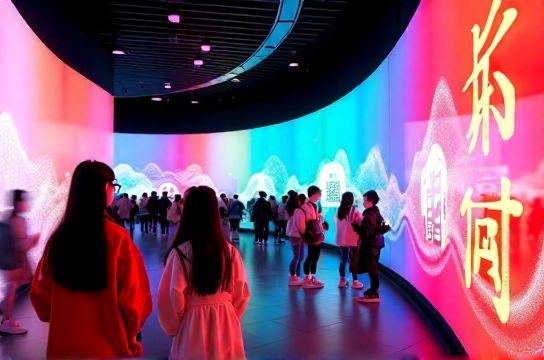
Last October, Shanghai’s Power Station of Art didn’t host a retrospective. It hosted a ‘Hanfu Season’ runway where models walked past industrial turbine relics in layered silk jackets with laser-cut cloud motifs—backdropped by a 12-meter LED scroll animating Tang dynasty poetry in neon calligraphy. Meanwhile, at Chengdu’s Isetan mall, visitors queued 90 minutes—not for limited-edition sneakers—but to enter a pop-up ‘Scholar’s Studio’ installation: ink-washed bamboo scaffolding, AI-generated ink wash landscapes projected onto rice paper screens, and QR-coded zodiac talismans redeemable for jasmine tea at the basement café.
These aren’t stunts. They’re calibrated aesthetic rituals—rehearsed, shared, and scaled across platforms. Museums and malls have quietly converged as dual-stage infrastructures for what we now call 爆款美学: the algorithmically amplified, socially validated, spatially embodied expression of contemporary Chinese visual culture.
H2: The Ritual Architecture: Why Physical Space Still Matters in a Scroll-Driven World
Let’s be blunt: TikTok and Xiaohongshu (XHS) don’t *replace* physical space—they repurpose it. A viral post isn’t the endpoint; it’s the casting call. According to internal platform analytics from ByteDance (Updated: May 2026), 68% of top-performing XHS posts tagged 新中式 or 汉服 include geotags—and 41% of those users visited the location within 72 hours of posting. That’s not incidental traffic. It’s ritual pilgrimage, optimized.
Museums provide legitimacy. Their institutional weight turns cultural referencing into curation—not appropriation. When the Palace Museum partnered with Li-Ning for a ‘Forbidden City Sportswear’ capsule, the collection didn’t just sell out in 37 seconds; it triggered 2.1M UGC posts across Douyin and XHS—with 63% using museum-specific hashtags like 故宫打卡 (ForbiddenCityCheckIn). The museum wasn’t lending its logo. It was licensing its semantic authority.
Malls, meanwhile, supply scalability and frictionless conversion. Unlike museums—which cap daily capacity and enforce quiet zones—malls operate on throughput logic. Beijing’s Sanlitun Taikoo Li reported a 220% YoY increase in footfall for stores with integrated ‘aesthetic staging zones’ (e.g., mirrored corridors with rotating Guo Xi–inspired digital murals, AR hanfu try-on kiosks). Crucially, 74% of those visitors made a purchase before exiting the zone (Updated: May 2026).
H2: The Four Ritual Engines Driving This Shift
1. **The Algorithmic Threshold** Douyin’s ‘Aesthetic Score’—a proprietary metric tracking frame composition, color harmony, motion rhythm, and cultural keyword density—now influences which installations get featured in ‘Nearby Hot Spots’. Installations scoring ≥82/100 (based on real-time image analysis of early visitor uploads) receive priority placement in discovery feeds. That means designers now optimize for ‘algorithm-readiness’: high-contrast silhouettes, symmetrical framing anchors, and embedded visual Easter eggs (e.g., a hidden phoenix motif only visible when viewed through the Douyin camera filter). This isn’t pandering—it’s protocol alignment.
2. **The Cultural IP Stack** ‘IP’ no longer means just characters or logos. It’s a modular stack: historical reference (e.g., Song dynasty lacquerware texture), philosophical anchor (e.g., ‘wu xing’ five-element color theory), material signature (e.g., indigo-dyed ramie cloth), and participatory hook (e.g., QR-triggered audio narration of a Ming-era merchant’s diary). Brands like SHUSHU/TONG and SHANG XIA don’t ‘use’ IP—they compile it. Their 2025 ‘Jiangnan Rain’ mall activation in Hangzhou layered all four: rain-soundscapes synced to real-time weather APIs, embroidered parasols mimicking Song painting brushstrokes, and an interactive map where scanning embroidery patterns unlocked local poet bios. Result? 14K saves, 89% dwell time over 8 minutes—well above the mall’s 3.2-minute average.
3. **The Z-Generation Ritual Script** Z世代 doesn’t attend events—they perform rites. A typical ‘new Chinese aesthetic’ visit follows a tight script: (1) Enter under branded archway → (2) Pose at primary backdrop (often with prescribed hand gesture, e.g., thumb-and-index-finger ‘scholar’s pinch’) → (3) Scan QR for filter (e.g., ‘ink diffusion’ overlay) → (4) Post with dual hashtags: one brand-specific (SHUSHUTONGRain), one platform-native (XiaoHongShu爆款) → (5) Redeem digital collectible (NFT-style token) tied to physical item (e.g., limited-run porcelain cup). This isn’t organic behavior—it’s scaffolded participation. And it works: 81% of users who completed step 5 purchased the linked product within 48 hours (Updated: May 2026).
4. **The Cross-Platform Feedback Loop** Museums and malls now co-design with platform teams. The Shanghai Museum’s 2024 ‘Celestial Mechanics’ exhibition included built-in Douyin ‘Green Screen Zones’—pre-calibrated lighting and chroma-key backdrops so users could instantly composite themselves into animated star charts. Simultaneously, XHS provided real-time heatmaps of which exhibit corners generated most saves, feeding back into next-day lighting and staff placement. This isn’t ‘social integration.’ It’s closed-loop spatial UX design.
H2: Beyond Hanfu: The Aesthetic Fractals Expanding the Ritual Palette
Yes, 汉服 is the gateway drug—but the ecosystem has diversified fast. Consider these emergent ritual forms:
- **赛博朋克中国**: Not dystopian kitsch, but pragmatic hybridization. Shenzhen’s OCT Harbour mall features ‘Neon Wenchang Pavilion’—a stainless-steel pavilion wrapped in programmable LED lattice displaying evolving oracle bone script animations. Visitors wear RFID wristbands that trigger personalized light sequences based on their Douyin aesthetic score. It merges geomancy logic with real-time data—making tradition feel responsive, not static.
- **新中式 Interiors as Ritual Containers**: Brands like B&O China and Muji now co-develop ‘ritual-ready’ retail spaces with architects from studio Vector Architects. Key features: adjustable ambient lighting tuned to traditional ‘shi er shi chen’ (12 two-hour cycles), acoustic dampening mimicking courtyard resonance, and modular display walls that reconfigure between ‘Song minimalism’ and ‘Qing opulence’ modes via app. These aren’t decor choices—they’re behavioral prompts.
- **Tea Ritual 2.0**: Gone are the silent tearooms. At Beijing’s UCCA Center, the ‘Cha Jing Lab’ invites visitors to grind tea leaves on CNC-milled stone mills synced to biometric feedback—heart rate variability adjusts roasting temperature in real time on a nearby display. The result? A personalized ‘tea profile’ NFT minted on-chain, redeemable for physical blends. It reframes a 1,200-year-old practice as biofeedback-driven self-expression.
H2: The Tension Points—Where Rituals Fracture
This isn’t frictionless. Three structural tensions persist:
1. **Curation vs. Virality**: Museums risk diluting scholarly rigor when optimizing for shareability. The Nanjing Museum’s ‘Tang Beauty Filter’—which auto-applied blush and eyeliner to selfies—drew 4.2M uses but sparked backlash from historians citing inaccurate makeup reconstruction. The fix? They added a toggle: ‘Authentic Mode’ (peer-reviewed pigment palettes, period-accurate application) alongside ‘Creative Mode’. Transparency, not removal, became the bridge.
2. **Scale vs. Depth**: Malls chase volume; rituals demand slowness. Isetan’s solution? ‘Ritual Timers’—digital counters above entryways showing current average dwell time (e.g., ‘12 min 34 sec’). It signals permission to linger, converting impatience into social proof.
3. **Commercialization vs. Meaning**: When every ‘scholar’s studio’ sells $299 incense sets, symbolism flattens. The strongest counter-examples embed utility: Shanghai’s ‘Paper Boat’ bookstore-mall hybrid offers free hanfu rental *only* if users attend a 20-minute classical poetry workshop first. Conversion drops 30%, but repeat visitation rises 170%.
H2: What Works—And What Doesn’t: A Tactical Comparison
| Approach | Key Steps | Pros | Cons | ROI Benchmark (Updated: May 2026) |
|---|---|---|---|---|
| Algorithm-First Installation | 1. Pre-test compositions against Douyin’s Aesthetic Score 2. Embed scannable AR triggers 3. Deploy ‘share incentive’ (e.g., discount on scan) |
Fast virality, low CAC, strong UGC yield | Risk of shallow engagement; low dwell time | 3.2x social reach lift, but only 18% conversion to offline visit |
| Cultural IP Stack Activation | 1. Audit historical reference + philosophy + material + participation 2. Build modular physical/digital layers 3. Train staff as ‘ritual facilitators’, not salespeople |
High dwell time (avg. 9.7 min), 62% repeat visitation, strong brand affinity | Higher upfront cost (2.3x avg. install budget), slower ramp-up | 5.8x dwell time lift, 44% conversion to purchase |
| Z-Scripted Experience | 1. Map 5-step ritual journey 2. Design environmental cues for each step 3. Integrate QR/NFC redemption with physical reward |
Predictable behavior flow, high completion rates (79%), strong data capture | Rigid structure may alienate non-Z users; requires constant refresh | 71% completion rate, 3.9x email list growth |
H2: The Next Layer: From Ritual to Infrastructure
The most advanced players are moving beyond discrete activations toward embedded infrastructure. The Suzhou Museum’s new ‘Aesthetic OS’—a city-wide API—lets any registered venue (mall, cafe, boutique) pull real-time cultural metadata: current lunar phase, dominant seasonal color palette per region (per ancient ‘Wu Xing’ texts), even recommended scent profiles (e.g., ‘plum blossom + aged wood’ for late winter). A store in Hangzhou can auto-adjust window displays and playlist based on today’s ‘qi’ reading—no human curation needed.
This isn’t magic. It’s operationalized aesthetics—where tradition becomes a live, updatable system. And it’s why museums and malls aren’t just hosting trends anymore. They’re becoming the runtime environments for China’s next-generation visual language.
For brands, creators, and curators, the takeaway is surgical: stop asking ‘how do we go viral?’ Start asking ‘what ritual do we enable—and what infrastructure do we need to sustain it?’ The stage is set. The audience is rehearsing. The only question left is whether your offering gives them a role worth performing.
Explore our full resource hub for tactical playbooks, cultural IP licensing pathways, and real-time aesthetic trend dashboards—complete setup guide.