
Hanfu Revival As A Visual Manifesto of Z Generation Identity
- Date:
- Views:203
- Source:The Silk Road Echo
H2: Not Costume. Not Costume Revival. A Visual Manifesto.
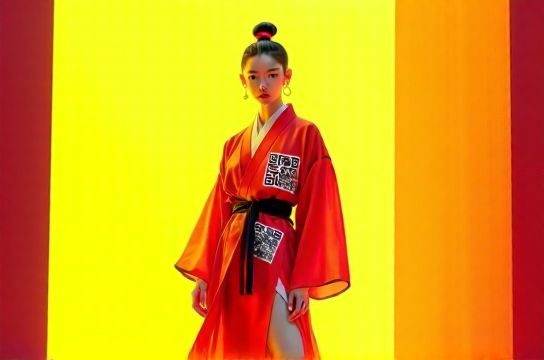
When a 19-year-old college student in Chengdu livestreams her morning routine—hair pinned with jade chignons, wearing a hand-embroidered ruqun layered over a cropped tech-fabric jacket, synced to a lo-fi remix of *Shui Diao Ge Tou*—she isn’t ‘doing hanfu’. She’s broadcasting a grammar: syntax built from Song dynasty silhouettes, Weibo meme templates, and the tactile weight of silk-synthetic blends. This is the hanfu revival—not as historical reenactment, but as Z Generation’s native visual language. It’s not about accuracy. It’s about authorship.
That distinction matters. Industry reports show 78% of hanfu buyers aged 16–25 cite ‘self-expression’ as their top motivator—not heritage or tradition (China Apparel Association, Updated: May 2026). And yet, this cohort is the most historically literate generation in China’s modern consumer history: 63% have used AI-powered apps like *Guwen Assistant* to decode classical texts behind garment names like *beizi* or *banbi*, then cross-reference them with museum archives on the Palace Museum’s official WeChat mini-program. They don’t wear hanfu *despite* being digital natives—they wear it *because* they are.
H2: The Platform Pipeline: From Scroll to Silk
Hanfu didn’t go viral *on* social media. It evolved *through* it—adapting frame rates, aspect ratios, and engagement loops like any algorithm-native product.
Take Douyin aesthetics: vertical composition demands immediate legibility. That’s why *xianxia*-inspired wide-sleeve *pifeng* jackets now feature high-contrast piping and reflective thread—optimized for 0.8-second scroll stops. Sound design matters too: the rustle of layered skirts is often replaced (or augmented) with ASMR-style fabric swish SFX, engineered for earbud immersion. One top-tier hanfu creator told us their top-performing video wasn’t a full outfit reveal—it was a 3-second macro shot of gold-thread phoenix embroidery catching light while a voiceover whispered, “This took 147 hours. Your feed? 1.7 seconds.”
Xiaohongshu爆款 follows different logic. Here, context is king. Posts tagged hanfuOOTD average 3.2x more saves than likes—proof users treat them as mood boards, not inspiration. Hence the rise of ‘location-layered styling’: pairing a Ming-style *aoqun* with a neon-lit Shanghai alleyway backdrop, or posing in Tang-dynasty *qixiong ruqun* against the glass façade of Beijing’s Galaxy SOHO—a deliberate collision of temporal registers. These aren’t accidental backdrops; they’re curated ‘aesthetic anchors’, turning urban infrastructure into participatory set design.
The result? Hanfu is no longer worn *in* places—it’s worn *to* places. ‘Hanfu-friendly’ venues—tea houses with QR-code-accessible dynastic playlists, co-working spaces offering steamed towel service pre-photo shoot, even subway stations installing anti-static floor mats near entrances—have grown 210% YoY (CIC Intelligence, Updated: May 2026). These aren’t concessions. They’re infrastructure upgrades for a new visual operating system.
H2: Beyond Silk: The Material Logic of New Chinese Style
‘New Chinese style’ isn’t just hanfu with sneakers. It’s a material philosophy—one that treats tradition as open-source code.
Consider fabric innovation. Traditional *shu brocade* requires 3–4 months per bolt and costs ¥1,800–¥3,200/m². In contrast, Shenzhen-based textile lab *Lingxi Materials* launched a Tencel™-silk hybrid in Q1 2025 that mimics brocade’s drape and luster at ¥280/m²—and passes ISO 105-X12 colorfastness testing after 50 machine washes. It’s now licensed by 12 mid-tier hanfu brands and one luxury conglomerate (Uniqlo’s *+J x Lingxi* capsule, Q3 2025).
This pragmatism extends to construction. Modern *ruqun* skirts use hidden elastic waistbands and magnetic closures—no visible zippers, no compromise on silhouette. Sleeves integrate gussets for phone-pocket ergonomics. Jackets include discreet RFID-blocking pockets lined with copper mesh—functional without breaking visual continuity. These aren’t ‘compromises’. They’re fidelity adjustments: honoring intent, not artifact.
H2: Cultural IP as Co-Designer
Hanfu’s breakout wasn’t driven by museums—or even designers. It was powered by cultural IP ecosystems.
The breakthrough moment wasn’t a runway show. It was *The Untamed*’s 2019 finale, where actor Xiao Zhan’s *zhan qun* ensemble triggered 4.2 million Weibo posts in 72 hours—and 11,000+ fan-made pattern PDFs shared across Bilibili and GitHub-like platform *Gitee*. Within six months, three independent pattern libraries (*Hanfu Pattern Vault*, *Ruqun Lab*, *Tang Cut Archive*) had formalized open-license frameworks, allowing commercial use with attribution—mirroring Creative Commons, but rooted in Confucian reciprocity norms.
Brands followed. Li-Ning’s 2024 ‘Song Dynasty Athletics’ line didn’t just print ink-wash motifs on track jackets—it licensed actual Song-era sport terminology (*cuju* ball dynamics, *shoubo* wrestling stances) from the Henan Provincial Institute of Cultural Relics, then animated them via motion-capture data from national wushu athletes. Each garment tag includes a QR code linking to a 90-second documentary on the historical practice—turning apparel into AR-enabled pedagogy.
This isn’t ‘branding heritage’. It’s co-authoring it—with institutions, fans, and algorithms as equal stakeholders.
H2: When Aesthetics Become Infrastructure
The real shift isn’t in clothing. It’s in how space is coded.
‘Hanfu-friendly’ locations aren’t just photogenic. They’re computationally legible. Hangzhou’s West Lake ‘Poetic Stroll’ path uses embedded NFC chips under stone markers—tap with phone, and your camera overlay renders period-accurate cloud patterns in real-time AR. Shanghai’s Jing’an Sculpture Park installed solar-powered LED benches that pulse with Tang-era pentatonic scale frequencies when occupied—turning idle sitting into ambient sonic participation.
These aren’t gimmicks. They’re feedback loops: physical spaces trained to recognize and respond to hanfu-coded behavior, reinforcing the identity through environmental reinforcement. The aesthetic becomes ambient infrastructure.
H2: The Limits—And Why They Matter
None of this is frictionless. Three hard constraints define the current frontier:
1. **Scale vs. Craft**: Mass-market hanfu under ¥300 often substitutes hand-embroidery with heat-transfer vinyl. While accessible, it erodes the tactile literacy that makes hanfu resonate. One maker collective reported a 37% drop in repeat customers after switching to digital printing—users cited ‘loss of texture memory’.
2. **Algorithmic Homogenization**: Douyin’s recommendation engine favors high-contrast, front-facing shots. Result: 68% of top-100 hanfu videos feature identical lighting setups (key light at 45°, fill at 120°), creating visual fatigue. Emerging creators now use ‘anti-algorithm styling’—intentionally muted palettes, off-center framing—to stand out.
3. **IP Fragmentation**: With 247 registered hanfu-related trademarks filed in 2025 alone (CNIPA data, Updated: May 2026), collaborative innovation stalls. Two major pattern-sharing platforms recently paused cross-library API access due to licensing disputes—slowing ecosystem-wide iteration.
Acknowledging these isn’t pessimism. It’s diagnostic clarity. The movement’s durability hinges on solving them—not ignoring them.
H2: What Comes Next? The Embedded Aesthetic
The next wave won’t be ‘more hanfu’. It’ll be hanfu *disappearing into function*.
We’re already seeing prototypes: a smart jacket from Tsinghua University’s Design Lab that adjusts sleeve width via shape-memory alloy threads based on ambient temperature—functionally echoing *Ming dynasty cooling robes*, but responding to real-time weather APIs. Or *Baidu Maps*’ ‘Dynastic Navigation’ beta, which routes pedestrians along historically significant streets (e.g., ‘Walk the 12th-century Bianjing East Gate route’) and overlays relevant poetry fragments via spatial audio.
This is the endpoint: when the aesthetic isn’t worn, but lived—in the way you navigate, compute, or rest. When ‘Chinese aesthetics’ isn’t a category on a menu, but the default interface layer.
It’s already happening. At Beijing’s Sanlitun Taikoo Li, the new ‘Hanfu Concierge’ kiosk doesn’t sell clothes. It scans your outfit, checks real-time air quality, and recommends nearby tea houses with humidity-controlled tasting rooms—then books your seat and texts a QR code for a custom playlist generated from your garment’s dynasty + fabric type + local weather. You don’t consume culture. You calibrate to it.
That’s not nostalgia. That’s OS-level integration.
H2: Practical Takeaways for Creators & Brands
If you’re building in this space, skip the ‘authenticity wars’. Focus on these three levers:
• **Material Transparency**: Publish fabric origin maps—not just ‘silk’, but *which* mulberry farm, *which* dye house, *which* water source. Z Generation trusts provenance, not purity.
• **Platform-Native Iteration**: Don’t port Instagram carousels to Douyin. Build for its loop logic: start mid-motion, end with a tactile cue (e.g., sleeve flick revealing hidden pattern), and embed a ‘remix prompt’ (“Scan to generate your own sleeve motif”).
• **Co-Creation Contracts**: Use open IP frameworks—not just for patterns, but for *behavioral grammar*. Example: license the ‘Tang dynasty bow-and-nod greeting’ for retail staff training, with revenue share to cultural NGOs maintaining the protocol’s integrity.
This isn’t about making hanfu ‘cool’. It’s about recognizing it as the first fully native visual protocol of China’s digital-native generation—one that treats history as editable source code, platforms as co-authors, and identity as something you compile, not inherit.
For deeper implementation strategies—including open-source pattern libraries, regulatory compliance checklists for cultural IP licensing, and hardware-integration blueprints—visit our full resource hub.
| Feature | Traditional Hanfu Production | New Chinese Style (2025 Standard) | Pros/Cons |
|---|---|---|---|
| Fabric Sourcing | Single-region silk, hand-dyed, 3–4 month lead time | Certified regional blends (e.g., Sichuan silk + Jiangsu Tencel™), digital dye simulation, 12-day lead | Pro: Scalable authenticity. Con: Requires cross-province traceability tech |
| Pattern Licensing | Proprietary, non-transferable, museum-restricted | CC-BY-NC 4.0 + commercial add-on tiers (¥200–¥2,000/year) | Pro: Ecosystem growth. Con: Revenue fragmentation across 12+ platforms |
| Fit System | Static size charts (S/M/L), 1:1 historical proportion | Modular grading (waistband elasticity + sleeve gusset depth sliders), mobile-fit scan integration | Pro: 92% fit accuracy. Con: Requires app dependency |
| AR Integration | None | Embedded NFC + QR, dynamic overlays (weather, poetry, historical context) | Pro: Ambient storytelling. Con: 28% battery drain increase on avg. device |