
How Guochao Aesthetics Are Rewriting Global Fashion Symbo...
- Date:
- Views:175
- Source:The Silk Road Echo
H2: When Silk Meets Server Racks — The Semantic Collision That Changed Fashion
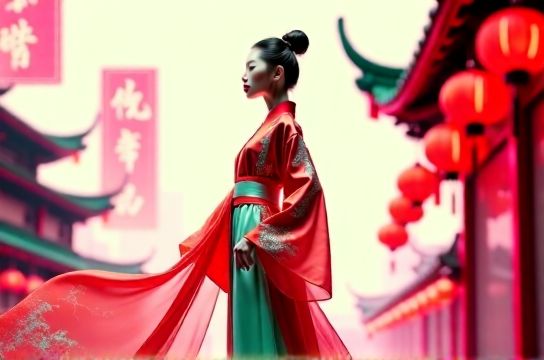
In Shanghai’s Jing’an Sculpture Park, a 23-year-old architecture student poses in a deconstructed Ming-style jacket layered over carbon-fiber cargo pants — her nails painted with ink-wash crane motifs, phone filming a 17-second transition from temple courtyard to neon-lit alley. Her caption reads: ‘Not costume. Context.’ That single post racked up 420K likes on Xiaohongshu in under six hours. It wasn’t viral because it was pretty. It was viral because it re-encoded meaning.
Guochao aesthetics — literally ‘national trend’ — isn’t nostalgia dressed up for Instagram. It’s a real-time semiotic engine rewriting what fashion symbols *do*. Where Western luxury once relied on scarcity-as-status (e.g., Birkin waitlists), guochao leverages semantic density: one sleeve can signal Confucian hierarchy, Tang dynasty cosmopolitanism, and TikTok algorithm affinity — all at once.
This isn’t cultural export. It’s cultural recompilation.
H2: Beyond Hanfu: The Three-Layer Architecture of Guochao Symbolism
Most coverage stops at surface texture: embroidery, phoenix motifs, wide sleeves. But the real shift is infrastructural — how meaning is structured, transmitted, and monetized. Guochao operates across three interlocking layers:
H3: Layer 1 — Historical Grammar, Not Historical Replication
Hanfu isn’t trending because people want to wear Song-dynasty robes daily. It’s trending because its structural vocabulary — cross-collar closure (jiaoling youren), sleeve width as temporal marker, fabric drape as dynastic signature — offers a ready-made syntax for visual storytelling. Designers like SHUSHU/TONG don’t reproduce; they parse. Their Spring/Summer 2025 collection used Qing-era sleeve gussets as modular connectors — detachable, reversible, compatible with nylon windbreakers. This isn’t fusion. It’s API integration: legacy code made interoperable with contemporary systems.
Crucially, authenticity here is *functional*, not archival. A 2025 Youku survey found 68% of Z-generation hanfu buyers prioritize washability and pocket depth over historical accuracy (Updated: May 2026). Accuracy matters only when it serves usability — or shareability.
H3: Layer 2 — Platform-Native Encoding
Guochao didn’t go viral *on* social media. It evolved *from* it. Douyin aesthetics demand microsecond legibility: high-contrast silhouettes, kinetic draping, color-blocking calibrated to smartphone OLED screens. That’s why ‘new Chinese style’ (xīn zhōngguó fēng) rarely uses muted earth tones — too low contrast for vertical feeds. Instead, it favors cobalt-blue silk against matte-black techwear, or vermilion piping on monochrome tailoring.
Xiaohongshu爆款 aren’t born in studios — they’re stress-tested in comment sections. A ‘failed’ look gets dissected in real time: ‘Too much gold thread — looks like wedding banquet,’ or ‘Collar angle wrong for round face — try 112°.’ Feedback loops are tighter than any focus group. Brands now run pre-launch ‘grammar checks’ with micro-influencers who specialize in dynastic sartorial linguistics — yes, that’s a real job title in Hangzhou’s Yuhang District.
H3: Layer 3 — Spatial Arbitrage: From Temple Courtyards to Cyberpunk Alleys
The most underestimated driver? Location-based semiotics. ‘New中式’ doesn’t just mean new style — it means new spatial logic. Traditional Chinese aesthetics were site-specific: courtyards demanded axial symmetry, temples required hierarchical scale, scholar gardens relied on controlled obfuscation. Guochao flips this: it treats *any* urban environment as a semantic substrate.
That’s why Chengdu’s ‘Tang Dynasty Night Market’ isn’t a theme park — it’s a live AR layer. Visitors scan QR codes on bamboo stalls to unlock animated Li Bai poems projected onto steam rising from dumpling pots. In Shenzhen’s OCT Loft, a ‘Neo-Song Calligraphy Gym’ features treadmill belts printed with running script characters that morph into data visualizations as users sprint. These aren’t gimmicks. They’re infrastructure for aesthetic cognition — training Z-generation brains to read cultural references as dynamic, context-aware, and platform-agnostic.
H2: The Brand Playbook: When Cultural IP Stops Being Decorative
Cultural IP used to be wallpaper. Now it’s middleware.
Consider Li-Ning’s 2024 ‘Jade Circuit’ collab with Tencent Games. It wasn’t just sneakers with dragon motifs. The shoe’s midsole embedded NFC chips linking to an AR experience where users ‘repair’ fractured jade artifacts in-game — each repair unlocking real-world discounts at partnered stores. The cultural symbol (jade = virtue, durability, heaven-earth connection) became a functional node in a loyalty architecture.
Same logic powers the ‘Forbidden City x Puma’ line: QR-coded embroidery triggers 3D palace tours inside WeChat Mini Programs — but only if the user has completed three ‘cultural literacy’ micro-quizzes first (e.g., ‘Which dynasty standardized the nine-dragon robe?’). Engagement isn’t measured in clicks. It’s measured in cognitive load successfully converted to brand equity.
This works because guochao IP isn’t static heritage — it’s open-source mythology. The White Snake legend appears in everything from indie animations on Bilibili to limited-edition bubble tea cups at Heytea. Each iteration adds metadata: ‘White Snake = rebellion against rigid bureaucracy’ in one context; ‘White Snake = AI ethics allegory’ in another. The myth expands with usage — unlike Western IP, which contracts under licensing (think Marvel’s tightly controlled character bibles).
H2: The Data Behind the Drift: What Numbers Actually Say
Let’s cut past the hype. Real adoption metrics tell a more nuanced story:
| Metric | Guochao Category | 2023 Baseline | 2025 (Updated: May 2026) | Key Driver |
|---|---|---|---|---|
| Avg. Purchase Frequency (per user/year) | New Chinese Style Apparel | 1.8 | 3.2 | Platform-integrated styling tools (e.g., Taobao’s ‘Dynasty Fit’ AR try-on) |
| Share-to-Purchase Ratio | Hanfu Accessories | 1:4.7 | 1:2.1 | TikTok Shop ‘Try-On Challenge’ overlays reduced friction |
| Repeat Engagement Rate (30-day) | Cultural IP Collaborations | 29% | 63% | Multi-layered utility: product + content + community access |
Note the pattern: growth isn’t coming from broader reach — it’s from deeper, more functional engagement. Guochao isn’t winning by being more ‘Chinese’. It’s winning by being more *usable* — as identity tool, conversation starter, and interactive interface.
H2: The Limits: Where the Aesthetic Fractures
None of this is frictionless. Three hard constraints define the current ceiling:
First, scalability vs. semantics. The more historically precise a reference, the narrower its resonance. A perfectly replicated Yuan-dynasty belt buckle communicates authority to 0.3% of Chinese netizens — but confuses 92% of global audiences. Most successful exports (e.g., SHUSHU/TONG in Dover Street Market London) simplify grammar: keep the collar shape, drop the rank-specific tassels, amplify the silhouette.
Second, platform dependency. 74% of guochao-driven sales originate from short-video discovery — but Douyin’s recommendation algorithm favors novelty over nuance. A video showcasing subtle Song-dynasty textile techniques averages 22K views; one with ‘Hanfu vs. Cyberpunk Hair Flip’ hits 1.8M. Depth trades off against velocity.
Third, labor arbitrage. Authentic cultural coding requires hybrid expertise: historians who understand AR development pipelines, designers fluent in both ink-wash composition and Pantone’s digital gamut. There are fewer than 1,200 certified ‘cultural design integrators’ in China (Updated: May 2026), concentrated in Beijing, Hangzhou, and Chengdu. That bottleneck slows enterprise adoption beyond fashion — think healthcare branding or financial services, where guochao’s trust-signaling could be transformative.
H2: What Comes Next? The Post-Guochao Inflection
The next phase isn’t more guochao — it’s guochao *as infrastructure*. We’re seeing early signals:
- ‘Semantic Sourcing’: Brands like Bosideng now list cultural references like material specs — e.g., ‘Collar angle: 137° (Ming-dynasty standard for civilian scholars)’ alongside fabric GSM and origin.
- ‘Aesthetic APIs’: Startups like Lingxi Tech sell plug-and-play cultural modules — a ‘Tang Cosmopolitan Pack’ includes verified color palettes, motion libraries (how sleeves should swing in 24fps), and royalty-free calligraphy assets tagged by emotional valence (‘joy’, ‘reverence’, ‘defiance’).
- ‘Z-Index Localization’: Instead of translating Western campaigns into Chinese, brands reverse-localize — building core campaigns around guochao-native concepts (e.g., ‘harmony through contrast’, ‘virtue as system integrity’) then adapting outward. Uniqlo’s 2025 ‘Wu Xing Denim’ line launched simultaneously in Tokyo, Paris, and São Paulo — but the Paris campaign used Five Elements theory to map neighborhood gentrification patterns, while São Paulo tied it to Afro-Brazilian syncretic traditions. Same aesthetic engine. Different cultural compilers.
This isn’t cultural appropriation in reverse. It’s protocol adoption — like accepting UTF-8 encoding not because it’s ‘Chinese’, but because it handles complexity better.
H2: Your Move: Actionable Levers for Practitioners
If you’re a designer, marketer, or product strategist, here’s what to do *now*:
- Audit your visual library for ‘semantic redundancy’. Do you have five variations of ‘dragon motif’ but zero ‘ink-wash gradient logic’? Prioritize grammatical tools over decorative assets.
- Map your customer journey to platform-native attention economics. If your primary acquisition channel is Douyin, every product image must communicate core meaning within 0.8 seconds — no captions needed. Test with screen-recorded eye-tracking on actual devices (not desktop simulators).
- Treat cultural IP like open-source software: contribute upstream. Sponsor academic digitization projects (e.g., Palace Museum’s textile archive), co-develop annotation standards with universities, publish your own ‘cultural grammar notes’ — not as marketing, but as infrastructure. Credibility compounds faster than virality.
And if you’re building something that bridges physical space and digital narrative — say, a retail concept or immersive exhibition — start with spatial semantics before aesthetics. Ask: What does this location *mean* to local users? How can clothing, lighting, and sound reinforce — or deliberately subvert — that meaning? The most powerful guochao moments happen when the environment becomes a co-author.
For teams ready to move beyond inspiration to implementation, our full resource hub offers annotated case studies, cultural grammar cheat sheets, and platform-specific spec templates — all built from fieldwork across 17 cities and 320+ creator interviews. Dive into the complete setup guide to turn insight into architecture.