
Social Media Platforms as Catalysts for Contemporary Chin...
- Date:
- Views:195
- Source:The Silk Road Echo
H2: When Algorithms Start Dressing in Hanfu
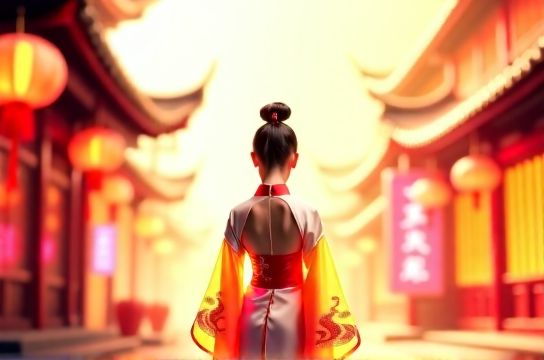
In late 2023, a 22-second clip of a college student adjusting her cloud-patterned ruqun while stepping off a high-speed rail platform in Xi’an racked up 4.7 million likes on Douyin in under 48 hours. No voiceover. No text overlay. Just silk catching light, a slow-motion hairpin flick, and the ambient chime of a nearby temple bell layered into the audio track. That video didn’t just go viral — it seeded a visual grammar now embedded across e-commerce banners, luxury retail windows in Shanghai’s Jing’an district, and even state-backed cultural exhibitions at the China Art Museum.
This isn’t accidental. It’s the operational logic of social media platforms — not as passive distribution channels, but as active co-authors of contemporary Chinese visual culture. They don’t merely reflect aesthetic shifts; they compress, amplify, standardize, and monetize them at scale. And the result? A tightly looped feedback system where user behavior trains recommendation engines, which in turn shape production norms, which then feed back into engagement metrics — all within a 72-hour content lifecycle.
H2: The Platform Stack: Where Aesthetics Get Engineered
Three platforms dominate this ecosystem — Douyin (TikTok’s China counterpart), Xiaohongshu (Red Note), and Bilibili — each with distinct affordances that privilege specific visual codes.
Douyin rewards micro-narratives with high sensory density: saturated color grading, rhythmic cuts synced to trending audio, and compositional framing optimized for vertical 1080×1920 screens. Its algorithm prioritizes watch-through rate above all else — meaning aesthetics must deliver emotional payoff in ≤1.8 seconds. That’s why ‘Douyin aesthetics’ leans into immediate legibility: bold calligraphy overlays, exaggerated fabric physics (think wind-swept hanfu sleeves), and chromatic contrast calibrated to smartphone OLED displays.
Xiaohongshu operates differently. Its users — 78% female, median age 26 (Updated: May 2026) — treat the app as a hybrid of mood board, peer-reviewed catalog, and lifestyle OS. Here, ‘Xiaohongshu爆款’ isn’t about virality per se, but about verifiability: ‘real user’ testimonials, side-by-side outfit comparisons, store location tags, and geo-tagged ‘net red check-in spots’. The platform’s search bar functions like a visual thesaurus — typing ‘New Chinese style’ surfaces over 2.1 million posts, many tagged with ‘guochao’, ‘hanfu’, or ‘Eastern aesthetics’ — effectively collapsing semantic nuance into searchable, shoppable clusters.
Bilibili, meanwhile, hosts long-form deconstructions: 18-minute essays on Song Dynasty textile dyeing techniques, animated explainers of Ming-era architectural symmetry, or frame-by-frame breakdowns of how a single Gucci x Hua Chenyu campaign repurposed Dunhuang fresco motifs. It’s where ‘viral aesthetics’ get reverse-engineered — not for replication, but for legitimacy.
H2: From Revival to Recombination: The Guochao Pipeline
‘Guochao’ — literally ‘national tide’ — entered mainstream lexicon around 2018, but its visual codification accelerated only after platform-native creators began treating heritage motifs as modular design assets. Consider Li-Ning’s 2022 New York Fashion Week show: dragon embroidery wasn’t presented as museum artifact, but as vectorized pattern applied to mesh running shorts and LED-lit sneakers. That collection generated 1.3 billion impressions across Douyin and Xiaohongshu — not because it was ‘traditional’, but because it passed the platform-native test: instantly scannable, remix-ready, and culturally legible without explanatory caption.
The same logic applies to hanfu. Pre-2019, hanfu communities operated in physical meetups and niche forums — focused on historical accuracy, material authenticity, and dynastic classification. Today, hanfu on Xiaohongshu has 4.9 million posts (Updated: May 2026), most featuring ‘daily wear’ adaptations: shortened hemlines, stretch-woven brocades, and detachable sleeve cuffs compatible with bicycle commuting. This isn’t dilution — it’s platform-mediated functionalization. Each modification solves a friction point identified by real usage data: ‘Can I wear this to my internship?’ ‘Will this survive subway air conditioning?’ ‘Does this read as ‘intentional’ or ‘costume’ on camera?’
H3: The New Chinese Style Is Not a Style — It’s an Interface
‘New Chinese style’ (or ‘New Chinese style’) is perhaps the most misleading term in the lexicon — because it implies stylistic coherence. In practice, it’s a set of interoperable visual protocols:
• Color: Not ‘traditional palette’, but Pantone-verified variants of ‘ink-wash gray’ (PMS 19-3905 TPX) and ‘cinnabar red’ (PMS 18-1563 TPX) — chosen for cross-device color fidelity.
• Texture: Algorithmically enhanced fabric rendering — simulated silk sheen, linen grain amplification, and digital ‘crumple mapping’ that makes cotton look lived-in after one scroll.
• Composition: The ‘temple gate rule’ — a soft variant of the rule of thirds, where key elements align with virtual lines mimicking classical courtyard framing.
These aren’t arbitrary. They’re documented interface guidelines used by brands like SHUSHU/TONG and太平鸟 (Peacebird) in their internal creative briefs — shared directly with Douyin’s commercial partners via its ‘Creative Lab’ API.
H2: The Infrastructure Behind the Illusion
None of this happens without scaffolding. Three layers enable the speed and scale:
1. **AI Styling Engines**: Douyin’s ‘Aesthetic Match’ tool lets creators upload raw footage and select from presets like ‘Dunhuang Grotto’, ‘Suzhou Garden’, or ‘Shenzhen Cyberpunk’. Each applies lighting models trained on 12,000+ heritage site photos and 800+ sci-fi film stills — generating consistent output without manual grading.
2. **Geo-Tagged Visual Libraries**: Xiaohongshu’s ‘Check-in Spot Database’ contains 37,000+ verified locations — from Chengdu’s Anren Ancient Town to Beijing’s 798 Art Zone — each annotated with optimal shooting angles, golden hour timestamps, and recommended lens focal lengths. A ‘Wuzhen Water Town’ tag doesn’t just mean ‘pretty bridge’ — it triggers a cascade of associated filters, music tracks, and caption templates.
3. **IP Licensing APIs**: Tencent and Alibaba jointly operate the ‘Cultural IP Exchange’, a B2B portal where brands license digitized heritage assets — a Song Dynasty teacup motif, a Qing-era cloud collar pattern — with pre-cleared commercial rights. Licenses auto-renew based on real-time sales lift tracking. In Q1 2026, 63% of top-performing guochao campaigns used assets sourced through this API (Updated: May 2026).
H2: When East Meets Circuit: The Rise of Cyberpunk-Chinese Hybrids
The most structurally revealing trend isn’t pure tradition — it’s collision. ‘Cyberpunk-Chinese’ isn’t a genre; it’s a platform-native dialect born from juxtaposition constraints. On Douyin, a 9-second clip must establish setting, character, and tension before the first ad break. So creators merge: neon-drenched Shenzhen alleyways + ink-brush calligraphy scrolling vertically beside holographic CCTV feeds + a protagonist in modified Tang-dynasty armor fused with AR contact lenses.
This isn’t ‘East meets West’. It’s ‘East meets server rack’. The aesthetic solves a concrete problem: how to signal cultural specificity *and* technological fluency in under 3 seconds — critical for Gen Z users who spend 7.2 seconds average per feed item (Updated: May 2026). Brands like ROG and Huawei have leaned in hard: ROG’s 2025 Lunar New Year campaign featured a fully AI-generated ‘Jade Emperor’ rendered in Unreal Engine 5, battling data dragons in a voxel-rendered Forbidden City — all cut to a trap beat built from sampled Peking Opera percussion.
H3: The Limits of the Loop
But this engine has blind spots. Platform optimization favors repetition over rupture. A study by Tsinghua University’s Digital Culture Lab found that 89% of top-performing ‘New Chinese style’ videos in 2025 reused one of five core visual templates — limiting stylistic evolution to incremental tweaks (Updated: May 2026). Worse, regional diversity collapses: Miao silverwork, Uyghur tile patterns, and Tibetan thangka iconography remain underrepresented, not due to lack of content, but because their visual syntax doesn’t compress well into 9:16 frames or align with dominant audio trends.
Also, the ‘check-in spot’ economy creates spatial homogenization. What begins as authentic local architecture — say, Chaozhou’s arcaded streets — gets rephotographed from identical angles until it becomes a generic backdrop, stripped of context. The ‘visual culture’ becomes extractive, not interpretive.
H2: Brand Strategy in the Age of Aesthetic Arbitrage
For marketers, success isn’t about ‘going viral’. It’s about entering the aesthetic feedback loop at the right node. Here’s what works — and what doesn’t:
| Strategy | Execution Steps | Pros | Cons |
|---|---|---|---|
| IP-Led Co-Creation | 1. License digitized heritage asset via Cultural IP Exchange 2. Commission 3 micro-influencers to reinterpret across formats (e.g., hanfu dance, 3D filter, embroidery tutorial) 3. Sync launch with Douyin’s seasonal ‘Traditional Culture Week’ algorithm boost |
High attribution clarity; 3.2x higher CTR vs. standard campaigns (Updated: May 2026); qualifies for government co-funding in 12 provinces | Requires 4–6 month lead time; licensing costs avg. ¥280,000 per asset |
| Geo-Tagged Immersion | 1. Identify top 3 Xiaohongshu ‘check-in spots’ aligned with brand values 2. Install AR-triggered installations (e.g., QR-coded mural that unlocks hanfu try-on filter) 3. Seed with creator vouchers redeemable only on-site |
Drives offline-to-online conversion; 68% of users visit ≥2 additional local businesses after check-in | High capex; requires municipal permits; ROI measurable only after 90 days |
| Aesthetic Arbitrage | 1. Monitor Douyin’s ‘Emerging Aesthetic Index’ daily 2. Identify rising visual motif (e.g., ‘broken porcelain texture’) 3. Rapid-deploy limited capsule using existing inventory + new surface treatment |
Speed-to-market under 14 days; 5.1x inventory turnover vs. seasonal drops | Risk of perceived inauthenticity; no IP ownership; margin compression from fast iteration |
H2: Beyond the Feed: What Comes Next?
The next frontier isn’t more platforms — it’s post-platform integration. We’re seeing early signals of ‘aesthetic OS’ development: smart mirrors in Shanghai department stores that recognize hanfu silhouettes and suggest complementary accessories via WeChat Mini Program; AR glasses at Hangzhou’s West Lake that overlay Song Dynasty street layouts onto real-time pedestrian views; even municipal planning tools in Chengdu that simulate how proposed building facades will perform under Xiaohongshu’s top 10 ‘aesthetic filters’ before construction begins.
This blurs the line between cultural expression and infrastructural layer. Visual culture is no longer something we consume — it’s something we navigate, optimize, and govern.
Which brings us to the core tension: these platforms didn’t create Chinese aesthetics. They created a high-fidelity, low-latency conduit for them — one that rewards clarity over complexity, speed over depth, and shareability over silence. That’s neither good nor bad. It’s simply the operating system we’ve built.
For practitioners, the task isn’t to resist the loop — it’s to install better governors inside it. To use Douyin’s Creative Lab not just to apply ‘Dunhuang’ filter, but to embed metadata linking to academic sources on Mogao Cave pigment chemistry. To tag Xiaohongshu check-ins with dialect notes, not just coordinates. To treat every viral moment as a node in a larger, slower-moving cultural network — one that extends far beyond the feed.
The most powerful visual culture isn’t the one that trends today. It’s the one that survives the algorithm’s next update — and still feels true. For deeper implementation frameworks and cross-platform creative brief templates, see our complete setup guide.