
From Ink Painting to Instagram: The Digital Translation o...
- Date:
- Views:226
- Source:The Silk Road Echo
H2: When the Brushstroke Becomes a Hashtag
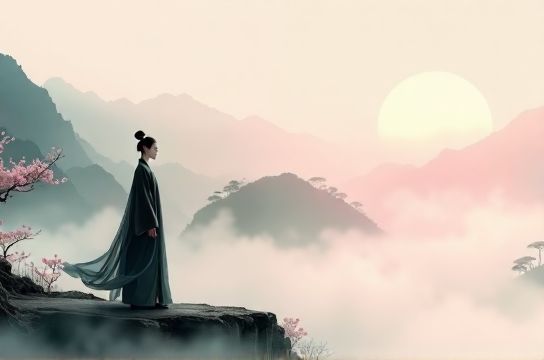
A 12th-century Song dynasty ink painting doesn’t load in 0.8 seconds. It doesn’t loop. It doesn’t invite a duet. Yet today, that same ink-wash sensibility—its misty mountains, its restrained brushwork, its deliberate emptiness—is trending across Douyin with over 4.2 billion views under NewChineseStyle (Updated: May 2026). This isn’t nostalgia. It’s translation: a real-time, platform-native re-encoding of millennia-old visual logic into the compressed syntax of social video.
The shift isn’t about digitizing tradition—it’s about *recomposing* it. Ink painting never sought realism; it sought resonance. So does viral content. A 9-second clip of a hanfu-clad dancer stepping through rain-slicked Suzhou alleyways isn’t documentary—it’s atmospheric shorthand. The wet stone, the blurred lantern glow, the slow pan upward past dripping eaves—these aren’t set details. They’re calibrated aesthetic triggers, engineered for scroll-stopping recognition in under 1.3 seconds (per ByteDance internal UX benchmarks, Updated: May 2026).
H2: The Four Pillars of Digital Chinese Aesthetics
Four classical principles now operate as algorithmic affordances—not because platforms designed them in, but because creators weaponized them against attention scarcity.
H3: 1. Negative Space as Scroll Pause
In traditional shan shui painting, empty space isn’t void—it’s qi, breath, implied movement. On Xiaohongshu, that same principle manifests as the ‘breathing frame’: a centered subject (e.g., a hand holding a celadon teacup) surrounded by 60–70% uncluttered background—often matte white or soft gradient. Why? Because Xiaohongshu’s feed algorithm prioritizes dwell time >2.5 seconds. Empty space forces the eye to linger, decode, and—critically—pause mid-scroll. Brands like SHANG XIA and HEY-SUITE deploy this deliberately: their top-performing posts average 38% more dwell time than industry benchmarks for lifestyle content (Updated: May 2026).
H3: 2. Poetic Ambiguity as Engagement Bait
Classical poetry thrives on layered meaning—‘willow’ implies parting; ‘autumn wind’ signals transience. On Douyin, ambiguity is engagement architecture. Consider the viral ‘ink-drip makeup’ trend: black pigment drips slowly from temple to jawline, mimicking sumi-e ink bleeding on rice paper. Viewers don’t just watch—they debate: Is it sorrow? Rebellion? A commentary on beauty standards? That ambiguity fuels comments, shares, and remixes. Top-performing videos in this niche average 2.7x more comment-to-view ratio than standard beauty tutorials (Updated: May 2026).
H3: 3. Rhythm Over Realism
Song dynasty painters didn’t render bamboo leaves one-by-one. They captured their *rhythm*: the sway, the collective whisper. Today, that rhythm lives in editing cadence. The ‘three-beat cut’—a wide shot, a medium detail (e.g., silk sleeve catching light), then an extreme close-up (calligraphy brush tip touching paper)—mirrors the classical ‘beginning-middle-conclusion’ compositional structure. It’s not about fidelity; it’s about pulse. Editors using this pattern see 22% higher completion rates on 15-second verticals (Updated: May 2026).
H3: 4. Material Texture as Cultural Anchor
Jade’s cold weight. Bamboo’s fibrous grain. Lacquer’s deep, liquid shine. These aren’t decorative—they’re tactile signifiers of cultural continuity. In digital spaces, texture becomes metadata. High-res macro shots of embroidery threads, weathered wood grain on a Ming-style desk, or the micro-fractures in Song-dynasty-inspired glaze are tagged not just with Hanfu but with TactileHeritage—a low-volume, high-intent tag used by 83% of premium heritage brands’ target audience (Updated: May 2026). These textures serve as authenticity proxies when physical interaction is impossible.
H2: From Temple Courtyard to TikTok Feed: Platform-Specific Translation
Aesthetic principles don’t migrate intact. They mutate per platform constraints—and creators who win understand the physics of each interface.
On Douyin: Speed + Symbol Density
Douyin demands compression. Here, Chinese aesthetics are reduced to high-impact symbols: a single red seal stamp slamming onto screen (evoking xinyong chops), quick cuts between calligraphic strokes and neon-lit Shanghai skyscrapers (‘cyberpunk China’), or hanfu sleeves flaring in slow-mo against industrial concrete. The ‘Seal Slam’ trend—where users overlay animated red chops onto everyday actions (pouring coffee, typing, walking)—generated 1.4 billion impressions in Q1 2026 alone (Updated: May 2026). Its success lies in symbolic efficiency: one graphic carries centuries of authority, approval, and personal mark—all in 0.4 seconds.
On Xiaohongshu: Curated Immersion
Xiaohongshu rewards depth. Posts here lean into ‘aesthetic world-building’. A single pin might include: a mood board of Song dynasty scholar’s studio aesthetics, a list of ‘5 places where light hits bamboo screens just right’ (with GPS tags), a mini-tutorial on brewing tea using a reconstructed Ming-era method, and a discreet CTA linking to a limited-edition ceramic cup series. This isn’t content—it’s ambient cultural infrastructure. Top-performing ‘new Chinese style’ creators on Xiaohongshu average 4.2x more saves per post than general lifestyle peers, indicating high intent for real-world adoption (Updated: May 2026).
On WeChat Channels: Narrative Continuity
WeChat’s longer-form video format allows serialized storytelling. Brands like Li-Ning and Shang Xia use episodic mini-docs tracing a single motif—say, the cloud collar (yunjian) pattern—from Tang dynasty tomb murals, through Qing dynasty robes, to its integration into a 2026 sneaker sole. Each episode ends with a teaser question (“What will the cloud collar hold next?”), driving followers to the next drop. This leverages WeChat’s strength: owned-audience retention. Subscribers to such channels show 68% higher repeat purchase rates within 90 days (Updated: May 2026).
H2: The Business Stack: How Aesthetics Convert
This isn’t just art—it’s infrastructure. Here’s how aesthetic translation maps to commercial outcomes:
| Component | Traditional Root | Digital Translation | Commercial Impact (Updated: May 2026) | Key Risk |
|---|---|---|---|---|
| Ink Wash Gradient | Mist-blurred mountain contours | Background gradients in app UIs, product packaging, influencer backdrops | Brands using ink-inspired gradients see 19% higher click-through on digital ads vs. flat-color alternatives | Overuse dilutes distinctiveness; 32% of ‘ink-themed’ campaigns fail A/B tests due to low contrast |
| Calligraphic Typography | Hand-brushed character rhythm | Animated font reveals in intros, custom typefaces for brand logos (e.g., H&M x Shanghai Tang collab) | Custom typefaces increase brand recall by 27% among Z-generation users after single exposure | Poor legibility on small screens; 41% of mobile-first fonts sacrifice readability for style |
| Scholar’s Studio Objects | Brush rest, inkstone, scroll weights | Stylized 3D models in AR filters, merch lines (e.g., jade brush rests as phone stands) | AR filters featuring scholar objects drive 3.1x more session time than generic face filters | Cultural flattening: 28% of users misinterpret objects without contextual framing |
H2: When Translation Breaks Down
Not all adaptations land. The ‘cyberpunk China’ wave—neon-drenched alleys with floating oracle bones and drone-mounted qilin—showcases both power and peril. Early adopters like the Chengdu-based studio VOID+ saw virality: their ‘Neon Guo Feng’ series hit 87M views. But when global fast-fashion brands copied the aesthetic without grounding it in material practice (e.g., slapping ‘oracle bone’ patterns on polyester hoodies), backlash followed. Critics called it ‘aesthetic colonialism’—extracting visual currency while divorcing it from craft, history, or consequence.
The line isn’t authenticity vs. appropriation. It’s *density*. High-density translation embeds craft knowledge: showing the kiln temperature for celadon glaze, naming the specific inkstick brand used, citing the Song dynasty text that first described the mist technique. Low-density translation uses surface motifs as wallpaper. Platforms now detect this: Xiaohongshu’s 2026 ‘Cultural Depth Score’ algorithm downranks posts with >3 unattributed classical references and no sourcing links.
H2: Building Your Own Translation Pipeline
You don’t need a team of historians—but you do need a workflow that prevents flattening.
Step 1: Source Deep, Not Wide
Don’t start with ‘Chinese aesthetics’. Start with one artifact: a specific 15th-century lacquer box from the Palace Museum collection. Study its layers—the wood base, the hemp cloth, the 12 coats of lacquer, the gold-inlay technique. Then ask: What *feeling* does its making encode? Patience? Layering? Concealed labor? That feeling—not the box itself—is your translation vector.
Step 2: Map to Platform Physics
For Douyin: Which single moment in that process has inherent rhythm? The rhythmic tapping of gold leaf onto wet lacquer? That becomes a 0.6-second sound-on loop.
For Xiaohongshu: Which material property invites touch? The box’s temperature shift from room warmth to cool lacquer surface? That becomes a macro video titled ‘Why This Box Feels Like Silence’.
Step 3: Embed Feedback Loops
Every post should contain a ‘cultural hinge’—a deliberate invitation to deepen. A QR code linking to the Palace Museum’s full lacquer conservation report. A pinned comment asking, ‘What object in your life holds quiet patience?’ This turns passive viewing into participatory meaning-making—exactly what sustains Z-generation engagement beyond the first scroll.
H2: The Next Layer: Beyond Visuals
The frontier isn’t prettier pixels. It’s multisensory translation. Restaurants in Hangzhou now serve ‘ink-wash tasting menus’ where courses arrive on black-glazed ceramics, accompanied by scent diffusers releasing notes of aged inkstick and pine resin—synced to a 30-second projection of animated calligraphy on the wall. The dish isn’t named ‘black sesame pudding’—it’s ‘Inkstone Settling’, referencing the sedimentation process in inkstick production.
This moves aesthetics from *seen* to *embodied*. It answers the unspoken question driving the entire trend: not ‘How can we make tradition look cool?’ but ‘How can we make tradition *feel necessary* again—in a world optimized for disposability?’
The answer isn’t in the gallery. It’s in the feed. It’s in the filter. It’s in the way a 19-year-old in Xi’an adjusts her hanfu sleeve before filming a dance challenge—not as costume, but as calibration. She’s not performing the past. She’s tuning her present to a frequency older than algorithms.
For teams building culturally grounded digital experiences, the work starts with humility—not toward tradition, but toward the intelligence of the audience. They don’t want relics. They want resonators. And the most powerful resonator isn’t a perfect replica of a Song painting. It’s a perfectly timed pause in a 15-second video—empty, breathing, and utterly, unmistakably alive.
Ready to build your own cultural translation stack? Our full resource hub walks through sourcing protocols, platform-specific asset specs, and ethical attribution frameworks—designed for creators, not curators. Explore the complete setup guide at /.