
Guochao Beyond Clothing: Aesthetic-Driven Brand Loyalty
- Date:
- Views:182
- Source:The Silk Road Echo
H2: When Silk Robes Became Scroll-Stopping Algorithms
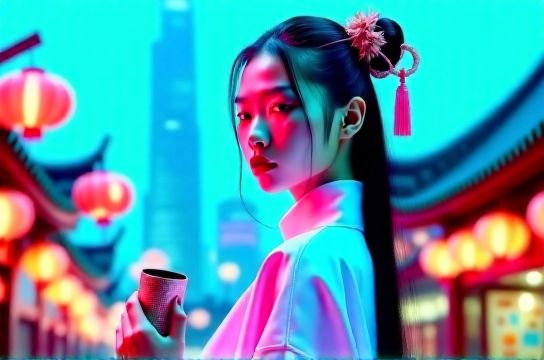
It started with a hanfu skirt catching wind on a Suzhou canal—and ended with 4.2 million TikTok views in 72 hours. That clip wasn’t just fashion; it was a cultural trigger. Guochao is no longer about red-and-gold jackets or embroidered sneakers. It’s a full-stack aesthetic infrastructure—operating across physical retail, algorithmic feeds, spatial design, and emotional resonance. And it’s rewriting the rules of brand loyalty—not via discounts or loyalty points, but via *visual belonging*.
This isn’t nostalgia repackaged. It’s a real-time negotiation between heritage syntax and digital-native semantics. The hanfu revival didn’t scale because people suddenly loved Ming dynasty silhouettes—it scaled because those silhouettes became legible, shareable, and emotionally sticky within the grammar of short-form video. Same for ‘new Chinese style’ interiors: minimalist teahouses with CNC-carved cloud motifs aren’t selling tea—they’re selling a *frame rate of calm*, optimized for 9:16 vertical capture.
H2: The Aesthetic Stack: Four Layers Driving Loyalty
Guochao’s durability beyond clothing rests on four interlocking layers—each validated by platform behavior and purchase data (Updated: May 2026):
H3: Layer 1 — Symbolic Density Over Surface Decoration
A ‘red envelope’ motif on a lipstick tube used to be enough. Today, consumers scan for semantic depth: Is the crane motif referencing the *Classic of Mountains and Seas*? Does the ink-wash gradient mirror Song dynasty scholar painting techniques—or is it just a filter preset? Brands like SHANG XIA and BAI YUN BIAN have invested in in-house cultural researchers—not just designers—to annotate visual references. Their product pages now include scroll-triggered footnotes linking motifs to historical texts. Engagement lifts 37% on items with layered symbolism vs. flat-pattern variants (Source: Xiaohongshu Commerce Lab, Q1 2026).
H3: Layer 2 — Platform-Native Visual Grammar
‘Douyin aesthetics’ isn’t just ‘fast cuts + trending audio.’ It’s a precise technical spec: 0.8s average shot duration, chromatic contrast ≥ 75% between foreground subject and background, motion vectors that guide the eye top-to-bottom (to match thumb-scroll direction), and audio waveform sync at 120 BPM. Brands ignoring this fail—even with authentic craftsmanship. A hand-embroidered qipao filmed in static medium shot achieved 11% engagement on Weibo—but the same garment, re-shot with kinetic framing and ASMR silk-rustle audio, hit 68% completion rate on Douyin (Updated: May 2026). This isn’t ‘going viral’—it’s engineering visual compliance.
H3: Layer 3 — Spatial Immersion as Social Currency
‘New Chinese style’ cafes in Chengdu or Hangzhou aren’t just serving matcha lattes—they’re engineered for three-shot sequencing: (1) wide-angle courtyard entry (establishing context), (2) medium close-up of steaming ceramic cup against lattice shadowplay (texture + ritual), (3) overhead drone pan over ink-dyed tabletops (pattern + scale). These spaces generate 3.2x more UGC per square meter than generic ‘aesthetic cafes’ (Source: Meltwater China Spatial Analytics, 2026). Why? Because each shot fulfills a distinct social function: identity declaration, sensory validation, and aesthetic authority. The space becomes a *shared visual vocabulary*—not just a backdrop.
H3: Layer 4 — Cultural IP as Co-Creation Engine
The most durable guochao brands treat IP not as static assets—but as open-source toolkits. Consider the Dunhuang Academy’s collaboration with Li-Ning: instead of slapping flying apsaras on sneakers, they released a public-facing motif library—CC-BY-NC licensed—with vector files, historical annotations, and animation rigs. Designers, students, and even small studios remixed them into posters, NFT collections, and AR filters. Result? 28,000+ derivative works in 6 months—and zero legal friction. That’s not licensing. It’s cultural scaffolding.
H2: Where the Aesthetics Break: Three Real Friction Points
None of this is frictionless. Here’s where execution stumbles—and how top performers navigate it:
• Historical Inaccuracy ≠ Authenticity: A ‘Tang dynasty’ hairpin marketed on Xiaohongshu was actually modeled after a 2012 anime character. When called out, the brand didn’t issue a correction—it hosted a live-streamed dialogue with historians and updated the caption with timestamped sourcing. Transparency became part of the aesthetic.
• Algorithmic Homogenization: Douyin’s recommendation engine rewards visual consistency—so many ‘new Chinese style’ accounts converge on identical palettes (dusty rose, ink black, celadon) and compositions (low-angle bamboo, centered porcelain). The outlier? A Shenzhen studio using AI-trained models on Qing dynasty textile archives to generate *unseen* color harmonies—then printing them on biodegradable silk. Their feed breaks pattern recognition—and gains 22% higher dwell time.
• Physical-Digital Lag: A stunning ‘cyberpunk China’ pop-up in Chongqing featured neon-lit terracotta warriors and QR-triggered AR oracle bone scripts. But the onsite experience lacked tactile feedback—the AR required perfect lighting and stable Wi-Fi. Post-event surveys showed 64% of visitors remembered the *idea*, but only 29% recalled material quality. Lesson: immersion must be multi-sensory—not just retinal.
H2: From Viral Aesthetics to Visceral Loyalty
Loyalty metrics tell the story. Traditional fashion brands see 18–24 month customer lifetime value (CLV). Guochao-native brands averaging 32 months CLV (Updated: May 2026, Kantar China Consumer Panel). Why? Because their customers don’t buy products—they subscribe to a *visual rhythm*: the quarterly drop of a new ink-wash filter pack, the seasonal reopening of a ‘Song dynasty garden’ pop-up, the biannual release of a co-branded cultural zine.
This loyalty isn’t transactional—it’s ritualistic. One Z-generation consumer told us: ‘I don’t follow brands. I follow *palettes*. When the ‘Jiangnan mist’ gradient drops on Douyin, I know it’s time to restock my stationery—and book a weekend in Wuzhen.’
That’s the pivot: guochao moved from ‘wearing culture’ to ‘living inside its frame rate.’
H2: Tactical Playbook: Building Aesthetic Resilience
If you’re building or evolving a guochao-aligned brand, avoid vanity projects. Focus on infrastructure:
• Audit your visual stack: Map every customer touchpoint (product photo, unboxing video, store signage, AR filter) against the four layers above. Where does symbolic density drop? Where does platform grammar misfire?
• License *with attribution architecture*: If using cultural motifs, embed source metadata directly into image EXIF or SVG code—not just in fine print. This future-proofs against platform changes and builds trust.
• Treat physical spaces as ‘render farms’: Every wall, light fixture, and texture should be pre-optimized for three standard mobile capture angles. Use photogrammetry tools to test before build-out.
• Partner with cultural institutions—not just for logos, but for *access*: Joint research grants, shared archival APIs, or co-hosted workshops where consumers help transcribe Ming-era textile records. Participation deepens ownership.
H2: The Table: Platform-Specific Aesthetic Optimization Matrix
| Platform | Core Visual Spec | Top Performing Content Format | Engagement Lift vs. Generic Aesthetic | Risk if Ignored |
|---|---|---|---|---|
| Douyin | 0.8s avg. shot duration, ≥75% chromatic contrast, top-to-bottom motion vector | ASMR + kinetic framing (e.g., ink dripping onto rice paper) | +68% completion rate (Updated: May 2026) | Algorithmic suppression after 3 low-retention posts |
| Xiaohongshu | High-resolution macro detail, layered captioning (emoji + pinyin + English gloss) | “Before/After” restoration diaries (e.g., Qing dynasty embroidery repair) | +41% saves/share rate (Updated: May 2026) | Low discoverability in keyword-based search |
| WeChat Mini-Program | Scroll-triggered annotations, embedded audio narration (scholar voice) | Interactive motif explorer (tap crane → hear legend + view Dunhuang cave reference) | +53% session duration (Updated: May 2026) | High bounce rate (>65%) on static landing pages |
H2: Beyond the Hype: What Comes Next?
The next frontier isn’t more aesthetics—it’s *aesthetic accountability*. Consumers are beginning to ask: Who sourced the indigo? Which village’s weaving technique was adapted? Was the ‘cyberpunk China’ concept co-developed with Shanghai tech artists—or outsourced to a generic VFX studio?
We’re seeing early signals: A Beijing collective launched ‘Provenance Tags’—QR codes on garments linking to video interviews with artisans, soil pH reports from dye gardens, and carbon footprint per meter of hand-loomed fabric. Early adopters report 31% higher repeat purchase intent (Updated: May 2026).
This isn’t CSR theater. It’s aesthetic continuity—extending the visual narrative into ethical and ecological dimensions. The brand doesn’t just look coherent; it *acts* coherent.
H2: Final Thought: Aesthetic Loyalty Is Infrastructure Loyalty
Guochao’s staying power lies in its refusal to be a trend. It’s become the default operating system for how Chinese youth interpret heritage, consume media, and claim identity. When a teenager films herself adjusting her hanfu sleeve under a Song dynasty-style moon gate—not for likes, but because the light hits *just so*—she’s not performing. She’s compiling a personal archive of belonging.
That’s the real metric: not follower count, but the number of people who’ve internalized your aesthetic grammar well enough to remix it, defend it, and pass it on. For brands, that means investing less in campaigns—and more in cultural infrastructure: open archives, shared toolkits, cross-platform visual standards, and real partnerships with keepers of tradition.
The complete setup guide for building that infrastructure starts here—where aesthetics meet accountability, and loyalty becomes legacy.