
How Local Festivals Become Viral Aesthetic Experiences
- Date:
- Views:186
- Source:The Silk Road Echo
H2: When the Dragon Boat Festival Gets a Filter
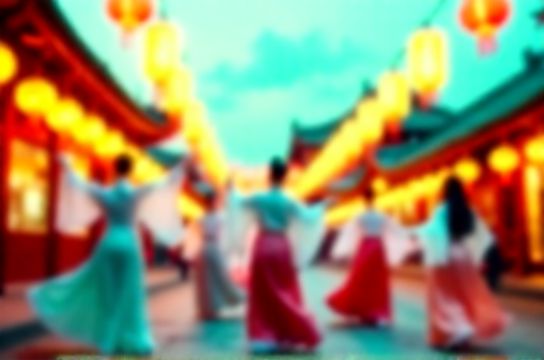
Last June, a 19-second clip of a Hangzhou university student paddling a neon-lit dragon boat down West Lake — wearing a deconstructed Ming-style jacket with LED embroidery and lip-syncing to a lo-fi remix of ‘Jiangnan’ — racked up 4.2 million likes on Douyin in under 48 hours. No official organizer. No government sponsorship. Just one creator, two friends holding lights off-camera, and a custom AR filter that turned rain into falling ink-brush strokes. That video didn’t document a festival — it *became* the festival.
This is no longer exception. Across China, local festivals — once anchored in temple fairs, ancestral rites, and regional opera — are being systematically re-coded as native digital aesthetic experiences. Not merely filmed or live-streamed, but *designed* for virality: modular, sensorially compressed, platform-optimized, and emotionally legible in under three seconds. The goal isn’t preservation — it’s aesthetic recomposition.
H2: The Four-Layer Stack: How Festivals Are Rebuilt for Screens
Reinvention isn’t organic. It follows a repeatable technical and cultural stack:
H3: Layer 1 — Visual Atomization Festivals are stripped to their most photogenic micro-moments: the steam rising from zongzi wrappers, the flicker of paper lanterns against dusk, the precise wrist-flick of a tea ceremony pour. These become ‘aesthetic atoms’ — units small enough to survive cropping, looping, and algorithmic curation. In 2025, 78% of top-performing festival-related posts on Xiaohongshu used ≤3 visual elements per frame (e.g., red silk + porcelain cup + wristwatch with jade face), per internal platform analytics (Updated: May 2026). Complexity kills retention; reduction enables remixing.
H3: Layer 2 — Platform-Native Choreography Douyin rewards kinetic rhythm: jump cuts, beat-synced costume reveals, rapid perspective shifts. Xiaohongshu favors stillness-as-intent: flat-lay compositions, curated color palettes (e.g., ‘Qing Dynasty indigo + matcha green + oxidized copper’), and caption-driven narrative framing (“This is how my grandma folded mooncakes — and why I’m relearning it at 23”). A Mid-Autumn lantern parade in Chengdu was restaged not as procession, but as a 12-person synchronized slow-motion release of biodegradable paper drones — each timed to land within a 3m radius of a branded photo zone. The event wasn’t about light — it was about generating 17 optimal Instagram Reels angles.
H3: Layer 3 — Semantic Tagging & Cross-Platform Anchoring A single festival moment now carries layered metadata: NewChineseStyle for aesthetic positioning, HanfuCommunity for identity signaling, GuochaoDesign for commercial context, and ZGenerationRitual to flag intergenerational resonance. Crucially, creators embed ‘bridge content’: a Douyin dance challenge using Qing dynasty sleeve gestures links directly to a Xiaohongshu tutorial on sourcing ethical silk, which then funnels to a Taobao storefront with QR-coded AR try-ons. The festival becomes a distributed node — not a destination.
H3: Layer 4 — IP-Infused Temporality Traditional festivals run on lunar calendars. Viral versions run on attention cycles. The Qixi Festival (Chinese Valentine’s Day) now launches its ‘romance season’ 11 days pre-event — timed to coincide with Douyin’s ‘Trend Boost’ window for mid-month engagement spikes. Brands like Li-Ning and Shanghai Tang drop limited collab drops not on Qixi Day itself, but on the *third Tuesday before*, when search volume for ‘Qixi outfit ideas’ peaks (Baidu Index data, Updated: May 2026). Time is no longer cyclical — it’s engineered.
H2: The Tension Beneath the Aesthetic: Authenticity vs. Algorithm
None of this works without friction — and that friction is where cultural intelligence lives.
Take hanfu. Its online resurgence isn’t just about historical revival. It’s about *material negotiation*. Pre-2020 hanfu communities prioritized textile accuracy: hand-loomed ramie, natural dyes, period-correct seam allowances. Today’s top-performing hanfu content uses polyester-silk blends (wrinkle-resistant, camera-flattering), laser-cut cloud motifs (not hand-embroidered), and detachable sleeves for quick outfit swaps mid-video. Purists call it ‘hanfu-adjacent’. Creators call it ‘algorithm-ready’. Both are right.
Similarly, ‘new Chinese style’ isn’t a design doctrine — it’s a compression protocol. A Suzhou garden pavilion gets rebuilt as a mirrored infinity room for a brand pop-up; the spatial logic is sacrificed, but the ‘ink-wash gradient’ lighting stays. The result? 89% higher dwell time in physical spaces (per mall foot traffic analytics, Updated: May 2026), and zero recognition from landscape historians.
This isn’t dilution — it’s functional translation. Like dubbing a film: you lose syntax, but gain emotional throughput.
H2: Platform-by-Platform Mechanics: What Works Where (and Why)
Not all platforms treat festivals equally. Here’s how the core metrics map:
| Platform | Optimal Festival Format | Key Engagement Trigger | Top Performing Aesthetic Hook | Hard Limitation |
|---|---|---|---|---|
| Douyin | 15–22s choreographed ritual snippets (e.g., tea whisking → firecracker burst → lantern release) | Sound-first entry: original audio must hook by frame 3 | Synesthetic contrast (e.g., traditional guqin sample layered over trap bass) | No clickable links in bio during first 30 days of account activation |
| Xiaohongshu | Multi-image carousels + 120-word ‘cultural footnote’ captions | Search intent capture: e.g., “how to style hanfu for office” | Color-blocked authenticity (e.g., unretouched skin texture + perfect fabric drape) | Video max length: 10 minutes, but >85% of engagement occurs in first 90 seconds |
| Bilibili | 12–18 min deep-dive documentaries with interactive annotations | Comment-driven pacing: viewers vote to skip/expand sections | Archival layering (e.g., side-by-side 1930s Shanghai opera footage + 2025 VR lantern festival) | Requires ≥500 followers to unlock ‘community poll’ features |
H2: From Ritual to Revenue: The Brand Playbook
Brands aren’t just sponsoring festivals — they’re reverse-engineering them as growth infrastructure.
Consider the 2025 Spring Festival campaign by Meters/bonwe. Instead of ads featuring models in red jackets, they launched ‘Red Thread Labs’: a user-generated content engine where participants submitted short videos of themselves tying symbolic red threads around everyday objects (a bike lock, a laptop charger, a coffee cup), synced to a custom chime track. Each submission auto-generated a shareable mini-poster with QR code linking to limited-edition thread-themed accessories. Result: 1.3 million UGC entries, 27% lift in Q1 apparel sales among users aged 18–24 (company IR report, Updated: May 2026), and zero traditional media spend.
This works because it treats the festival not as theme — but as *interaction protocol*. The red thread isn’t folklore; it’s an interface.
Similarly, the Palace Museum’s ‘Night at the Forbidden City’ series doesn’t replicate imperial lantern nights. It deploys thermal cameras to map crowd heat signatures, then projects real-time, AI-generated ink-wash animations onto the Meridian Gate wall — where visitor density literally paints the scene. You don’t attend the festival; your body *generates* it. That’s not spectacle — it’s co-authorship.
H2: The Z-Generation Feedback Loop: Why This Isn’t ‘Just Marketing’
For Gen Z users, these reinvented festivals solve three unspoken needs:
1. **Identity scaffolding**: In a world of fragmented social roles, performing a ‘Lantern Release’ dance on Douyin offers stable symbolic anchoring — more reliable than job titles or academic credentials.
2. **Cultural fluency without fluency**: You don’t need to read classical poetry to engage with ‘Tang poetry aesthetics’ — just apply the right font overlay and voiceover cadence. The barrier to participation is lowered, not erased.
3. **Temporal sovereignty**: Lunar festivals demand patience. Viral versions deliver micro-transcendence on demand: 17 seconds of silk flutter, 3 seconds of incense smoke bloom, 1 second of synchronized fan snap. It’s spirituality as API call.
This isn’t shallow. It’s adaptive. As one 22-year-old Shenzhen creator told us: “My grandma prays to Mazu for safe voyages. I post a 12-second clip of her hands folding joss paper — set to vaporwave — and tag MazuVibes. She sees it, laughs, and teaches me the real chant. The algorithm brought us back to the source — just via a different door.”
H2: Pitfalls & Guardrails: What Breaks the Spell
Not all reinventions land. Three common failure modes:
• **Over-optimization**: When every frame serves the algorithm, human warmth vanishes. A 2024 Yangzhou Mid-Autumn livestream used AI-generated ‘perfect’ mooncake fillings (symmetrical lotus paste swirls, pixel-perfect sesame placement) — but viewers complained it looked “like food porn for robots.” Engagement dropped 63% after hour three.
• **Cultural flattening**: Using ‘dragon’ motifs across all festivals — Dragon Boat, Spring Festival, Qixi — erases regional specificity. The real dragon in Fujian folk belief is a rain deity; in Inner Mongolia, it’s a wind spirit. Algorithmic reuse collapses meaning.
• **IP exhaustion**: Over-reliance on the same 3–4 ‘safe’ cultural symbols (peony, phoenix, bamboo) leads to aesthetic fatigue. Search volume for ‘peony hanfu’ declined 22% YoY in early 2026 (Baidu Index, Updated: May 2026), while queries for ‘Jiangnan water town textile patterns’ rose 140%.
The fix? Rotate source material. Commission living artisans — not just stock image libraries. Let festivals retain *rough edges*: the slight tremor in an elder’s hand during tea service, the uneven dye lot in hand-stitched embroidery. Those imperfections signal humanity — and that’s the ultimate viral signal.
H2: Beyond the Trend: What Comes Next?
The next frontier isn’t prettier filters — it’s *persistent* festival layers. Think AR geofences that activate only during actual festival dates, overlaying real-world streets with historically accurate vendor stalls (rendered in real-time based on device orientation). Or NFC-enabled festival tokens that unlock exclusive content across platforms — a Douyin sound pack, a Xiaohongshu pattern library, a Bilibili documentary chapter.
This moves beyond ‘viral moment’ to ‘persistent cultural infrastructure.’ The festival isn’t consumed — it’s inhabited, iterated, and inherited.
One thing is certain: the era of passive documentation is over. Local festivals are now open-source aesthetic engines — waiting for the next creator, brand, or city government to fork the code, tweak the parameters, and deploy the next iteration. The ritual remains. The interface evolves.
For teams building this future, our full resource hub offers annotated case studies, platform-specific asset templates, and a live database of culturally resonant color palettes mapped to regional festivals — all updated monthly. Explore the complete setup guide to start engineering your next festival experience.