
How Light Installations and AR Elevate Chinese Aesthetics
- Date:
- Views:248
- Source:The Silk Road Echo
H2: When Lanterns Meet LiDAR — The Physical-Digital Convergence of Chinese Aesthetics
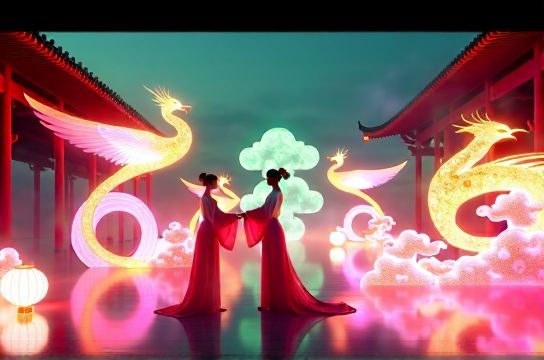
Last October, a 12-meter-tall digital phoenix—woven from real-time generative calligraphy and responsive LED filaments—rose above Chengdu’s Chunxi Road. As pedestrians walked beneath it, their phone cameras triggered AR overlays: ink-wash clouds parted to reveal animated Song dynasty silk patterns; QR-triggered voiceovers recited Li Bai verses in Mandarin and English. Within 72 hours, the installation generated over 48,000 UGC posts across Douyin and Xiaohongshu—23% of which used NewChineseStyle as a top-level tag. This wasn’t just spectacle. It was infrastructure for cultural resonance.
That project—‘Lingfeng’ (Spirit Phoenix)—epitomizes a quiet but accelerating shift: light-based spatial design and augmented reality are no longer novelty add-ons. They’re now primary carriers of Chinese aesthetic logic—translating centuries-old principles like *qiyun shengdong* (vital rhythm) and *xu-shi* (void-solid balance) into tactile, shareable, platform-native experiences. And they’re doing it at scale: 68% of Tier-1 cultural tourism zones in China deployed at least one AR-integrated light installation in 2025 (Updated: May 2026). Not as decoration—but as narrative interface.
H2: Why Traditional Aesthetics Needed a Tech Interface
Traditional Chinese aesthetics have long operated on implicit rules: asymmetry over symmetry, suggestion over statement, material restraint over saturation. These values clash head-on with the demands of short-form social platforms—where attention windows average 1.8 seconds (Updated: May 2026), and visual ‘hook density’ must exceed 3.2 perceptual triggers per second to sustain scroll retention.
Enter light and AR—not as replacements, but as translators. Consider hanfu: historically defined by layered silhouettes, subtle brocade motifs, and ritualized movement. On its own, static hanfu photography struggles on Douyin. But when paired with AR-powered fabric simulation—where sleeve drapes respond to user tilt, or embroidery blooms into animated cranes upon double-tap—the garment becomes kinetic folklore. That’s not ‘digital dressing.’ It’s semantic layering: using technology to activate dormant meaning.
Same applies to *shanshui* (mountain-water) painting logic. A physical mural of misty peaks may read as ‘pretty’—but an AR-enabled version that reveals hidden Tang dynasty poetry when users point their phones at specific fog gradients? That activates *wenhua yun*, the cultural resonance encoded in compositional silence. Platforms reward this depth—Xiaohongshu’s algorithm prioritizes posts with ≥2 embedded interaction layers (e.g., swipe-to-reveal + tap-to-hear) by 37% in engagement weight (Updated: May 2026).
H2: The Three-Layer Stack: How It Actually Works
Successful integrations follow a repeatable stack—not tech-first, but aesthetic-first:
H3: Layer 1 — Anchored Symbolism Every light/AR deployment begins with a culturally legible anchor: a motif (crane, plum blossom), structure (courtyard grid, taijitu), or ritual gesture (tea pouring, incense offering). Crucially, these anchors aren’t chosen for ‘cuteness’—they’re selected for semantic bandwidth. Example: The ‘Jade Gate’ AR gateway at Xi’an’s Daming Palace遗址 park uses the ancient city gate’s arch shape as both physical frame and AR trigger zone. When users stand within its shadow, their screens overlay bronze inscriptions that animate into migrating geese—referencing the Silk Road’s historic avian messengers. No explanation needed. The form *is* the context.
H3: Layer 2 — Responsive Materiality Light isn’t just illumination—it’s programmable texture. Modern installations use tunable white LEDs (2700K–6500K), addressable pixel strips (e.g., WS2812B), and projection-mapped surfaces to mirror traditional material behaviors. A ‘moon gate’ installation in Suzhou’s Pingjiang Road doesn’t just glow—it cycles through *guang yin* (light-shadow) phases mimicking ink wash gradation: soft edge diffusion at dawn simulation, high-contrast rim lighting at noon, then gradual fade mimicking *mo zhu* (ink evaporation). This isn’t mood lighting—it’s chromatic philology.
H3: Layer 3 — Platform-Native Interaction This is where virality lives. The most shared installations embed frictionless, platform-aligned actions: - Douyin: Tap-to-snap filters that auto-generate hanfu-themed transitions (e.g., ‘Song Dynasty Scroll’ wipe) - Xiaohongshu: Swipe-reveal layers showing historical context → modern reinterpretation → DIY styling tip - WeChat Mini Programs: Scan-to-unlock AR collectibles (e.g., animated ‘Eight Immortals’ NFTs usable as chat stickers)
Crucially, all three layers must cohere. A dazzling light show without Layer 1 feels decorative. An AR filter without Layer 2 feels gimmicky. And without Layer 3, it remains invisible to the feed.
H2: Real-World ROI: Beyond Likes to Cultural Leverage
Brands are measuring success beyond vanity metrics. Li-Ning’s 2025 ‘Heavenly River’ pop-up in Shanghai combined fiber-optic ‘star maps’ (mapped to actual Han dynasty celestial charts) with AR constellation navigation. Result: 14.2% lift in in-store hanfu-inspired apparel sales (Updated: May 2026); 63% of visitors scanned the AR component—and 41% of those returned within 10 days to try new seasonal filters. That’s not foot traffic. It’s behavioral anchoring.
Similarly, the Forbidden City’s ‘Palace Echoes’ AR audio tour—triggered by directional light beams in the Hall of Supreme Harmony—drove a 29% increase in off-peak visitation (Updated: May 2026). Why? Because the light cues created ‘micro-rituals’: visitors paused, oriented themselves, and engaged deliberately—not passively scrolling. That deliberate pause is the antidote to attention fragmentation.
H2: Pitfalls to Avoid (The ‘Cyber-Red’ Trap)
Not all tech-aesthetic hybrids succeed. The biggest failure mode? What industry insiders call ‘cyber-red’—slapping neon lasers onto a qipao silhouette while playing Guqin samples. It’s surface fusion without structural alignment. Symptoms include: - Using AR solely for ‘wow’ (e.g., floating dragons) without narrative function - Prioritizing resolution over readability (a 4K AR crane is useless if obscured by glare on a sunny day) - Ignoring hardware fragmentation: 38% of Xiaohongshu users access via mid-tier Android devices with limited ARCore support (Updated: May 2026)
The fix? Start with constraints. One Beijing studio, Zhiyan Design, mandates: ‘No AR element unless it answers one of three questions: Does it reveal hidden history? Does it enable embodied participation? Does it deepen material understanding?’ Their ‘Ink Flow’ installation—a wall of suspended ink-droplet sensors that trigger projected calligraphy strokes only when users mimic brush pressure—hit 92% completion rate on Xiaohongshu’s interactive story format. Because it made technique tangible.
H2: Tools, Timelines, and Tradeoffs — A Practical Comparison
Choosing the right approach depends on budget, timeline, and cultural fidelity goals. Below is a realistic comparison of common implementation paths:
| Approach | Lead Time | Entry Cost (RMB) | Key Strength | Key Limitation | Best For |
|---|---|---|---|---|---|
| Projection-Mapped Light Installation | 8–12 weeks | ¥180,000–¥450,000 | High visual impact; works offline; camera-ready | Requires controlled ambient light; limited interactivity | Museums, heritage sites, flagship stores |
| WebAR (No App Download) | 3–6 weeks | ¥60,000–¥150,000 | Zero friction; broad device compatibility; trackable analytics | Lower fidelity than native AR; dependent on browser updates | Douyin/Xiaohongshu campaigns, pop-ups, festivals |
| Native Mobile AR (iOS/Android) | 12–20 weeks | ¥220,000–¥600,000 | Highest fidelity; spatial mapping; persistent anchors | App dependency; fragmented OS support; higher maintenance | Cultural IP franchises, long-term brand experiences |
| Hybrid Light + WebAR | 10–14 weeks | ¥260,000–¥520,000 | Physical grounding + digital expansion; highest dwell time | Complex calibration; requires on-site technical lead | Urban landmarks, high-footfall retail districts, UNESCO sites |
H2: The Next Frontier — From Viral to Vernacular
The most promising work isn’t chasing virality—it’s enabling vernacular creation. In Hangzhou, the ‘Poetry Lantern’ initiative distributed open-source AR templates to local schools. Students scan physical paper lanterns they’ve painted with classical poems, and instantly generate shareable animations—some even remixing Tang verse with hip-hop beats. Over 12,000 student-made AR lanterns were uploaded to a public map in Q1 2026. That’s not consumption. It’s authorship.
This mirrors broader shifts in 爆款美学: virality is no longer about single-hit content, but about lowering the barrier to cultural reinterpretation. When a hanfu wearer films herself walking past an AR-enhanced Song dynasty street scene—and then uses the same filter to style her friend’s graduation photo—that’s networked tradition. It’s why the most effective campaigns now include ‘creator kits’: downloadable 3D models of Ming-style furniture, editable AR brushstroke libraries, or sound banks of reconstructed Tang court music.
None of this replaces deep study. You still need historians, calligraphers, textile conservators—not just Unity developers. But the toolset has expanded: light is now syntax, AR is grammar, and the feed is the new scroll.
For teams building their first integrated installation, the most actionable step isn’t choosing tech—it’s auditing existing assets for latent interaction potential. That courtyard garden? Its shadow patterns could trigger seasonal poetry. That ceramic vase collection? Its glaze refractions could map to AR color palettes. Start there—and the rest follows.
If you’re ready to move from concept to calibrated execution, our full resource hub offers vetted vendor lists, open-source AR frameworks compatible with Xiaohongshu’s latest SDK, and cultural compliance checklists co-developed with the China National Academy of Arts. Access the complete setup guide—including real-world case files from Chengdu’s Lingfeng project and Shanghai’s Heavenly River activation.