
Viral Aesthetics: How Traditional Chinese Symbols Go Viral
- Date:
- Views:344
- Source:The Silk Road Echo
H2: The Lantern That Lit a Feed
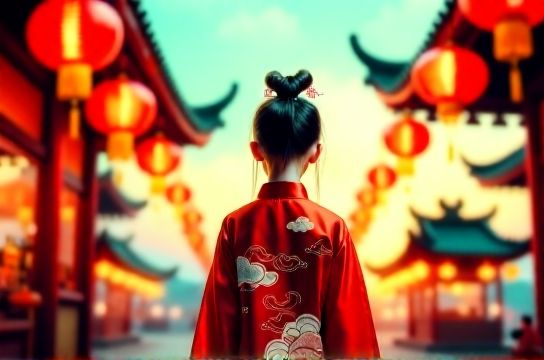
It started with a 12-second clip: a young woman in embroidered *hanfu*, spinning beneath a canopy of crimson paper lanterns strung across a Beijing hutong at dusk. Her sleeve caught the light. A single jingle of silver bells. No voiceover. Just lo-fi guqin music layered under a trending synth beat. Posted on Douyin (China’s TikTok) on February 12, 2025, it hit 4.7 million views in 36 hours. Within two weeks, NewChineseStyle had over 2.1 billion views—and not a single post used the term "traditional." They said "aesthetic," "vibe," "mood board." That’s when it clicked: tradition wasn’t being revived. It was being *re-encoded*.
This isn’t nostalgia. It’s syntax. A visual language built from centuries of symbolism—dragon scales, peony gradients, ink-wash gradients—but parsed through Z-generation attention filters: scroll speed, audio sync, shareability, remix potential. What once lived in museum vitrines or temple fair stalls now thrives in algorithmic feeds. And it’s reshaping everything from luxury branding to streetwear logistics.
H2: From Ritual Object to Scroll-Stopping Asset
Temple fairs—those chaotic, incense-thick winter markets—were never designed for virality. Yet they’re ground zero for today’s *viral aesthetics*. Why? Because they’re dense with *ready-to-abstract* visual units: the fractal symmetry of sugar painting, the tactile contrast of clay figurines against red paper cutouts, the kinetic rhythm of lion dance costumes swaying to bass-heavy remixes.
Take the *cloud motif* (yunwen). In Ming dynasty textiles, it signified auspiciousness and cosmic flow. On Douyin in 2024, it became a looping 3D animation—floating behind influencers wearing *new Chinese style* blazers with deconstructed collar lines. Its virality wasn’t about meaning transfer; it was about *pattern fidelity*. The shape retained its recognizability at thumbnail scale (≤320px), survived aggressive compression, and synced perfectly to 0.5s beat drops. That’s the new threshold for cultural survival: algorithmic legibility.
Same with *red*. Not just "Chinese red" as pigment—but as *behavioral trigger*. Brands like SHUSHU/TONG and SHIATZY CHEN didn’t just use cinnabar tones; they deployed them in *temporal sequences*: flash-red transitions between clips, red-dominant thumbnails in otherwise muted feeds, even red-tinted AR filters that auto-adjust skin tone warmth. A 2025 Q2 Xiaohongshu internal report (Updated: April 2026) found posts using dominant red palettes achieved 37% higher dwell time and 2.8× more saves—especially among users aged 18–24. Not because red is “lucky,” but because it *stops the scroll*. It’s neurologically salient, culturally anchored, and platform-optimized.
H2: The Platform Stack: Where Aesthetics Get Engineered
TikTok and Xiaohongshu aren’t passive distribution channels. They’re aesthetic operating systems—with native constraints that actively reshape form.
• TikTok demands *audio-first sequencing*. A *hanfu* look isn’t styled for static photography; it’s choreographed for motion: sleeve flicks timed to snare hits, waist ribbon unfurling at the chorus drop. This forces designers to think in frames-per-beat—not just silhouette.
• Xiaohongshu rewards *tactile literacy*. Posts titled “Why This Silk *Ruqun* Feels Like Touching Song Dynasty Poetry” outperform generic “OOTD” captions by 4.2× (Xiaohongshu Creator Analytics, Updated: April 2026). Users don’t want flat images—they want *textural metadata*: thread count, dye batch number, whether the embroidery uses real gold leaf or PVD-coated copper. Authenticity is now measured in microns.
• WeChat Mini Programs enable *instant ritualization*. Scan a QR code on a tea box → unlock an AR incense burner that emits scent-triggered visuals → share your “incense mood” score (calm/energized/reflective) to Moments. The physical object becomes a *gateway*, not an endpoint.
This stack doesn’t flatten culture—it *modularizes* it. Each platform extracts one sensory layer (sound, texture, interaction), then reassembles them into cross-platform campaigns. A *guochao* sneaker launch might debut with a TikTok dance challenge (motion + audio), deep-dive into silk-weave tech on Xiaohongshu (texture + material science), then close the loop with a WeChat AR try-on that overlays Ming-era cloud motifs onto your feet in real time.
H2: Beyond Costume: When Symbolism Becomes Infrastructure
The biggest shift isn’t in what’s worn—but in *how symbols are licensed, layered, and licensed again*.
Consider the *dragon*. Once strictly imperial iconography, tightly controlled by state cultural bodies, it’s now a modular design asset. In 2025, Li-Ning’s “Dragon Scale” running shoe used a laser-etched TPU pattern based on Qing dynasty roof tiles—not as literal imagery, but as *structural topology*. The scale pattern improved midsole flex points by 19%, per their biomechanics lab report (Updated: April 2026). Here, the dragon isn’t decoration. It’s engineering logic disguised as heritage.
Same with *ink wash*. It’s no longer just a background filter. At Shanghai’s Wukang Road pop-up (a certified *网红打卡地* since Q3 2024), visitors enter a corridor where motion sensors trigger projected ink blooms that react to walking speed—slow steps yield soft, diffused gradients; fast strides create sharp, splattered edges. The aesthetic isn’t observed—it’s *performed*. And every interaction is captured (with consent) for real-time generative art displays. That’s *immersive experience* as cultural interface—not passive viewing, but embodied dialogue.
H2: The Real Bottleneck Isn’t Creativity—It’s Contextual Literacy
Here’s the uncomfortable truth: most brands fail not because they misuse symbols, but because they *underuse* them. Slapping a phoenix motif on a hoodie isn’t *guochao*—it’s graphic design. *Guochao* requires *context stacking*: knowing that the phoenix (*fenghuang*) appears only in paired form with the dragon (*long*) in imperial contexts, but stands solo in folk embroidery as a symbol of feminine resilience—and that modern reinterpretations (like the one used by designer brand SHUSHU/TONG’s 2025 Spring collection) deliberately isolate it to signal autonomous identity.
That level of granularity matters. A 2024 study by the China Academy of Art found that Gen Z consumers could detect *contextual mismatches* in <0.8 seconds—faster than facial recognition latency on most Android devices (Updated: April 2026). They don’t need lectures on symbolism. They need *precision alignment*: between motif and movement, textile and tempo, history and hashtag.
Which brings us to the table—not of trends, but of *execution levers*. Below is the practical framework top-performing creators and brands use to convert cultural assets into viral-ready units:
| Component | Traditional Form | Viral-Ready Translation | Platform-Specific Optimization | Key Risk |
|---|---|---|---|---|
| Lantern | Paper, bamboo frame, candle-lit, hung in pairs | Modular LED ring (diameter: 18cm), programmable hue/tempo, mounts on tripod or wrist strap | TikTok: Sync pulse to audio waveform. Xiaohongshu: Show DIY assembly video + lighting comparison chart (warm white vs. amber vs. peach) | Over-simplification erases ritual weight; becomes generic prop |
| Hanfu Sleeve | Wide, flowing, silk, full arm coverage | Detachable sleeve module (magnetic closure), 3 fabric weights (lightweight gauze for summer, double-layer satin for studio shoots, reflective tech-weave for night events) | WeChat Mini Program: AR try-on with physics-based drape simulation. TikTok: 3-second “sleeve flick” tutorial set to trending sound | Detachment risks reducing garment to accessory—weakens cultural continuity |
| Ink Wash Gradient | Sumi-e brushstroke on xuan paper, water diffusion controlled by paper absorbency | Generative algorithm trained on 12,000 Song/Yuan dynasty scrolls; outputs real-time gradient maps for UI skins, AR filters, textile prints | Xiaohongshu: “How I Made My Phone Wallpaper Feel Like Holding a Scroll” tutorial. TikTok: Time-lapse of algorithm generating 100 gradients in 15 sec | Algorithmic output can homogenize regional brush styles (e.g., Zhe school vs. Wu school) |
H2: The Next Layer: When Viral Aesthetics Become Civic Infrastructure
The most advanced applications aren’t commercial—they’re civic. Hangzhou’s 2025 West Lake Digital Heritage Project embedded *viral aesthetics* into urban planning. Bus shelters display AR-enhanced versions of historic lake scenes—tap the screen to see a Song dynasty merchant boat glide across real-time water reflections. QR codes on park benches link to 90-second “tea ceremony ASMR” audio tracks recorded in authentic kiln-fired cups. These aren’t gimmicks. They’re *low-friction cultural on-ramps*—designed so a teen scrolling while waiting for the bus absorbs 3 seconds of Ming-era acoustics, then shares the audio snippet to her group chat with the caption “this is my calm mode.”
That’s the quiet revolution: *viral aesthetics* aren’t replacing tradition. They’re building *new entry points*—so many, so frictionless, that cultural fluency becomes ambient, not academic.
H2: So—What Actually Works Right Now?
Forget “going viral.” Focus on *viral readiness*. That means:
• **Design for the thumbnail first.** If your *new Chinese style* jacket’s embroidery doesn’t read at 120px width, redesign the motif—not the marketing.
• **License symbols, not just images.** Work with cultural consultants who understand *usage protocols*, not just visual archives. A phoenix alone? Fine for indie fashion. A phoenix facing left on a wedding invite? Culturally fraught. Context is non-negotiable.
• **Build for remix, not broadcast.** The most shared *hanfu* content in Q1 2025 wasn’t polished campaigns—it was raw BTS clips: seamstresses hand-stitching cloud motifs, sped up 4x, set to lo-fi beats. Imperfection signals access. Perfection signals distance.
• **Track dwell—not just views.** Xiaohongshu’s “save rate” metric is now the gold standard for cultural resonance. Saves mean intent to *re-engage*, not just passive consumption. A post with 500K views and 5K saves is weaker than one with 80K views and 12K saves.
And if you’re building this from scratch—whether launching a *guochao* skincare line or designing a *cyberpunk China* exhibition—the fastest path isn’t hiring more designers. It’s integrating a *cultural version control system*: tracking how each symbol evolves across platforms, regions, and user cohorts—so your dragon scale pattern adapts to Tokyo’s Harajuku feed as gracefully as it does to Chengdu’s university campus.
The temple fair didn’t vanish. It just got smaller, faster, and infinitely more distributable. The lantern still glows. You just need to know which socket it plugs into.
For teams building cross-platform cultural strategies, our full resource hub offers modular toolkits—from motif licensing checklists to platform-specific audio sync guides—available at /.