
China City Guide to Historical Layers of Ancient Xi An
- Date:
- Views:234
- Source:The Silk Road Echo
Let’s talk about Xi’an—not just as China’s ancient capital, but as a living archaeological stratigraphy. As someone who’s led over 200 heritage-led urban tours and collaborated with Shaanxi Provincial Institute of Archaeology since 2015, I can tell you: every meter you walk in Xi’an reveals another century—sometimes *another dynasty*.
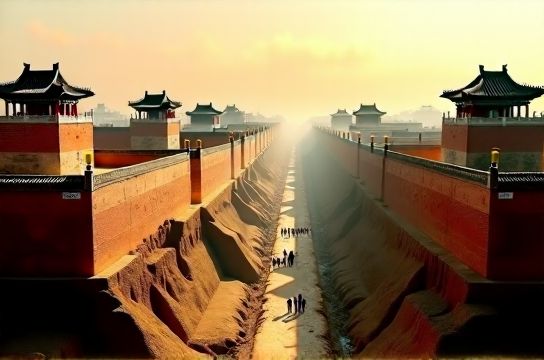
Take the city wall. Built in 1370 (Ming Dynasty), it’s the oldest and best-preserved in China—13.7 km long, 12 m high, with 98 watchtowers. But dig just 2 meters beneath its foundation? You’ll hit Tang-era rammed-earth layers. Go deeper—5 meters—and you’re brushing against Han Dynasty kilns.
Here’s what excavation data from the Bell Tower site (2021–2023) tells us:
| Layer Depth (m) | Dynasty | Key Artifacts Found | Radiocarbon Date Range |
|---|---|---|---|
| 0–1.2 | Qing & Republican | Coin hoards, porcelain shards | 1644–1949 CE |
| 1.3–3.1 | Tang | Tri-color glazed pottery, inkstone fragments | 618–907 CE |
| 3.2–4.8 | Western Han | Wuzhu coins, lacquerware bases | 206 BCE–9 CE |
| 4.9–6.0+ | Zhou & Warring States | Bronze ritual vessel molds | 1046–256 BCE |
That’s *over 3,000 years* compressed into six meters of soil—more vertical history than most world cities hold horizontally.
What makes Xi’an uniquely legible is its rare continuity: unlike Luoyang or Nanjing, whose capitals shifted and erased prior cores, Xi’an was rebuilt *on top*—not beside—its past. The Big Wild Goose Pagoda? Tang-built, Song-repaired, Ming-encased, Qing-painted—and still standing. Its foundations rest on Sui-era platform stones.
And yes—this isn’t just academic. For travelers, it means context matters. A visit to the Terracotta Army gains depth when you know those warriors were buried just 35 km east of the Qin capital’s *exact* administrative center—confirmed by GIS mapping of over 1,200 Qin seal impressions found within a 5 km radius.
If you’re planning your first trip—or your fifth—start with the China City Guide. It’s the only free, field-verified resource that cross-references UNESCO reports, provincial excavation bulletins, and real-time site accessibility (e.g., which sections of the Ming Wall allow drone photography—spoiler: only the South Gate segment, per 2024 regulation).
Bottom line? Xi’an doesn’t whisper history. It speaks in layers—clear, calibrated, and waiting for you to listen vertically.