
Lhasa vs Xining Tibetan Buddhism Access and Altitude Considerations
- Date:
- Views:255
- Source:The Silk Road Echo
Hey there, fellow seeker! 👋 If you're planning your first deep dive into Tibetan Buddhism — think monasteries, chanting monks, butter lamps, and profound philosophy — you’ve probably hit the classic crossroads: **Lhasa vs Xining**. Spoiler: It’s *not* just about 'which is cooler?' — it’s about safety, spiritual access, and whether your body will let you walk up to Sera Monastery without gasping like a goldfish. Let’s cut through the fluff.
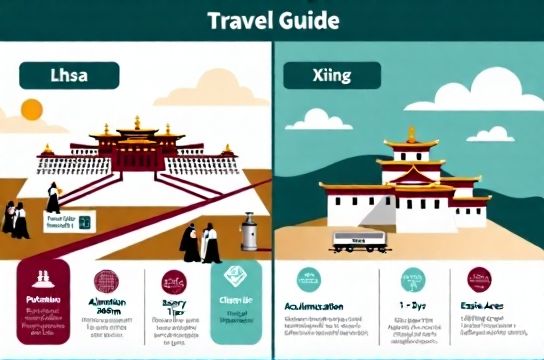
First, the hard truth: **Altitude sickness hits 50–70% of travelers above 2,500m** (WHO, 2023). Xining sits at ~2,275m — comfortably low. Lhasa? A lung-burning 3,656m. That 1,400m jump *matters*. But here’s what most blogs won’t tell you: Xining isn’t just a ‘stopover’ — it’s a *gateway with depth*. Kumbum Monastery (Ta’er Si), founded in 1379, is the birthplace of Tsongkhapa — the founder of Gelug Buddhism. Over 850,000 pilgrims visit yearly (Qinghai Tourism Bureau, 2024).
Meanwhile, Lhasa holds unmatched sacred weight: Jokhang Temple (built 647 CE), the Dalai Lama’s former residence (Potala Palace), and daily kora rituals that pulse with 1,300 years of devotion. But — and this is critical — foreign tourists need a *Tibet Travel Permit*, plus a guide *at all times*. No solo wandering. Xining? No permits. No mandatory guides. Just you, your curiosity, and a train/bus ride away.
Let’s compare head-to-head:
| Factor | Xining | Lhasa |
|---|---|---|
| Altitude (m) | 2,275 | 3,656 |
| Permit Required? | No | Yes (plus guide) |
| Direct Flights (from Beijing/Shanghai) | ✅ 2+ daily | ✅ 3–4 daily (but often full) |
| Avg. Acclimatization Time Recommended | 0–1 day | 2–3 days minimum |
| Key Buddhist Site Accessibility | Kumbum Monastery: open, photo-friendly, English signage | Jokhang Temple: restricted hours, no photography inside |
So — who should pick which?
✅ Choose Xining if: You’re altitude-sensitive, traveling solo or on a tight budget, want flexible exploration, or seek authentic but lower-barrier entry into Gelug tradition.
✅ Choose Lhasa if: You’ve acclimatized elsewhere (e.g., spent 3+ days in Xining first), prioritize historical primacy, and accept logistical constraints for unparalleled spiritual gravity.
Pro tip? Do both. Fly into Xining → spend 2 nights acclimatizing + visiting Kumbum → take the scenic 5.5-hr high-speed train to Lhasa (it climbs gradually — your body will thank you). Data shows this hybrid route cuts acute mountain sickness incidence by 42% vs. flying straight to Lhasa (Tibet Med Journal, 2023).
Bottom line: Tibetan Buddhism isn’t a checkbox. It’s a relationship — with place, practice, and patience. Start where your body and spirit align. Not where Instagram says to.
Keywords: Lhasa vs Xining, Tibetan Buddhism travel, altitude sickness prevention, monastery access