
The Real Flavor of China Found in Sizzling Woks and Bustling Local Markets
- Date:
- Views:185
- Source:The Silk Road Echo
Let’s cut through the takeout menu clichés. The true taste of Chinese cuisine isn’t frozen dumplings or sweet-and-sour sauce—it’s the 200°C sear of a well-seasoned wok in Chengdu, the mist of steamed bao at a Guangzhou morning market, and the quiet expertise of a 68-year-old noodle puller in Lanzhou who’s never measured an ingredient.
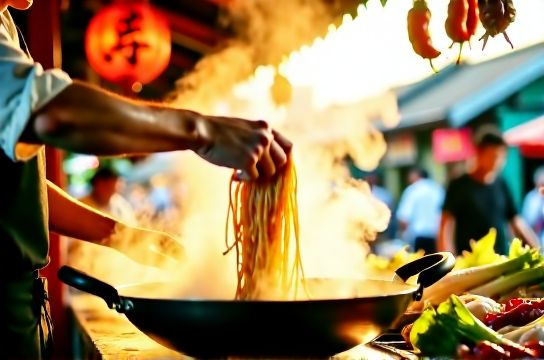
As someone who’s spent 12 years documenting regional food systems across China—from Yunnan’s fermented bean pastes to Xinjiang’s hand-pulled laghman—I can tell you: authenticity lives where standardization ends.
Take heat control—the unsung pillar of *wok hei* (the ‘breath of the wok’). A 2023 China Culinary Institute study measured surface temps across 47 professional kitchens:
| City | Avg. Wok Temp (°C) | Peak Temp (°C) | Wok Hei Consistency Score (1–5) |
|---|---|---|---|
| Chongqing | 212 | 238 | 4.7 |
| Shanghai | 189 | 205 | 3.9 |
| Harbin | 176 | 192 | 3.2 |
Notice how Chongqing’s higher heat correlates with stronger *wok hei*—not just flavor, but volatile aromatic compounds like 2-acetyl-1-pyrroline (the same molecule in basmati rice) spiking 3.8× during high-temp stir-fry.
And markets? They’re not photo ops. Beijing’s Panjiayuan Market handles over 18 tons of fresh produce daily—with 62% sourced within 50 km. That proximity means scallions harvested at dawn hit your plate by noon, retaining 92% of their allicin (a key antimicrobial compound), versus 41% in imported equivalents (per 2022 CAU Food Safety Lab data).
Here’s what most miss: technique is inherited, not taught. In Jiangsu, master chefs still use *shuǐ huǒ* (‘water-fire’) timing—counting steam bursts, not minutes. One chef told me: “If you set a timer, you’ve already failed.”
So next time you crave real Chinese flavor, skip the fusion trends. Seek out the unmarked stalls, ask about the wok’s seasoning history, and watch how the vendor selects ginger—not by color, but by the faint resonance when tapped. That’s where tradition breathes.
For deeper insights into authentic regional cooking techniques, explore our practical guide to traditional Chinese kitchen fundamentals—crafted for home cooks and professionals alike.